Saturday, April 30, 2011

Common Sense Thought for the Day

“As an apologist I am the reverse of apologetic. So far as a man may be proud of a religion rooted in humility, I am very proud of my religion; I am especially proud of those parts of it that are most commonly called superstition. I am proud of being fettered by antiquated dogmas and enslaved by dead creeds. (as my journalistic friends repeat with so much tenacity), for I know very well that it is the heretical creeds that are dead, and that it is only the reasonable dogma that lives long enough to be called antiquated.”

-G.K. Chesterton

Friday, April 29, 2011

Video: Remains of John Paul II removed from the Grottoes

RomeReports has posted the video below:


My husband and I were there only last November on our first ever pilgrimage to Europe (or to anyplace, really). It still seems strange to think we actually walked through those passages through which John Paul II's remains are being moved in the video. The experience will remain with us for the rest of our lives.


John Paul II, pray for us.

Wednesday, April 27, 2011

National Infertility Awareness Week

"There is no sign unless something happens contrary to nature. The brightness of the sun is no sign, but an eclipse is." 
- Fulton Sheen


This year, Easter Week and National Infertility Awareness Week fall at the same time.

Catholic couples who face infertility face some unique struggles, and often bear their crosses in silence. Those outside the church often approach fertility as something one can switch on and off like a light, and often do not understand why Catholics will not pursue IVF and similar artificial reproductive technologies.  Within the church, many assume that couples with few or no children are using contraception, turn up their noses at them, and ask no more questions.

When couples, Catholic or not, discover their infertility, the experience is somewhat like facing a death, only they mourn something that was never there. In her personal memoir, former First Lady Laura Bush puts it this way:

For some years now, the wedding invitations that had once crowded the mailbox had been replaced by shower invites and pink-or-blue-beribboned baby announcements. I bought onesies or rattles, wrapped them in yellow paper, and delivered them to friends. I had done it with a happy wistfulness, believing that someday my time, my baby, would come. George and I had hoped that I would be pregnant by the end of his congressional run. Then we hoped it would be by the time his own father announced his presidential run, then by the presidential primaries, the convention, the general election. But each milestone came and went. The calendar advanced, and there was no baby.

The English language lacks the words to mourn an absence. For the loss of a parent, grandparent, spouse, child or friend, we have all manner of words and phrases, some helpful some not. Still we are conditioned to say something, even if it is only “I’m sorry for your loss.” But for an absence, for someone who was never there at all, we are wordless to capture that particular emptiness. For those who deeply want children and are denied them, those missing babies hover like silent ephemeral shadows over their lives. Who can describe the feel of a tiny hand that is never held?
Jennifer Fulwiler of the National Catholic Register has posted an article on the often invisible experiences of infertile Catholic couples.  If you or someone you know is facing infertility, it is a worthwhile read.


Tip of the Schoomarm Ruler to Tito, for posting the NCR article on Facebook, and to In All Things Good.

G.K. Chesterton on "The Superstiton of School"

"The snag in it is this: that the self-educated think far too much of education. I might add that the half-educated always think everything of education. That is not a fact that appears on the surface of the social plan or ideal; it is the sort of thing that can only be discovered by experience. When I said that I wanted the popular feeling to find political expression, I meant the actual and autochthonous popular feeling as it can be found in third-class carriages and bean-feasts and bank-holiday crowds; and especially, of course (for the earnest social seeker after truth), in public-houses. I thought, and I still think, that these people are right on a vast number of things on which the fashionable leaders are wrong. The snag is that when one of these people begins to "improve himself" it is exactly at that moment that I begin to doubt whether it is an improvement. He seems to me to collect with remarkable rapidity a number of superstitions, of which the most blind and benighted is what may be called the Superstition of School. He regards School, not as a normal social institution to be fitted in to other social institutions, like Home and Church and State; but as some sort of entirely supernormal and miraculous moral factory, in which perfect men and women are made by magic. To this idolatry of School he is ready to sacrifice Home and History and Humanity, with all its instincts and possibilities, at a moment's notice. To this idol he will make any sacrifice, especially human sacrifice. And at the back of the mind, especially of the best men of this sort, there is almost always one of two variants of the same concentrated conception: either "If I had not been to School I should not be the great man I am now", or else "If I had been to school I should be even greater than I am". Let none say that I am scoffing at uneducated people; it is not their uneducation but their education that I scoff at. Let none mistake this for a sneer at the half-educated; what I dislike is the educated half. But I dislike it, not because I dislike education, but because, given the modern philosophy or absence of philosophy, education is turned against itself, destroying that very sense of variety and proportion which it is the object of education to give. No man who worships education has got the best out of education; no man who sacrifices everything to education is even educated. ... What is wrong is a neglect of principle; and the principle is that without a gentle contempt for education, no gentleman's education is complete."

Read the entire essay here.

Tuesday, April 26, 2011

Catholic Education in Transition

(Source)
Darwin Catholic offers an insightful post on the cultural forces both within the Church and without that have changed the way Catholic schools relate to the communities they serve. He cites changing demographics within cities, the disappearance of explicitly Protestant culture from public schools, and the shrinking numbers of vocations in teaching orders as highly significant factors.

Having  experienced secondary-level Catholic education from both sides of the teacher's desk, I think he is correct in identifying these as reasons why schools struggle to compete with public schools for students and why they find it increasingly difficult to keep their budgets in the black. Costs go up as fewer religious are available to teach, and more electronic "bells and whistles" are perceived as necessities for education both public and private.

In addition to facing difficulties with enrollment and budgets, the cultural crises within the church can alter the culture of schools as well.  Catholic education was originally meant to serve Catholics for a reason:  parents wanted their children to be instructed in the faith as well as in the core subjects.  Catholic schools provided a place for this. It was especially necessary because public schools were once more influenced by anti-catholic segments of Protestant Christianity.

In communities where there are high numbers of serious Catholic parents, catholic schools have little difficulty maintaining their identity.  It has been my observation that in local communities where there are few serious Catholics, it is much easier for schools to shed their Catholic identity and emphasize their academics instead, as a way to attract enrollment. Parents who are not dedicated to living out the faith in their everyday lives do not usually catechize at home, and often react badly if schools expect students to take the Faith seriously, even to the point of expecting the school to let it slide when students openly violate the school rules and the moral teachings of the church by, say, repeatedly turning in plagiarized work or even showing up drunk at prom, or worse.

As with many questions the Church faces at present, the question of the direction of Catholic education is largely going to be answered by families. Strong Catholic families produce vocations to the religious life, making more priests and religious available to serve in schools.  They influence schools to provide clear catechesis and a strong community of faith for their students. They reinforce this catechesis at home by living out the faith in the daily life of their little "domestic church".

Unfortunately, the Church has not been immune from the general decline of the family in our culture, and many Catholic educators and the institutions that employ them find themselves fighting harder and harder in an uphill battle to maintain themselves, as do the families they serve.  There are no easy answers here, and even the hard answers remain incomplete or elusive.

Sunday, April 24, 2011

Resurrexit Sicut Dixit, alleluia!

A little Mozart for Easter. Christ is risen!


I


Regina coeli laetare, Alleluia,
Quia quem meruisti portare. Alleluia,
Resurrexit sicut dixit, Alleluia.
Ora pro nobis Deum. Alleluia.

Queen of heaven, rejoice, alleluia:
For He whom you merited to bear, alleluia,
Has risen, as He said, alleluia.
Pray for us to God, alleluia.

Saturday, April 23, 2011

New Title, New Template

I haven't changed my template in years. Really.

It's about time I redecorated.

So here it is: "Confessions of a Crazy Schoolmarm" has now become "Schoolmarm Sense".

Friday, April 22, 2011

Real Research means Real Books

I have nothing to add to this:


(Image Source)

Kiss the Green Light Goodbye

The 20,000 square foot mansion said to be F. Scott Fitzgerald's inspiration for Tom and Daisy Buchanan's opulent East Egg home is no more.  Carolyn Kellogg of the L.A. Times reports that the 1902 home was demolished this week to make way for five custom homes to be sold at roughly ten million dollars apiece. (Click here for photos of the place before its demise.). 


Supposedly, this house is where Fitzgerald attended parties hosted by the mansion's owner, renowned journalist Herbert Bayard Swope.

Fitzgerald drew heavily on his own life when he wrote The Great GatsbyDaisy Buchanan herself bears a rather interesting resemblance to Fitzgerald's wife Zelda, who came from a prominent Montgomery, Alabama family just as Daisy herself is a wealthy Southern Belle.  His experiences with the "idle rich" in New York shape those of Nick Carraway and Jay Gatsby in the novel.

After the start of the Great Depression, Fitzgerald's novel lost popularity for a time, as the difficult economy seemed to make it less relevant. It was rediscovered, strangely enough, after the United States began to regain its prosperity, and the "American Dream" once again seemed attainable.

The novel seems more relevant than ever today, even with the so-called "Great Recession" dominating our headlines.  The American Dream, though continually changing with the times, still holds sway over the way we raise our children. On top of this, the culture of entitlement, decadence, carelessness, and conspicuous consumerism that dominates the fictionalized West and East Egg, and bleeds even into the impoverished recesses of the Valley of Ashes bears an uncomfortable resemblance to the world we live in today.

Perhaps this is why, when I taught this novel, I thought it so important to encourage my students to think critically about the culture they live in, and to examine their own goals for their lives as they read. Adolescence is a period of time in which many young people face the tension between what others think and expect, and their own individual needs and ideals. It is a time when they crave freedom, often without fully understanding what that means, or what relationship freedom has to responsibility.  Reading Gatsby gives them an opportunity to look at what they want, and decide what is worth the effort in the end: to realize that "it profits a man nothing to give his soul for the whole world", much less for Wales. Or Daisy.

The American Dream, once a simple little house and picket fence, a mild feeling of contentment, a decent job, and a life in which we are free to do what we ought, has given way to something more complicated, less attainable, and a touch more sinister.  A mixture of wealth, fame, power, and a life in which we are free, like Tom and Daisy, to do whatever we want, regardless of who or what is damaged in the process, is now the American Dream of too many.  Like Gatsby, we pour our whole selves into ambitious pursuits, or like Myrtle Wilson with her apartment cluttered with oversized furniture and her borrowed lover, we fill our lives with out of place surface details that we think will impress others.  From reality show stars, to teenagers posting what they ate for lunch on Twitter, we all have our own ways of trying to be important in the eyes of the world. Some people give their lives and their sanity to this end. Others, with an excessive sense of entitlement,  waste their lives waiting for "success" to be handed to them.

Jay Gatsby spends his life chasing a dream version of himself in order to make himself worthy of that to which his ambition leads: Daisy, a shadow from his past; the woman whose alluring voice is "full of money".  What makes Gatsby "great" is his "heightened sensitivity to the promises of life": his capacity to dream and pursue his dream with his whole heart. His tragedy is "what foul dust floated in the wake of his dreams" and the great waste of his "romantic readiness". Deluded by his own ideals, he pursues an object that is hollow, unreachable, and without lasting significance.  American Reality got in the way of Gatsby's American Dream.  The "fresh, green breast of the new world" which nurtured the dreams of our country's founders, had given way by Fitzgerald's time to mansions, skyscrapers, and the Valley of Ashes.

It is funny, then, that the demise of a home like that in which Tom and Daisy lived is going to make way for five more that can only be afforded by the stupendously wealthy.  Five more Tom and Daisy Buchanans?  Possibly.  But even though carelessness and corruption still permeate the world, idealism still has its place.  Let us hope--and work--for something better.

Monday, April 11, 2011

Food Fight!

Remember the processed swill that passed for food in your school cafeteria?

Imagine if someone told you that was all you could have for lunch?

According to the Chicago Tribune, that's exactly what is happening under a new policy at Chicago's Little Village Academy.

I took bag lunches most of the time in elementary school for two reasons:  One, my school cafeteria only made two dishes that were actually palatable: pizza and hamburgers.  Two, it was actually more affordable for my mom to send a healthy bag lunch from home.  I switched to bag lunches entirely in junior high.


Unsulfured Dried California Apricots
I suppose my mom might have been a little ahead of her time, really. Feeding healthy food to kids is all the rage now, but my mom was already doing it before it was cool. My lunch usually consisted of a sandwich on whole wheat bread, and some unsulphured dried fruit, and maybe some yogurt. Occasionally, there would be some blue corn chips and a do-it-yourself alternative to a Lunchable consisting of meats and cheeses my mom sliced herself, and some organic crackers or blue corn chips.


Blue Corn Chips
Yes, occasionally my friends would make remarks about my food.  They had never seen blue corn chips before, much less an unsulfured dried apricot.  I told them the apricots were really leather boot heels, and the blue corn chips were made of granite.  I have to say that I got kind of a kick out of their horrified reactions, espeically since I knew my food tasted better theirs. My mother encouraged this.  Frankly, I think this little lesson in the joys of being a little different was highly beneficial to me later on.

To this day, I detest the taste of fruit preserved with sulfur dioxide (a food preservative and an industrial pollutant, by the way), and I prefer to avoid processed cheese.

If someone had told me I was now required to eat the revolting mess that passed for a "sloppy joe" at my school, I think I would have reacted exactly the same way as these kids in Chicago:

Fernando Dominguez cut the figure of a young revolutionary leader during a recent lunch period at his elementary school.

"Who thinks the lunch is not good enough?" the seventh-grader shouted to his lunch mates in Spanish and English.

Dozens of hands flew in the air and fellow students shouted along: "We should bring our own lunch! We should bring our own lunch! We should bring our own lunch!"

Fernando waved his hand over the crowd and asked a visiting reporter: "Do you see the situation?"


Call the detention supervisor! We have a food rebellion!


Really, after looking at what passes for "enchiladas" in the Chicago Tribune picture, I completely understand.  It looks like it's been used already. Yuck.

The school's principal states that this policy was implemented after she saw a lot of junk food brought along on field trips.  What does she call that stuff in the photo?

Even if the kids' everyday lunches aren't any better than cafeteria food, the school is still imposing a financial burden on parents by requiring them to purchase a school lunch everyday for their kids.  Many families who do not qualify for free or reduced lunches still have to watch their budgets closely, and bag lunches are usually cheaper.

And then there is the question of whether cafeteria food is actually healthy.  The nutritional value of the food is open to doubt, as is the safety and cleanliness of many cafeterias. Just serving under-ripened fruit and a carton of milk with that greasy pile of slop that they call "enchiladas"  doesn't make it a healthy meal.

Interestingly, the Tribune follows the money:

Any school that bans homemade lunches also puts more money in the pockets of the district's food provider, Chartwells-Thompson. The federal government pays the district for each free or reduced-price lunch taken, and the caterer receives a set fee from the district per lunch.
 
First they tell parents the school lunches are the healthiest option, even though their contents barely resemble actual food,  and then they force people to buy them?  I'm surprised more parents aren't questioning this rather convenient collusion between big government and big business.  Smells like yesterday's mystery fish tacos to me.

If the school sincerely wants to improve students' health, its officials should consider treating the parents like intelligent human beings instead of assuming they're too ignorant or apathetic to feed their own children.

Some people don't know how to eat well, but sincerely wish to learn!   Most parents do actually want healthy children, many are receptive to useful information about how to achieve this. In most urban communities, there are local organizations dedicated to promoting healthy eating.  The school could offer information on such organizations, or even invite them into the school to talk to interested parents. (What a concept! A school promoting education!)

Real parenting and real food sound like the healthiest combination to me.


------------------------------

Update: "Real Food" activists and political conservatives are equally outraged by this bag lunch ban. See this post by "WellnessMama", and this by Jenn Savage at the "Mother Nature Network".

Bloodsucking Vermin

No, I'm not talking about Congress.

I mean those small, hopping insects that annoy our pets and us.  One usually doesn't think of them as inspiring creatures, except when they inspire loathing.  That is, unless one is a gifted poet who can find inspiration in small things...even small, irksome insects

Probably the only good thing to come from the existence of fleas is this amusing poem by John Donne:


THE FLEA.


MARK but this flea, and mark in this,
How little that which thou deniest me is ;
It suck'd me first, and now sucks thee,
And in this flea our two bloods mingled be.
Thou know'st that this cannot be said
A sin, nor shame, nor loss of maidenhead ;
    Yet this enjoys before it woo,
    And pamper'd swells with one blood made of two ;
    And this, alas ! is more than we would do.

O stay, three lives in one flea spare,
Where we almost, yea, more than married are.
This flea is you and I, and this
Our marriage bed, and marriage temple is.
Though parents grudge, and you, we're met,
And cloister'd in these living walls of jet.
    Though use make you apt to kill me,
    Let not to that self-murder added be,
    And sacrilege, three sins in killing three.

Cruel and sudden, hast thou since
Purpled thy nail in blood of innocence?
Wherein could this flea guilty be,
Except in that drop which it suck'd from thee?
Yet thou triumph'st, and say'st that thou
Find'st not thyself nor me the weaker now.
'Tis true ; then learn how false fears be ;
Just so much honour, when thou yield'st to me,
Will waste, as this flea's death took life from thee.


To read more of Donne's work, click here.

Friday, April 8, 2011

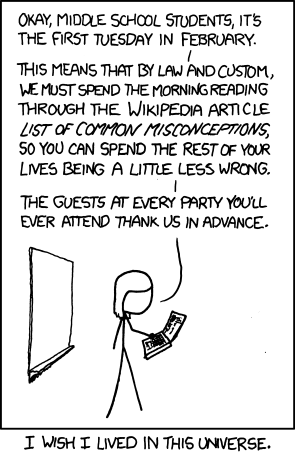
Combating misconceptions.

Educators have a slight problem when it comes to Wikipedia. On the one hand, it is a quick place to find answers to some random questions that inevitably pop up in the minds of the curious or the forgetful. (What is "zeugma"? Will that be on the test?)

A common misconception among students is that the word "research" means "spending five minutes on Google". And "writing a research paper" means paraphrasing the first five items that pop up. 

Many teachers do not allow their kids to use Wikipedia as a source for research papers, though its reference lists can be a good place to find some sources.  The idea is to force them to actually look around for information from sources that carry some academic weight.

But, perhaps there is a place in the secondary education universe for Wikipedia after all:

(http://xkcd.com/843/)

Sunday, April 3, 2011

Oral Contraceptives and your future children

(Source)
Many of us are already aware that there are medications, such as antibiotics and many acid-reducers that can adversely affect the beneficial flora in our intestines.  I did not know until recently that oral contraceptives also do this.

Many women also know that imbalanced gut flora from antibiotics makes us more likely to end up with a yeast infection. This study suggests  contraceptives have a similar effect.

According to natural health experts, imbalanced gut flora or "gut dysbiosis" is also associated with difficulties absorbing nutrients from food, something that is vitally important to both the pregnant woman and her child, as she must maintain her own body, and nurture the developing human life in her womb during a very crucial period. (See here for an article on how gut dysbiosis may affect babies and children, and here for another)

It seems like there is a legitimate question here that deserves answers through widespread research,    so that women can be more fully informed before using synthetic hormones or taking any other medication that changes the environment inside one's gut.  But, I won't hold my breath.

One more item for my list of reasons not to take The Pill.  And, one more reason to be fully informed when taking any medication, for that matter.


Tip of the Schoolmarm Ruler to TheHealthyHomeEconomist.com

Mama Lions in Lipstick

I think I'm going to have to add another subscription to my blog reader!

She posts on great topics, has excellent taste in music, and her writing style is fun and approachable, and scathingly humorous in places.

I'm talking about Parisienne Farmgirl, specifically her recent "Momma Lion Rant" on the issue of oversexualization of girls.


I'll take Grace Kelly over Britney Spears as a role model any time, and I hope that any girls I raise will feel the same way.

 I'd post a contrasting Photo of Ms. Spears, but I just can't bring myself to do it. If you must compare the two yourself, click here


Like "Parisienne Farmgirl", I find much of the fashion and images available for girls at present rather shocking, and sometimes just ugly.


The day I saw a toddler old at the zoo  in a bare midriff top, miniskirt, and knee-high boots (strangely enough, a lot like her mother's outfit), I knew that we had reached a new low in children's fashion and the objectification of females.  On a grown woman, the only place that outfit would have been appropriate would be on a seedy street corner. No doubt mommy dearest thought the little outfit was cute.

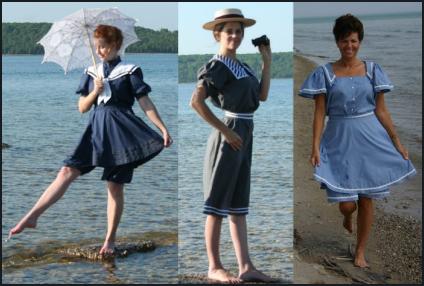
We don't have to wear jumpers that look like barbershop awnings to be modest.  Neither do we have to dress in turn of the century bathing suits to go to the beach, though it is interesting that a Victorian swimsuit is more modest than some outfits on the market today.


But, let's at least teach our daughters that an outfit is not actually more attractive the more likely it is to ride up or fall off.

I'm still trying to figure out how shoes that barely let one walk, or a skirt and top in which one can't bend over, much less run or lift anything, is supposed to help "empower" the female half of the population.

It's nice to find another kindred spirit, even in the blogosphere. Pariesienne Farmgirl is right on, and she makes me laugh.  I like her already.


 ----------------------------------
For more on why modesty and chastity are such important parts of true "woman power", see the post titled "The Politics of Porn" at Tea at Trianon.

Saturday, March 5, 2011

Support the Ohio Heartbeat Bill!

Proposed legislation in Ohio would protect all unborn children with a heartbeat detectable by ultrasound.

Click here for more information.


And then tell your pro-life friends!

 
(A woman Listens to the heartbeat of her unborn baby at 12 1/2 weeks gestation)

Tuesday, March 1, 2011

Wisconsin Woes

(Source)
I suppose it is about time I said something about Wisconsin.

I have spent most of the last few weeks listening.  Mostly to a lot of hotheaded responses on both sides.

On one end of the spectrum, liberals accuse conservatives of inventing and even creating budget deficits in order to keep the working man down in favor of fascism,  greedy corporations, and the great anti-feminist conspiracy.   Some compare the striking teachers to the demonstrators in Egypt. Others, who appear to have forgotten some details of world history, compare the Wisconsin teachers to the Solidarity Movement in Poland.  (Wait, wasn't the solidarity movement working against collectivism?)

Even some of my fellow conservatives have let their tempers override their reason. Some accuse teachers of being greedy statist shills, and distort information about their compensation, suggesting that they make $80,000-$100,000 per year, conveniently never bothering to mention that this figure includes the estimated value of their benefits. The Madison school district website states that their salary ranges from $32,913 to $64,681.  A fairly typical range for a public school teacher salary schedule. Rachel Alexander at TownHall reports that the average salary in Wisconsin is around $56,000.  Depending on whom one asks, the national average is somewhere between $40,000-$50,000 per year.


Sheesh.

This self-described "Crazy Schoolmarm" will now try to offer a sane reflection on the issue from the perspective of an educator.

When I initially entered this field, it was with full knowledge that I would be making much less  money than friends in other fields with similar education and experience. I assumed I would be driving used cars, and renting a small apartment for most (if not all ) of the rest of my life.   Contrary to rumor, my home state of California does not pay a higher salary to its public school teachers to compensate for the cost of living. In fact, because of the cost of living, I expected that if I were ever able to own a home, it would not be until my retirement.   In fact, I considered myself fortunate that I could even afford to pay rent on my own 500 square foot apartment while I taught in that state, instead of living with relatives or half a dozen roommates.  (My apartment was smaller than my classroom, by the way.)   I have two things to thank for my ability to rent that quiet apartment where I could retreat to grade papers in peace. One is the highly sensible upbringing I received from my parents. The other, I must suppose, is  the teacher's union, whose machinations led, no doubt, to the very affordable health benefits in my district which freed up more of my monthly budget  for rent.

This would probably be the right time to mention that I have been a (reluctant) card-carrying member of the California Teacher's Association (CTA), and therefore also of the NEA.

You are probably asking, "So, how did a nice conservative Catholic blogger like you end up in a union like that?".  Read on.

California, like Wisconsin, is not what we call a "Right to Work" state. What this meant for me as a public school teacher was that union dues were deducted from my paycheck whether I joined the union or not. The only way to have any say in how this money was used was to (yes, you guessed it!) join the union! This way, I could check the little box on the membership form that told them to keep my money out of political activity, and I had a vote. Unfortunately, my vote would not be enough to change the Union's socially liberal bias.  As Black Adder points out in his post at American Catholic, this does not exactly honor one's right to freely associate. I would have much preferred to take my money to the  Association of American Educators, which offers similar membership benefits, without the liberal politics.

In principle, I am not actually opposed to Teacher's unions, so long as they do what all unions were originally meant to do, which is protect their members from unjust treatment in the workplace.  Those who have never worked in a school may not realize how intensely dysfunctional and even hostile internal school politics can become, and the level to which unprofessional behavior can, in certain unfortunate cases, dominate a school and drive out skilled teachers.  (In fact, I would guess that this is the greatest reason for most problems with teacher retention.)

In practice, however, I have mostly found that the dysfunctional internal politics in schools has merely spread to the union.  As a result, I felt I needed a union to protect me from my union, more than from my employer. The problem is that the mainstream teacher's unions have been overstepping their bounds for some time, and function more as ideological advocacy groups than as professional associations protecting the rights of workers and the integrity of the profession at the same time.   (Did I mention that we were sometimes requested to picket against legislation, regardless of our personal opinions?--I quietly stayed out of that, by the way.)

When working as a public school teacher, I often wondered how much the district was paying for the highly affordable (for me) health benefits I mentioned before. There is, after all, "no such thing as a free lunch".  I wondered how the state was able to afford it. Now I know.

It couldn't.

California now faces a problem similar to, and perhaps even more dire than, that of Wisconsin.  High cost of living and a troubled economy continue to contribute to declining enrollment in public schools. Declining enrollment means less funding, and less funding means a system-wide budget crisis, and severely reduced job security for teachers.  Even before I left, schools were pink-slipping many teachers every spring, just in case they couldn't afford to keep them the next year. Shortly after, there was speculation that some teachers might have to be payed in IOU's!

As in Wisconsin, the CTA often demands that the state continue the dubious practice of spending money it doesn't have.  Many state employees forget that the state's money comes from taxpayers, including themselves. Others do not forget, and actually ask for increased taxes.  The problem is, taxes can only go so high before everyone starts to suffer. This is usually when they start moving somewhere else, as my husband and I did, and the declining enrollment problem only gets worse! If I were still living on my own in my home state, even given the tightness of my personal budget at the time, I would have been willing to pay a higher premium on my health benefits, if it meant a greater likelihood that I would actually still have a job and said benefits in future years.

As far as I have been able do discover, the cost of living in Wisconsin is considerably less than that in California, making it much more likely that someone, even in her first years in the classroom, will be able to support herself there on her take-home pay.  A slight increase in one's health care premium is, under the circumstances, a small price to pay for increased job security, especially if one is still able to eat and have a roof over one's head.  Furthermore, interrupting the education of thousands of children, and even using false doctor's notes (video link) to do so, is poor role modeling and in violation of what should be the generally accepted ethics of the profession.

There is, of course, the question of collective bargaining rights. Governor Walker's bill does limit these. So far as I can tell though, it does not do so sufficiently to warrant the outrage we have seen. In fact, it looks like it will do something to protect union members from misuse of their money, and prevent unions from making unreasonable demands on the state budget. If you are interested, here is a summary of what the bill will do, and if you are really interested, the full text of the actual bill (a very lengthy PDF document).

In short, I believe the following:

Public workers, like other workers have the right to unionize. What they do not have is the right to  force  dues out of public employees who do not wish to join them, and then to use that money for ends contrary to the consciences of those from whom they obtained it. They do not have the right to make demands or perform actions that are contrary to the public good. Since public worker strikes often mean serious harm to the public good, I do not think striking is a moral option under most circumstances, including those in Wisconsin. (See what the Catechism of the Catholic Church says about strikes here)

The state, as an employer, does have the duty to respect the rights of its employees, and during the budgeting process should make a reasonable effort to pay them a just wage. It also has the duty to protect the society in general, and the economic welfare of the taxpayer, and part of this is keeping an eye on the budget and not taxing the private sector out of existence.  It is wrong, as Chris Christie tried to point out to the New Jersey firefighters,  for politicians to make promises of benefits and perks for which the state cannot pay, leaving future generations to deal with rising debt and tempers.

A good salary and great benefits are very welcome things, but not if they lead to general ruin.

Sanity restored.

Maybe.

Back to business.


__________________________________
Related reading:
A Statement by the Bishop of the Diocese of Madison

Sunday, February 20, 2011

It isn't all Wal-Mart's Fault

My two favorite locally-owned cafés recently went out of business.  It's too bad. They both had great atmosphere and some really dangerous desserts, not to mention very friendly people behind the counter who actually bothered to recognize the faces and habits of their regular customers. Now the nearest place for me to get an herbal tea and my chocolate fix is the place Dave Ramsey loves to call "Fivebucks".

My first summer job in high school was also at a locally-owned coffee place back in my hometown.  My boss told me that the place pretty much lived hand-to-mouth most of the time, and it had been in business for almost a decade at that point, and had a steady flow of loyal customers!

It's tough owning a small business, which is probably why I have never yet actually done it. I have imagined.  I have fantasized. I have even done a little research on the matter.  But then I always get a nice cold dose of reality. Like this story earlier this month involving a man who was shot in a Seattle-area Denny's.  He was shot, as it happens, by another customer who had a bad temper, and even worse aim.  Tragically, he ended up a paraplegic as a result of his injuries. The shooter went to prison, and the victim went to court--and took Denny's with him.

Denny's settled out of court for $13 million, which saved it from the $46  million the jury was about to award. According to the article, "The jury found the company failed to provide security even though police had responded many times to reports of violent crimes at the restaurant."

Now, I do not wish to minimize the genuine pain and suffering of the victim.  It does seem like someone ought to compensate him for that which he has lost, but I am not certain that it is the restaurant who has the responsibility, and I am greatly concerned about what such a ruling means for restaurant owners who do not have thirteen million dollars lying around to pay to injured customers.  Even with security present, there is no guarantee that some hothead with a firearm isn't going to start shooting.  If they can't hire their own security guard, will mom and pop and grandma have to go to court, too?  Should business owners move if the neighborhood starts to decline, in order to avoid liability?

Small businesses do not only have to contend with cuthroat competition from impersonal big-box stores and monster coffee chains. They also have to face the increasingly high cost of doing business in a lawsuit-happy society.  Along with small restaurants and coffee shops we are watching the gradual disappearance of   small,  medical practices and other types of businesses. Small private schools have to dedicate ridiculous amounts of time and paperwork to keeping their legal backsides covered in every detail. Why? Because people are just as happy to sue them as Wal-mart, and for the same large amounts.  Maybe the big guys can take it. But I don't know about mom and pop and grandma.

Maybe that's why internet businesses are becoming so popular. No buildings for people to be injured in.

Sunday, February 13, 2011

A tip for job seekers:

Hello, ladies! (Men, be advised that reading this post further is optional for you.)  Welcome to today's fashion rant.  The topic:  What not to "wear to work"


Example:

These little numbers from the Chartlotte Russe Website show up in their "wear to work" section.  In fairness, I will say that most of the items they list could be appropriate for an office setting (Blazers, pants, pencil skirts, ruffled tops, etc.) A sweater or jacket would be essential with the sleeveless tops, and the pencil skirts are a tad short (just above the knee, rather than just below).  Then there are things like these:


Either the Charlotte Russe folks expect some of their clients to be...*ahem*... working outdoors, or they are completely clueless about appropriate office wear.

If you don't want it ogled or fired, keep it covered.

If you want to know what is appropriate "business casual" or "business formal" attire, there are many websites out there with detailed information.

Monday, January 3, 2011

Cybill Shepherd on going on The Pill

"... I became sexually active as a teenager. One day, my mom took me to my family doctor. He wrote something on a prescription pad and said, ‘Take one of these every day, and all your periods will be regular.’ What a thrill! He didn’t even tell me it was birth control.”

It's a thrill to have your doctor lie to you?  Really?

Shouldn't she be completely offended at the sexist attitude of her doctor, whose behavior suggests that he believed women (especially young ones) can't handle a simple explanation of what medications actually do?

I know I'm offended as much by her attitude toward herself, as by his attitude toward women.


Shepherd's comments are cited in a New York Magazine article entitled "Waking Up from the Pill".  Interesting reading, as it shows that some people in secular culture are questioning the cost of such technological interventions in a woman's fertility, even if they are not yet ready to admit that they may have overestimated their value.


----------------------------------------

Update: Ms. Shepherd also made similar remarks about her first birth control pills in an interview with Larry King:

KING: You've always been pro-choice, right?

SHEPHERD: Always been pro-choice.

KING: Even growing up in an area where pro-life would have been sacrosanct?

SHEPHERD: I was very lucky. Very close family friend in 1966, a doctor, prescribed me birth control pills without telling my mother and without telling me. Just went for my first gynecological appointment, and he said, "Do you have a boyfriend?" I said yes. He said, "Do you love him?" I said, "Yes, we're going to get married?"

He said: "Well, you know, your periods have been a little irregular here. I'm going to give you a prescription of something that's going to make your periods real regular."

I was very fortunate, and that is why I feel compelled to stand up for the young women in this country now who are not allowed to control their own fertility, their bodily fertility. People keep wanting to take away from women our right to control our pleasure and our bodies and our reproductive health. And for this, I will always continue to fight wherever it is. 

KING: Are you Catholic?

SHEPHERD: No, I'm not. I was raised Episcopal.

I still cannot understand how a "pro-choice" woman could be so excited about this, since her doctor made the choice for her.

Monday, November 1, 2010

Priorities

"How can it be a large career to tell other people’s children about the Rule of Three, and a small career to tell one’s own children about the universe? How can it be broad to be the same thing to everyone, and narrow to be everything to someone?"

--G.K. Chesterton, The Emancipation of Domesticity


Tip of the Schoolmarm Ruler to Emily Lunsford of the Distributist Review.

Tuesday, October 19, 2010

Examine your OB/GYN

(Photo Source)
Would you let Dr. Kevorkian take care of your grandmother?

Neither would I.

It's just a little creepy to think that the person looking after one's loved one would be equally comfortable killing her as caring for her.

For the same reason, it is important to many of us pro-life women that our OB/GYNs not perform abortions.   Someone I know recently changed doctors mid-pregnancy because she discovered that her Obstetrician was doing so.  She had been seeing this doctor for some time before she became aware of this.

How was it possible that she didn't know?

Many of us don't ask. Sometimes, it is because we don't want to know. It may be because we assume that the wonderful person cheerfully taking care of us and our babies couldn't possibly be one of "those doctors".

It is also true that some doctors don't exactly advertise that end of their practices to patients who do not ask.

Take, for example, Houston based OB/GYN Dr. Bernard Rosenfeld, who is the abortion provider for a National Abortion Federation (NAF) Clinic.  He also has a private practice, with a website to which the NAF clinic links.  The main site for his private practice makes absolutely no mention of the fact that this doctor also specializes in performing abortions, and the only link back to the NAF facility from this site is buried deep in his "Other Resources" menu, out of the way of the eyes of those who aren't looking for it.

Well, as long as he's doing the abortions somewhere else, and not in his private office, some say...

Incidentally,  a simple Google search for this man's name also reveals a second website for his private practice, dedicated to the abortion "services" that he offers in the same office where he also provides prenatal and fertility care to women with, or desperately trying to achieve, wanted pregnancies.

Interestingly, if you want an abortion from Dr. Rosenfeld at his private office, it will cost you twice as much as the exact same services at the NAF facility a short distance away. Quite a price to pay just to avoid having other patients in the waiting room know why you are really there.

According to a video on the NAF website (watch it in Windows or Quicktime format), he has been doing abortions since 1980, and both abortion-related websites indicate that he prides himself on the quality of his work, even to the extent of performing abortions on patients other abortionists will not take! Why does he not advertise this on his main website, along with tubal ligation reversals and obstetric care?  After all, are we not constantly being told that abortion is just another legitimate part of women's health care? And are we not also told that abortion providers are heroes?

I think we can figure out the answer to that little puzzle.

At least Rosenfeld's association with abortion can be readily found on the internet by those patients who are determined to examine his background. Not so for many other doctors, including the one my friend is now no longer seeing.

Many of us avoid patronizing businesses that support Planned Parenthood, and refuse to vote for political candidates who support public funding for abortion.  The same policy should apply to our choice in doctors.

Sometimes the hard questions must be asked.

Tuesday, October 5, 2010

Say Cheesy!

There are many little things that serve to make life more pleasant, and they are often the patient work of skilled hands. Good meals made from scratch, beautiful music, and richly worded poetry are among them.  The mass-produced, the inane, the vulgar, and the bland become much less appealing when held alongside these things.

Tonight my husband drew my attention to this post over at Fr. Z's blog which links to a recently composed sample of bland lounge music a setting for the new translation of the Gloria in the forthcoming new (and, dare I say, improved) missal.

If you are interested in assailing your ears for a moment, click here.

Here I must paraphrase the fictionalized version of Mozart in the film Amadeus. "One hears such sounds and what can one say but... turn of the century liturgical music!"
 
I once saw a T.V. documentary explaining the process by which perfectly good cheese is adulterated with procesed fats and artificial colorings in order to produce the ubiquitous single slice of American cheese.  Oddly enough, this composition put me in mind of that.

I have been a liturgical singer since I was in my teens. Up to and during that period of my life, the works of Haugen and Haas, as well as much protestant worship music, made up the bulk of the music I heard and sang at mass. It was not until my college years (at a secular university) that I was exposed to truly traditional and well-performed Catholic music, and knew it for what it was.  I had to take courses from the Music department at my university and join one of the performance choirs in order to learn about and sing what had previously been hidden from me.  It had been hidden, in part, because many in the generation before mine had ignored it, laboring under the misconception that the young have no capacity to appreciate that which is old.

Hearing traditional music after a lifetime of hearing the new stuff is much like trying gourmet cheese after a lifetime of eating Velveeta.
 

What I have seen of the new English translation is more poetic, more faithful to the Latin, and more theologically "meaty" than that which we currently use.   It is the hope of many that this will lead to a more beautiful liturgy and better catechesis for the Faithful.  In particular, I would like to see the Latin Rite liturgy in America better retain its Catholic identity. (We can take a lesson from Eastern Catholics as well as our Orthodox brothers and sisters here, whose worship suggests a preoccupation with tradition over superficial modernization.) Maybe the new translation will even encourage a higher level of composition for liturgial music?   Maybe?

I am not insisting that we all have to install massive pipe organs in our churches and start singing nothing but FaurÄ—, Mozart, Byrd and Palestrina.  Not all choirs have the skill for that.  Simple, traditional hymns have enough of the poetic and the reverent in their lyrics and their composition to sound lovely with less traditional guitar or piano accompaniment.  For new mass settings, it might be worthwhile to take some of our cues from these.

Or, if I may continue my cheese analogy, if you can't have brie, try a good, everyday cheddar!

Alas, listening to the sample above is like watching someone pour Cheez Whiz all over a delicately prepared filet mignon.

Wednesday, September 8, 2010

Take The Pill for Spider Veins!

(Photo Source)
If you want to have spider veins that, is.

According to Web MD and the US Department of Health Services, taking medications containing estrogen and progesterone can contribute to the development or worsening of spider veins.

Avoiding spider veins is not merely a question of vanity.  They can be very uncomfortable, and can also be a sign of serious circulatory problems in the legs.

Of course, there are plenty of other factors that contribute to spider veins, including heredity, pregnancy, aging, menopause, and lack of exercise.

But, considering that the Pill is also associated with increased risk of cancer, stroke, heart attack, decreased libido, bone loss and many other unpleasant side effects, why give your body one more reason to develop spider veins?

Natural Family Planning keeps looking better and better.

Friday, September 3, 2010

Language fun for the Weekend

Victor Borge and Dean Martin punctuate music.


Victor Borge's Inflationary Language

Wednesday, June 9, 2010

Woman Power in the Primaries

 This blog would like to offer its congratulations to Meg Whitman and Carly Fiorina.  I hope they beat the pants off of Jerry Brown and Barbara Boxer.


No doubt there will be much discussion of pro-life feminism (versus the more well-known pro-abortion feminism we have seen in this country over the past 50 years) over the months between now and the election.   Marjorie Dannenfelser, president of the Susan B. Anthony List, rightfully recognizes that abortion, instead of empowering women, has instead created a cultural atmosphere that makes it easier for men to use us as playthings for their own pleasure, and requires us to sacrifice our natural femininity as a condition of full participation in society.  I excerpt her comments below:
 

It’s surprising, really, that abortion-rights feminists are so unequivocal in their insistence that “pro-life feminism” is an oxymoron. After all, the pro-life feminist argument relies upon feminism’s better angels. It is a communitarian argument for one thing.

The pro-life feminist looks out for the interests of other people affected by her decisions. She refuses to take terrible advantage of another vulnerable group - the unborn - in order to advance her own case. She makes the “both/and” argument: both the woman and the unborn child deserve respect.

Secondly, the pro-life feminist relies upon empirical and scientific datum. She makes a rational argument about when life begins or about the psychological or physical harm some women suffer after abortion; she is not shouting down or pressuring her opponents, or belittling them personally.

Finally, she insists that what women alone are capable of doing – bearing and mothering children–– merits more respect than it presently receives. Abortion rights have unburdened men from the fathering role. His freedom from sexual responsibility is premised on the woman's choice to abort or not.

It is no coincidence, suggests the pro-life feminist, that 37 years after women were granted the “right to abortion,” the number of women and children living without the presence or the support of the father is at an all-time high. She thinks it’s no accident that elite jobs are regularly populated by women who, often with regret, felt pressured, with no support available to them, to avoid parenting in order to advance in their career.

Sunday, March 21, 2010

Blue Dogs fall for New Trick.

Via Christopher Blosser and Donald McClarey at American Catholic:


US Catholic Bishops: Executive Order Deal A Non-Starter:
We’ve consulted with legal experts on the specific idea of resolving the abortion funding problems in the Senate bill through executive order. We know Members have been looking into this in good faith, in the hope of limiting the damage done by abortion provisions in the bill. We believe, however, that it would not be fair to withhold what our conclusion was, as it may help members in assessing the options before them:

“One proposal to address the serious problem in the Senate health care bill on abortion funding, specifically the direct appropriating of new funds that bypass the Hyde amendment, is to have the President issue an executive order against using these funds for abortion. Unfortunately, this proposal does not begin to address the problem, which arises from decades of federal appellate rulings that apply the principles of Roe v. Wade to federal health legislation. According to these rulings, such health legislation creates a statutory requirement for abortion funding, unless Congress clearly forbids such funding. That is why the Hyde amendment was needed in 1976, to stop Medicaid from funding 300,000 abortions a year. The statutory mandate construed by the courts would override any executive order or regulation. This is the unanimous view of our legal advisors and of the experts we have consulted on abortion jurisprudence. Only a change in the law enacted by Congress, not an executive order, can begin to address this very serious problem in the legislation.”

Richard Doerflinger
U.S. Conference of Catholic Bishops


A further roundup of commentary from other sources here.

One would think that a politician would know all of the tricks in the book well enough to avoid falling for one.

It's too bad we'll have to wait till November to vote these people out of office.

Thursday, July 9, 2009

Thursday, June 18, 2009

Cancer Chemistry

The Breast Cancer Fund is an advocacy group that draws attention to environmental toxins that are linked to breast cancer, including those in food storage containers, cosmetics, and even oral contraceptives.

One more group that recognizes the link between the Pill and cancer.