Tuesday, June 21, 2011

Movie Review: "Super 8"

Over the weekend my husband and I went with some friends to see this latest addition to the pre-teen-boy-adventure-movie genre.  Some people are already comparing Super 8 to films like Stand by Me and The Goonies.

The plot line of Super 8 certainly has much in common with its two predecessors.  All three movies feature as a main protagonist a fresh-faced young boy in his early teens facing a significant personal loss or problem (in this case, the death of his mother in a horrific industrial accident). He is accompanied by his small cohort of quirky friends, each with his own issues (in this case, one overweight boy with attention and control issues, another who has a strange fascination with explosions, and another with a tendency to be sick every time he is frightened).  An event ensues that sends them all down the road to an adventure (In this case a dramatic train derailment, which releases a mysterious and dangerous extra-terrestrial creature and uncovers a military conspiracy to keep the alien being captive and secret). The boys face danger together, grow up a little (at least, to a point), and are never the same again.

For a fuller synopsis--with spoilers--hop on over to Wikipedia.


While parents are largely absent in The Goonies and Stand By Me, they occupy a more prominent place in Super 8.  Deputy Jackson Lamb, the father of the main protagonist, has a difficult time coping with the loss of his wife and with single fatherhood.  He has an even more difficult time coping with his anger toward Louis Dainard, his wife's alcoholic coworker, since she was killed while covering a shift for him while he was drunk.  Dainard's daughter, played by Elle Fanning, occupies the novel place of token girl in a pre-teen-boy-adventure-movie.  Her own guilt and embarrassment over her father's behavior adds dimension to her budding friendship with the central protagonist, giving their relationship more depth than the typical "first crush".  Dainard himself is coping with guilt over his own actions, and anger at his wife for leaving him. Naturally this puts a strain on his relationship with his daughter.

The film revolves around the question of how to handle personal loss, and the importance of allowing one's own pain to turn into compassion, rather than destruction of self or others.  Even the mysterious alien creature is coping with its own grief and anger at its captivity at the hands of the military.  As the plot unfolds, each of the emotionally injured characters is forced to confront his or her own pain, and in the process, they help each other find healing and forgiveness.

Given that Stephen Spielberg is one of the producers, one would expect the special effects to be interesting, and these should satisfy anyone who enjoys action, noises, some gore, and (much to the satisfaction of one of the characters) spectacular explosions. Even with the very current nature of the effects, the atmosphere of the film, aided by the retro 1970's setting, hearkens back to earlier movies.  The alien creature is handled in a way that prefers suspense over spectacle.  The film's reliance on effects does diminish its opportunities for character development somewhat.

A roll of super 8 film.
If you do go to see the movie in the theaters, don't forget to stay for the end credits. They feature the amateur film the boys make using the Super 8 film from which the movie gets its title.

Due to frightening situations, some profanity, and one instance of less than glamorous drug use by an empty-headed store clerk, I'd say this film's PG-13 rating makes sense.  Young children would probably find the movie excessively frightening. Parents of younger teens should exercise their own discretion before allowing their youngsters to see this movie. Older teens and adults should  be able to watch the film with no trouble.

With its entertaining performances, well-timed scares and laughs, and relevant, if predictable, themes, I found Super 8 to served very well as weekend entertainment. The Catholic News Service gives this film a rating of A-III (Adults). This schoolmarm gives it a grade of B+.

Friday, June 17, 2011

Conan Does Dartmouth

If one has to invite a speaker to talk for half an hour at a graduation ceremony without putting people to sleep, an accomplished comedian is a good choice.

Conan O'Brien's commencement address this year at Dartmouth is probably one of the most honest and entertaining commencement speeches I have ever heard. It is worth a listen.


(Warning: Some profanity.)

State-Sponsored Eugenics in America

In our national conversations about the history of racism in the United States, I have rarely heard the Eugenics movement mentioned, much less properly condemned.

The machinations of eugenicists have affected real people in real ways, not just in far away places, but here in our own country. The frightening part is the extent to which the eugenics movement has influenced both our national conscience and public policy.

Maybe the following story will get us thinking and talking a bit more.


From BBC News:
Sterilisation: North Carolina grapples with legacy


More than 60,000 Americans were sterilised, many against their will, as part of a eugenics movement that finished in 1979, aimed at keeping the poor and mentally ill from having children. Now, decades on, one state is considering compensation.

In 1968, Elaine Riddick was raped by a neighbour who threatened to kill her if she told what happened.

She was 13, the daughter of violent and abusive parents in the desperately poor country town of Winfall, in the US state of North Carolina.

While she was in hospital giving birth, the state violated her a second time, she says.

A social worker who had deemed her "feeble-minded" petitioned the state Eugenics Board to have her sterilised.

Officials coerced her illiterate grandmother into signing an "x" on an authorisation form. After performing a Caesarean section, doctors sterilised her "just like cutting a hog", she says.


Read the rest at BBCNews 


Interestingly, sterilization of the "feeble minded", minorities, and other populations was one of the central goals of the American Birth Control League founded by Margaret Sanger.  Over the years that organization has remade its image to keep up with changing times.  Since the early 1940's, when eugenics began to lose its political popularity, that organization that began as the American Birth Control League has gone by the slightly friendlier name of Planned Parenthood.


Tip of the Schoolmarm Ruler to the Institute for Marriage and Public Policy

Tuesday, June 14, 2011

Surviving the Economy and Avoiding the Servile State

It seems like everyone is talking about the economy and what ails it. Some blame big government and socialist thinking and policies. Others blame capitalism, republicans, and big business. They are both right. They are also both wrong.

Neither big government nor big business have the needs of human beings as their central concern.  Big business is too busy with its profits,  big government is too busy holding onto its power, and very often they are both too busy cooperating with each other to reach their respective goals to have any time left to take human dignity into account.  When Hilaire Belloc published The Servile State, he was concerned that trends at the time would lead to "the establishment of compulsory labour legally enforceable upon those who do not own the means of production for the advantage of those who do". Were he alive today, I think he would still be worried.

At the time, Belloc was more alarmed about big business running amok, but he also pointed out that an out of control government would ultimately lead to the same end: a society in which a few have total legal and economic power over the many (see the illustration below for a visual representation of this concept).  Considering the size of the government at present, as well as the current state of big business, we may have even more reason for concern than did Belloc and his contemporaries.


Belloc argued that the best way to halt our advancement toward the "servile state" was to encourage policies that favor keeping both government and business small, and ownership of the means of production (i.e. land, tools, equipment, skills, etc.) as widespread as possible.   The ideal economy, he believed, would be one consisting primarily of small, independent, family owned businesses. He reasoned that this would lead to a more human (and humane) workplace as well as a more just society. This economic ideal, which is neither capitalist nor socialist, is commonly called Distributism.

Over at The Huffington Post, Thom Hartmann is trying to make sense of the present economy.  He is right that, historically speaking, "There's Nothing "Normal" About A Middle Class".  His observation that social upheaval precedes two historical surges in the middle class population is also worth considering. But there are two flaws in his approach as he tries to figure out why a middle class is able to sustain itself in certain periods of history and not in others.

The first problem is that he fails to take into account the existence of widespread ownership of the means of production during the historical periods he cites. Without this, the middle class could not have grown as it did.

Hartmann points to the depopulation of the European continent during the plague, and the colonization of the Americas as points in history that allowed a middle class to form. These instances of social upheaval lead to movement away from a servile society to a more democratic one. Hartmann attributes this movement to the changed ratio of people to resources, but there is more to it than that.  This social upheaval led to the absence of landowning nobility, allowing the common man to take ownership of the resources around him.

Whether plague survivors or colonists, people in both periods of history Hartmann cites would have found themselves in a position much more favorable to ownership and self-sufficiency because they would have been able to control the land on which they lived and worked.  Stake out a plot of land, plant a few crops, teach your kids how to farm, and you have a family business. Or, at least, you have the means to feed yourself even if you can't make money selling what you grow.

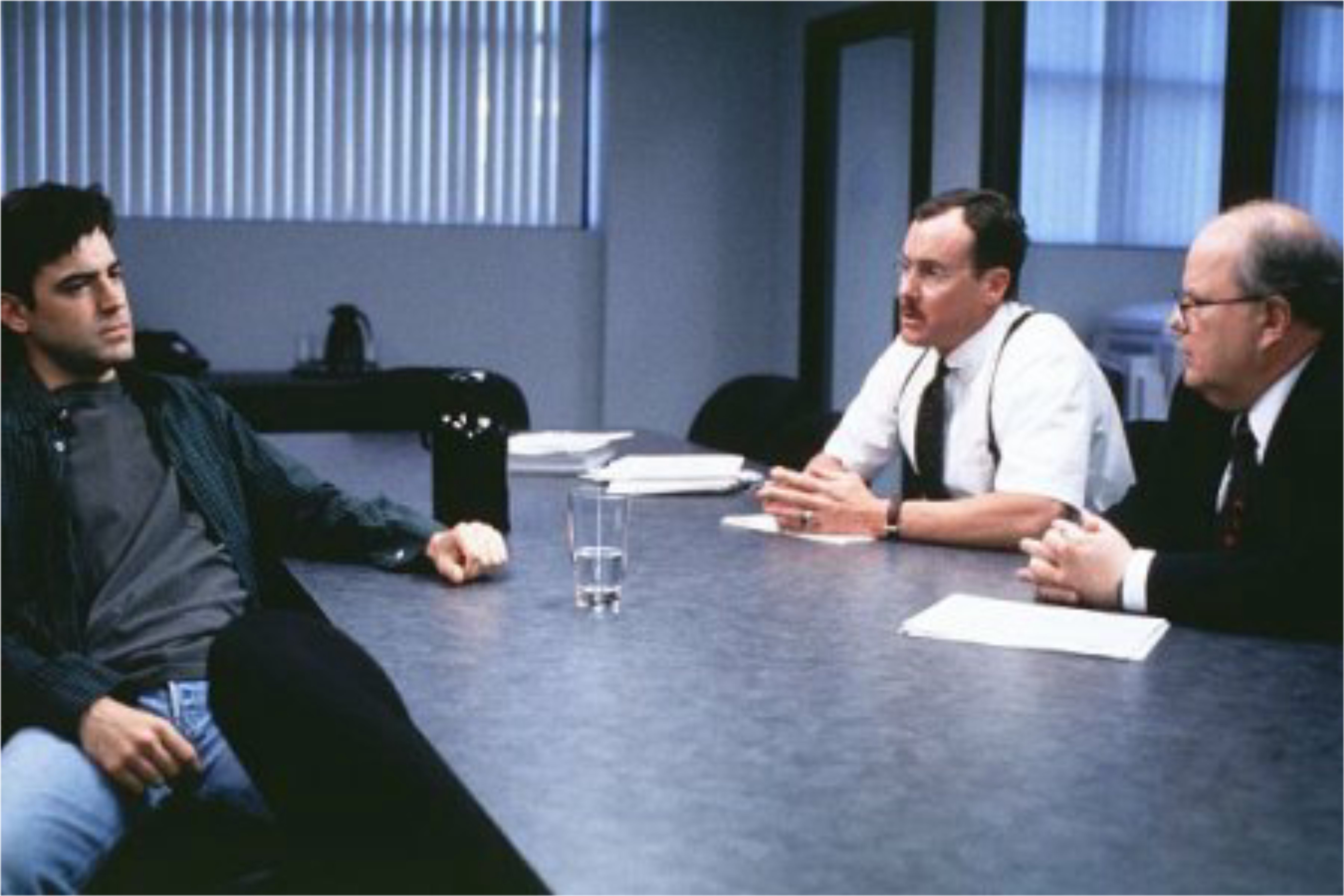
Like commoners living in a feudal society, corporate and government employees of today spend their labors working with resources that are not their own.  What does this mean for employees? I offer the following dialogue from "Office Space" as an answer to that:


Peter Gibbons: The thing is, Bob, it's not that I'm lazy, it's that I just don't care.
Bob Porter: Don't... don't care?
Peter Gibbons: It's a problem of motivation, all right? Now if I work my a** off and Initech ships a few extra units, I don't see another dime, so where's the motivation? And here's something else, Bob: I have eight different bosses right now.
Bob Slydell: I beg your pardon?
Peter Gibbons: Eight bosses.
Bob Slydell: Eight?
Peter Gibbons: Eight, Bob. So that means that when I make a mistake, I have eight different people coming by to tell me about it. That's my only real motivation is not to be hassled, that and the fear of losing my job. But you know, Bob, that will only make someone work just hard enough not to get fired.

In other words, employment is not the problem for the middle class. Nor is unemployment.  The problem is dependence, either on government or employers.


This leads to Hartmann's second problem: he ignores what the "middle class" was, and does not think carefully enough about what it is now.

In the past, the middle classes were those who were able to make a living for themselves without being born into the wealthy upper classes. Socially, they were commoners. Economically they were not, because they owned the fruits of their labors. That left them somewhere in between the two.

In present political discourse we are generally inclined to define the middle class as those who have an income that is--well--in the middle.  We do not often consider how many of those people do not depend on either government or corporate employment for their "middle class" status. Hartmann compares the merchant classes of the middle ages to present-day middle class citizens. Many merchants of that period (such as the father of St. Francis of Assisi) certainly made a tidy income. But they did so as owners of their own small businesses.  Small farmers would have been able to feed themselves without depending on corporate food distributors to provide groceries. They would have earned money selling their goods to the local community without having to contract with a large corporation in order to survive.  Farmers and merchants in pre-industrialized society were not at the mercy of an indifferent bureaucracy to "create jobs". They created their own.

G.K. Chesterton wrote "Too much capitalism does not mean too many capitalists, but too few." The social gap that ought to concern us today is not merely between rich and poor. It is between employers and employees. There are far too few of the former.

Unfortunately, we have a long way to go before we can change the structure of our economy.  Our culture and our education system still train us and our children to become employees rather than entrepreneurs or independent thinkers. Our political system thrives on the votes our politicians buy from us using our own tax dollars.
 
The solution to our present economic problem is not "investment in infrastructure" through another "New Deal".  This merely makes the government another big employer.  Nor is the solution to  give existing big employers more latitude to do whatever they want regardless of the human cost.   Common sense and a renewal of an independent human spirit is the answer.

I only hope that it won't take another bubonic plague to make us regain ours. 


--------------------------------------------------------------------------------------
Further Reading:

Pope Leo XIII, Rerum Novarum
Hilaire Belloc, The Servile State
G.K. Chesterton, Orthodoxy
G.K. Chesterton, What’s Wrong with the World

Wednesday, June 8, 2011

Fashion Trend Trivializes Rosary

One of my favorite gifts that I received for my confirmation was a beautiful rosary bracelet.  I felt that wearing it provided me with  a way to express my faith publicly but not ostentatiously, and on occasion it became a conversation piece that allowed me to share my faith with others who do not know what the rosary is.  It also came in very handy if I happened to forget to bring a full-sized rosary with me when I might have need of one.

(Photo Source)
Those who wear their beads with genuine devotion are in good company. After all, many religious wear their rosaries in their cinctures, keeping them available at all times.  In our human frailty, keeping our rosaries where we can see them is probably the best way many of us have to remind ourselves to actually use them.

But, we have to be careful about how we do so, lest they become Pharisaical display or mere superficial ornaments.

I have noticed over the past few years that many more people, especially teens and young adults, are wearing rosaries as fashion statements.  Even Justin Bieber has jumped on this bandwagon.

Unfortunately, the comportment and dress of some of some forces me to doubt that they are wearing rosaries as devotionals.  Many celebrities whose public behavior is, shall we say, less than in line with Catholic morality,  have popularized rosary beads as superficial fashion statements.   Britney Spears and Madonna are among the most prominent examples.

At the most extreme end of this problem is the inclusion of rosaries worn around the neck in the attire of gang members.  This has even caught the attention of schools, law enforcement, and news media. The San Antonio Police Department Youth Crime Service Unit "Gang Awareness" handbook and USA Today both report that rosary beads are now common components of gang-related attire.


More recently I have seen items labeled as "rosary necklaces" for sale in shops that cater to the more unsavory trends in youth fashion.  These usually have features that are rather different from the real thing.  Hot Topic, a mall chain that features some of the more edgy fashions popular among suburban teens, offers a so-called "rosary necklace" with a charm that looks like a pair of brass knuckles where the crucifix should be, and a gun-shaped center.   Such items are especially appealing to teens and young adults who buy into the glorified images of street culture so common in entertainment media

On the one hand, it could be argued that if  someone is going to wear a rosary as a mere fashion statement, it is less disrespectful to wear a bad knock-off than an actual sacred object. On the other hand, calling the bad knock-off a rosary, instead of something else, mocks the real thing and suggests that it is OK to pervert an item that is sacred into a profane fad.  Either way, this trend displays a great lack of respect for Catholic beliefs and practices, especially when worn by those who have no interest in even the appearance of using them for actual prayer or following Catholic teaching.  This public trivialization of one of our most distinctive spiritual tools should be of great concern to those who understand its true value.

Pope John Paul II called the rosary "an effective spiritual weapon against the evils afflicting society" (Rosarium Virginis Mariae).  No weapon, whether temporal or spiritual is of any use if we do not understand it or know how to use it.

It may seem like I am splitting hairs here. It may seem like I am nitpicking when I express concern about this. After all, we have much to be concerned about when it comes to our kids and what they do and what they see on television.  The fact that Lady Gaga wears something resembling a rosary around her neck (or eats one) may seem trivial compared to everything else she wears (or doesn't) and the things she says and does.

But I'm not alone here. Even the bishops find this trend to be disturbing, and have encouraged efforts to catechize people who walk into Catholic shops looking for rosaries, and thinking they are merely buying a necklace. Some business owners have begun giving out free leaflets on how to pray the rosary to the customers who purchase them, hoping that this will at least encourage respect for it, and maybe even teach people something.

If prayer, and the rosary in particular, is the most powerful tool we have to combat all of those evils that threaten our children (and he who is behind them), we must be concerned if people begin to forget what the rosary is for.

Imagine if every celebrity, twenty-something, and teen who wore something like the absurd piece of jewelry above actually learned to pray a real rosary. 

Tuesday, June 7, 2011

Catholic Feminism: Common Sense or Oxymoron?

Husbands, love your wives, even as Christ loved the church and handed himself over for her to sanctify her, cleansing her by the bath of water with the word, that he might present to himself the church in splendor, without spot or wrinkle or any such thing, that she might be holy and without blemish. So (also) husbands should love their wives as their own bodies. He who loves his wife loves himself. For no one hates his own flesh but rather nourishes and cherishes it, even as Christ does the church, because we are members of his body. (Eph. 5: 25-30)


During my engagement, I found myself explaining to a professional colleague (not a Catholic, nor, to my knowledge a practicing Christian of any kind at the time) that the passage above is, when taken in historical context, a feminist statement. In ancient times, men were expected to love their wives about as much as they were expected to love their cattle.   This message of Paul's was probably a bit of a surprise to them.

In the end, I told my colleague, if husbands do indeed follow the model above, women could safely "submit" to them without fear or loss of dignity, as the end result would be a mutual relationship in which each spouse places the other first.   If both strive for the ideal St. Paul lays out for us, neither spouse will be able to habitually treat the other as a mere object for exploitation.

This would also mean that both spouses should object to social and cultural trends that encourage violations of human dignity, and especially those trends which encourage gender-based exploitation and discrimination.

Simcha Fisher, a self-described Catholic feminist and blogger for the National Catholic Register, explains what Catholic feminist ideals look like in the present world in a recent post:

My husband says I’m a feminist. I know many liberal feminists would recoil in horror at that assessment: After all, I have all these kids, and I’m a member in good standing with that horrible old misogynistic Church, with its oppressive rules about reproduction and obedience. I’m pro-life and wholeheartedly follow the Magisterium’s teaching on the male priesthood and contraception, and try to make the Blessed Virgin my model.

So what makes me a feminist? Some would say that all faithful Catholics are feminists, because the Church is the most pro-woman organization around: The Church honors and values the particular gifts of women, and demands that men treat women with dignity and even a little bit of fear. John Paul II famously called himself a “feminist pope”; and in practical terms, the Church has probably done more for the physical well-being of women around the world than any other charitable organization.

Catholics who are feminists recognize that, while so many true wrongs have been righted in the last 50 years, the poor treatment of women in America has just been displaced, not eradicated. So now, instead of corsets and disenfranchisement, we have widespread pornography, abortion, and abandonment of every kind. We have gained some necessary ground, but lost so much else that is valuable in the process. Most of my Catholic friends see the world this way.

...

What change would I like to see? From the secular world: Stop thinking of women as sex objects; but at the same time, stop thinking of women as identical to men. Stop treating fertility like a disease; but stop pretending that women can be full-time mothers and full-time careerists. Stop blaming men for everything that is wrong with the world. It’s tiresome and counterproductive.

From my fellow Catholics: Stop thinking of women as objects who are here to save you from personal sexual sin; and stop thinking of women as intellectually inferior to men. Stop assuming that all women are meant to bear child after child no matter what; and stop pretending that if women just tried a little harder, men would be happy all the time. Stop blaming women for everything that is wrong with the Church. It’s cowardly and childish.

That’s for starters.

But feminism is not all about complaining and protesting. What I would like most of all is for women to ask themselves honestly, without worrying about history or politics, “What is it that I, as a woman, can do especially well? How can I help other women do what they do well?”

Read more: http://www.ncregister.com/blog/what-is-a-catholic-feminist/#ixzz1Oe03Z7Ui

Monday, May 30, 2011

Remembering Sacrifices

“It must often be so, Sam, when things are in danger: someone has to give them up, lose them, so that others may keep them.”
--Frodo Baggins in J.R.R. Tolkien's Lord of the Rings

Thursday, May 19, 2011

Pope in Carbonite?

"Oh, they've encased him in carbonite. He should be quite well protected.  If he survived the freezing process, that is."
 -C3PO


  (Image Source)

On the left, the cover art from the Spring 2011 Ignatius Press Catalog. On the right, something rather familiar.  I wonder if the artist is a Star Wars fan?  The resemblance is too funny.


--------------------------
Update: Looks like I'm not the only person to find this little art piece amusing.

Sunday, May 15, 2011

What Draws the Young to Old Things?

Vintage is in.

Perhaps it would be more accurate to say that it never went out.

Many people under 35 are currently fascinated with everything from the vintage to the ancient. Why?  Aren't young people supposed to be wholly preoccupied with the latest and greatest?

This is not just true for thrift store shoppers and fashion bloggers. Within the Catholic Church there are many young people gravitating toward traditional liturgy and practices that, to some of our elders of the baby-boomer generation, seem a little antiquated and possibly somewhat baffling. Most of the women I see in veils at mass each week appear to be under 35.  The religious orders that are getting high numbers of vocations from the young are those with the most traditional attitudes

Oddly enough, we can turn to an antique book for an explanation of this youthful preference for tradition. As usual, G.K. Chesterton can shed some light on the matter in a single paragraph:
"To each man one soul only is given; to each soul only is given a little power--the power at some moments to outgrow and swallow up the stars. If age after age that power comes upon men, whatever gives it to them is great. Whatever makes men feel old is mean--an empire or a skin-flint shop. Whatever makes men feel young is great--a great war or a love-story. And in the darkest of the books of God there is written a truth that is also a riddle. It is of the new things that men tire--of fashions and proposals and improvements and change. It is the old things that startle and intoxicate. It is the old things that are young. There is no sceptic who does not feel that many have doubted before. There is no rich and fickle man who does not feel that all his novelties are ancient. There is no worshipper of change who does not feel upon his neck the vast weight of the weariness of the universe. But we who do the old things are fed by nature with a perpetual infancy. No man who is in love thinks that any one has been in love before. No woman who has a child thinks that there have been such things as children. No people that fight for their own city are haunted with the burden of the broken empires. Yes, O dark voice, the world is always the same, for it is always unexpected." (The Napoleon of Notting Hill, 1904)

St. Peter's Basilica, Rome.

Sunday, May 8, 2011

On Sin and the Opression of Women

John Paul II wrote the following in his encyclical Mulieris Dignitatem (On the Dignity of Women):

Jesus enters into the concrete and historical situation of women, a situation which is weighed down by the inheritance of sin. One of the ways in which this inheritance is expressed is habitual discrimination against women in favour of men. This inheritance is rooted within women too. From this point of view the episode of the woman "caught in adultery" (cf. Jn 8:3-11) is particularly eloquent. In the end Jesus says to her: "Do not sin again", but first he evokes an awareness of sin in the men who accuse her in order to stone her, thereby revealing his profound capacity to see human consciences and actions in their true light. Jesus seems to say to the accusers: Is not this woman, for all her sin, above all a confirmation of your own transgressions, of your "male" injustice, your misdeeds?

This truth is valid for the whole human race. The episode recorded in the Gospel of John is repeated in countless similar situations in every period of history. A woman is left alone, exposed to public opinion with "her sin", while behind "her" sin there lurks a man - a sinner, guilty "of the other's sin", indeed equally responsible for it. And yet his sin escapes notice, it is passed over in silence: he does not appear to be responsible for "the others's sin"! Sometimes, forgetting his own sin, he even makes himself the accuser, as in the case described. How often, in a similar way, the woman pays for her own sin (maybe it is she, in some cases, who is guilty of the "others's sin" - the sin of the man), but she alone pays and she pays all alone! How often is she abandoned with her pregnancy, when the man, the child's father, is unwilling to accept responsibility for it? And besides the many "unwed mothers" in our society, we also must consider all those who, as a result of various pressures, even on the part of the guilty man, very often "get rid of" the child before it is born. "They get rid of it": but at what price? Public opinion today tries in various ways to "abolish" the evil of this sin. Normally a woman's conscience does not let her forget that she has taken the life of her own child, for she cannot destroy that readiness to accept life which marks her "ethos" from the "beginning".

Early feminists such as Mary Wollstonecraft called for a higher moral standard for men, knowing that to do so would not only improve life for women, but also elevate the entire human race.  They too opposed the contraceptive mentality that made women the playthings of immoral men, and the pattern of exploitation and abandonment that left women bearing the weight not only of their own sins, but those of men who used them.  They believed rightly that this pattern must be broken.   Here, Bl. Pope John Paul II offers us the same challenge, this time woven into the great tapestry of Biblical theology.

It is worthwhile to note his explicit linking of the fallenness of humanity with the phenomenon of gender-based oppression. This is a connection largely missed by the more recent incarnations of the feminist movement, which have instead suggested that women must be just like men (including adopting their supposedly congenital sexual depravity) in order to be "equal".  In short, they have themselves bought into a lie that has its roots in our very fallenness as human beings: a lie invented by men (or passed to them by the Father of Lies) in order to "keep women in their place".

What is this lie?  That anything uniquely female is also inherently inferior, and that only male behavior and male-defined success, and male power is real and legitimate.


G.K. Chesterton addressed that lie in What's Wrong with the World:
The shortest way of summarizing the position is to say that woman stands for the idea of Sanity; that intellectual home to which the mind must return after every excursion on extravagance. The mind that finds its way to wild places is the poet's; but the mind that never finds its way back is the lunatic's. There must in every machine be a part that moves and a part that stands still; there must be in everything that changes a part that is unchangeable. And many of the phenomena which moderns hastily condemn are really parts of this position of the woman as the center and pillar of health. Much of what is called her subservience, and even her pliability, is merely the subservience and pliability of a universal remedy; she varies as medicines vary, with the disease. She has to be an optimist to the morbid husband, a salutary pessimist to the happy-go-lucky husband. She has to prevent the Quixote from being put upon, and the bully from putting upon others. ...

...


The final fact which fixes this is a sufficiently plain one. Supposing it to be conceded that humanity has acted at least not unnaturally in dividing itself into two halves, respectively typifying the ideals of special talent and of general sanity (since they are genuinely difficult to combine completely in one mind), it is not difficult to see why the line of cleavage has followed the line of sex, or why the female became the emblem of the universal and the male of the special and superior. Two gigantic facts of nature fixed it thus: first, that the woman who frequently fulfilled her functions literally could not be specially prominent in experiment and adventure; and second, that the same natural operation surrounded her with very young children, who require to be taught not so much anything as everything. Babies need not to be taught a trade, but to be introduced to a world. To put the matter shortly, woman is generally shut up in a house with a human being at the time when he asks all the questions that there are, and some that there aren't. It would be odd if she retained any of the narrowness of a specialist. Now if anyone says that this duty of general enlightenment (even when freed from modern rules and hours, and exercised more spontaneously by a more protected person) is in itself too exacting and oppressive, I can understand the view. I can only answer that our race has thought it worth while to cast this burden on women in order to keep common-sense in the world. But when people begin to talk about this domestic duty as not merely difficult but trivial and dreary, I simply give up the question. For I cannot with the utmost energy of imagination conceive what they mean. When domesticity, for instance, is called drudgery, all the difficulty arises from a double meaning in the word. If drudgery only means dreadfully hard work, I admit the woman drudges in the home, as a man might drudge at the Cathedral of Amiens or drudge behind a gun at Trafalgar. But if it means that the hard work is more heavy because it is trifling, colorless and of small import to the soul, then as I say, I give it up; I do not know what the words mean. To be Queen Elizabeth within a definite area, deciding sales, banquets, labors and holidays; to be Whiteley within a certain area, providing toys, boots, sheets, cakes and books, to be Aristotle within a certain area, teaching morals, manners, theology, and hygiene; I can understand how this might exhaust the mind, but I cannot imagine how it could narrow it. How can it be a large career to tell other people's children about the Rule of Three, and a small career to tell one's own children about the universe? How can it be broad to be the same thing to everyone, and narrow to be everything to someone? No; a woman's function is laborious, but because it is gigantic, not because it is minute. I will pity Mrs. Jones for the hugeness of her task; I will never pity her for its smallness.

Chesterton recognized the vast and profound importance of women, especially in their role as mothers.  He does not, as many people suppose Christian men do, view us as mere incubators, as playthings, or as servants.  We are the center of the most important place in the world: the home, the fundamental unit of society, and as such may be said to be, in a sense, the center of the human universe!  One may contribute to society in the workplace, but one creates society in the home.

Instead of using gender differences as a bludgeon to keep women down,  as an excuse to deprive one half of the population of education and social power, Catholic teaching and common sense challenge us to elevate women without diminishing our uniqueness, leaving us free to influence the world around us as God meant us to do.   As a culture we must "keep women in their place", not as slaves to men, but as partners.


------------------------------------------------

Related reading:
Psychology Today: Why Do So Many Women Experience The "Impostor Syndrome"?

Happy Mother's Day!

"Mother is the name for God in the lips and hearts of little children..."
--William Makepeace Thackeray, Vanity Fair (1848)

(Photo by LobotomizedGoat. Used with permission)

Friday, May 6, 2011

Movie Recommendation: "Vision"

"Faith and reason are like two wings on which the human spirit rises to contemplation of the truth; and God has placed in the human heart a desire to know the truth—in a word, to know Himself—so that, by knowing and loving God, men and women may also come to the fullness of truth about themselves."
--Blessed Pope John Paul II

There are many who would be surprised to find faith and reason united in the life of an abbess living in the middle ages.  Such people cannot be familiar with the life of Hildegard of Bingen. She wrote books, music, and mystery plays, and also taught and practiced medicine. For an introduction to her, I highly recommend the recent film Vision.

After seeing a highly favorable review over at Tea at Trianon, I discovered that Vision was available for instant play on Netflix, so I naturally had to add it to my queue.

Elena Maria Vidal writes:

Resisting the temptation to make the film into a piece of feminist propaganda, Vision portrays Hildegard as an obedient daughter of the Church. Her obedience is by no means mere childish acquiescence, as the vow of obedience is too often misconstrued, but an expression of a vibrant faith. St. Hildegard is not afraid to take a firm but charitable stand against injustice. She will brook no infractions of the Rule which protects the serene and disciplined life of her nuns. She is a true mother ready to fight to the death for her spiritual children. (Read the rest.)

That sounded good to me!

I was never terribly familiar with her work before I saw this film, but I have to say that it has sparked my interest, particularly in her morality plays, one of which is shown in the film, and her hauntingly beautiful music, which is used extensively in the soundtrack. Here is an example of one of her compositions:


The film as a whole manages to show the beauty of monastic life alongside the inevitable human realities of internal politics.  It allows the story to tell itself, without excessive glorification of the heroine, or unnecessary demonization of the Church.  Barbara Sukowa's performance portrays a strong woman dedicated to the truth and beauty of her faith with a kind of radical orthodoxy that challenges those around her. She takes delight in the created world, and passes that on to the nuns in her care. At the same time, she is still a human being with human weakness who has to struggle to reach high ideals.  She is, like the rest of us, completely dependent on God for whatever abilities, strengths, or successes she has.

This film was, in short, a breath of fresh air.

Enjoy.

Thursday, May 5, 2011

It's About Time

You may recall that the University of Notre Dame was the center of a much publicized scandal some time back.  Much to the chagrin of every serious Catholic associated with the institution and the outrage of many other serious Catholics who are not,  they invited President Obama to speak a their 2009 commencement, despite the fact that his positions on many fundamental social issues are directly contrary to Church teachings. (See the video below or read the Voter's Guide for Serious Catholics for more on which issues these are and why they are important.)


It could be argued that a Catholic university could legitimately invite a public figure who disagrees with church teaching to speak in a debate on issues of life and family. But, to invite President Obama to be a commencement speaker, and to award him an honorary degree while he was there, was a strange gesture for a Catholic university to make, to say the least. This is especially so when one considers the USCCB's 2004 statement on "Catholics in Political Life" which says:

"The Catholic community and Catholic institutions should not honor those who act in defiance of our fundamental moral principles. They should not be given awards, honors or platforms which would suggest support for their actions."


Not surprisingly, Obama's remarks on the occasion, while full of words like "common ground", essentially asked Catholics and others with traditional Judeo-Christian values to set aside their consciences and follow his own moral views. (My response to his speech here.)  Genuinlely conciliatory? I think not.

(Source)
Protestors who came to speak out against this scandalous invitation were arrested for trespassing.

Those charges have now, two years later, been dropped, thanks to the efforts of the Thomas More Society, the president of which happens to be a Notre Dame graduate.

Links:

Thomas More Society’s Relentless Legal Pursuit Wins Justice for Pro-Life Activists at Notre Dame
WDNU News: Charges Dropped in Notre Dame Protest
LifeNews.com: Charges Dropped Against Notre Dame-Obama Speech Protestors


Tip of the Schoolmarm Ruler to: Joseph Bottum at CatholicVote.org.

Wednesday, May 4, 2011

They call him "The Prince of Music" for a reason.

I'm not talking about the guy in purple.

Long before there was a King of Rock and Roll or an artist formerly known as anything, there was Giovanni Pierluigi da Palestrina, a gifted 16th century composer, whose work can still be heard in the liturgy as well as in concert halls.

His Sicut Cervus is one of the first pieces of renaissance polyphony I ever heard. It continues to be a particular favorite of mine.  One need not understand the Latin text to appreciate the beauty and meaning in this piece, though it helps:

Sicut cervus desiderat ad fontes aquarum
ita desiderat anima mea ad te Deus.


"As the deer longs for streams of water,
so my soul longs for you, O God."


Sunday, May 1, 2011

On Victories

St. George and The Dragon (Raphael)
"War must be, while we defend our lives against a destroyer who would devour all; but I do not love the bright sword for its sharpness, nor the arrow for its swiftness, nor the warrior for his glory. I love only that which they defend..."

--Faramir in J.R.R. Tolkien's The Lord of the Rings: The Two Towers

Saturday, April 30, 2011

Common Sense Thought for the Day

“As an apologist I am the reverse of apologetic. So far as a man may be proud of a religion rooted in humility, I am very proud of my religion; I am especially proud of those parts of it that are most commonly called superstition. I am proud of being fettered by antiquated dogmas and enslaved by dead creeds. (as my journalistic friends repeat with so much tenacity), for I know very well that it is the heretical creeds that are dead, and that it is only the reasonable dogma that lives long enough to be called antiquated.”

-G.K. Chesterton

Friday, April 29, 2011

Video: Remains of John Paul II removed from the Grottoes

RomeReports has posted the video below:


My husband and I were there only last November on our first ever pilgrimage to Europe (or to anyplace, really). It still seems strange to think we actually walked through those passages through which John Paul II's remains are being moved in the video. The experience will remain with us for the rest of our lives.


John Paul II, pray for us.

Wednesday, April 27, 2011

National Infertility Awareness Week

"There is no sign unless something happens contrary to nature. The brightness of the sun is no sign, but an eclipse is." 
- Fulton Sheen


This year, Easter Week and National Infertility Awareness Week fall at the same time.

Catholic couples who face infertility face some unique struggles, and often bear their crosses in silence. Those outside the church often approach fertility as something one can switch on and off like a light, and often do not understand why Catholics will not pursue IVF and similar artificial reproductive technologies.  Within the church, many assume that couples with few or no children are using contraception, turn up their noses at them, and ask no more questions.

When couples, Catholic or not, discover their infertility, the experience is somewhat like facing a death, only they mourn something that was never there. In her personal memoir, former First Lady Laura Bush puts it this way:

For some years now, the wedding invitations that had once crowded the mailbox had been replaced by shower invites and pink-or-blue-beribboned baby announcements. I bought onesies or rattles, wrapped them in yellow paper, and delivered them to friends. I had done it with a happy wistfulness, believing that someday my time, my baby, would come. George and I had hoped that I would be pregnant by the end of his congressional run. Then we hoped it would be by the time his own father announced his presidential run, then by the presidential primaries, the convention, the general election. But each milestone came and went. The calendar advanced, and there was no baby.

The English language lacks the words to mourn an absence. For the loss of a parent, grandparent, spouse, child or friend, we have all manner of words and phrases, some helpful some not. Still we are conditioned to say something, even if it is only “I’m sorry for your loss.” But for an absence, for someone who was never there at all, we are wordless to capture that particular emptiness. For those who deeply want children and are denied them, those missing babies hover like silent ephemeral shadows over their lives. Who can describe the feel of a tiny hand that is never held?
Jennifer Fulwiler of the National Catholic Register has posted an article on the often invisible experiences of infertile Catholic couples.  If you or someone you know is facing infertility, it is a worthwhile read.


Tip of the Schoomarm Ruler to Tito, for posting the NCR article on Facebook, and to In All Things Good.

G.K. Chesterton on "The Superstiton of School"

"The snag in it is this: that the self-educated think far too much of education. I might add that the half-educated always think everything of education. That is not a fact that appears on the surface of the social plan or ideal; it is the sort of thing that can only be discovered by experience. When I said that I wanted the popular feeling to find political expression, I meant the actual and autochthonous popular feeling as it can be found in third-class carriages and bean-feasts and bank-holiday crowds; and especially, of course (for the earnest social seeker after truth), in public-houses. I thought, and I still think, that these people are right on a vast number of things on which the fashionable leaders are wrong. The snag is that when one of these people begins to "improve himself" it is exactly at that moment that I begin to doubt whether it is an improvement. He seems to me to collect with remarkable rapidity a number of superstitions, of which the most blind and benighted is what may be called the Superstition of School. He regards School, not as a normal social institution to be fitted in to other social institutions, like Home and Church and State; but as some sort of entirely supernormal and miraculous moral factory, in which perfect men and women are made by magic. To this idolatry of School he is ready to sacrifice Home and History and Humanity, with all its instincts and possibilities, at a moment's notice. To this idol he will make any sacrifice, especially human sacrifice. And at the back of the mind, especially of the best men of this sort, there is almost always one of two variants of the same concentrated conception: either "If I had not been to School I should not be the great man I am now", or else "If I had been to school I should be even greater than I am". Let none say that I am scoffing at uneducated people; it is not their uneducation but their education that I scoff at. Let none mistake this for a sneer at the half-educated; what I dislike is the educated half. But I dislike it, not because I dislike education, but because, given the modern philosophy or absence of philosophy, education is turned against itself, destroying that very sense of variety and proportion which it is the object of education to give. No man who worships education has got the best out of education; no man who sacrifices everything to education is even educated. ... What is wrong is a neglect of principle; and the principle is that without a gentle contempt for education, no gentleman's education is complete."

Read the entire essay here.

Tuesday, April 26, 2011

Catholic Education in Transition

(Source)
Darwin Catholic offers an insightful post on the cultural forces both within the Church and without that have changed the way Catholic schools relate to the communities they serve. He cites changing demographics within cities, the disappearance of explicitly Protestant culture from public schools, and the shrinking numbers of vocations in teaching orders as highly significant factors.

Having  experienced secondary-level Catholic education from both sides of the teacher's desk, I think he is correct in identifying these as reasons why schools struggle to compete with public schools for students and why they find it increasingly difficult to keep their budgets in the black. Costs go up as fewer religious are available to teach, and more electronic "bells and whistles" are perceived as necessities for education both public and private.

In addition to facing difficulties with enrollment and budgets, the cultural crises within the church can alter the culture of schools as well.  Catholic education was originally meant to serve Catholics for a reason:  parents wanted their children to be instructed in the faith as well as in the core subjects.  Catholic schools provided a place for this. It was especially necessary because public schools were once more influenced by anti-catholic segments of Protestant Christianity.

In communities where there are high numbers of serious Catholic parents, catholic schools have little difficulty maintaining their identity.  It has been my observation that in local communities where there are few serious Catholics, it is much easier for schools to shed their Catholic identity and emphasize their academics instead, as a way to attract enrollment. Parents who are not dedicated to living out the faith in their everyday lives do not usually catechize at home, and often react badly if schools expect students to take the Faith seriously, even to the point of expecting the school to let it slide when students openly violate the school rules and the moral teachings of the church by, say, repeatedly turning in plagiarized work or even showing up drunk at prom, or worse.

As with many questions the Church faces at present, the question of the direction of Catholic education is largely going to be answered by families. Strong Catholic families produce vocations to the religious life, making more priests and religious available to serve in schools.  They influence schools to provide clear catechesis and a strong community of faith for their students. They reinforce this catechesis at home by living out the faith in the daily life of their little "domestic church".

Unfortunately, the Church has not been immune from the general decline of the family in our culture, and many Catholic educators and the institutions that employ them find themselves fighting harder and harder in an uphill battle to maintain themselves, as do the families they serve.  There are no easy answers here, and even the hard answers remain incomplete or elusive.

Sunday, April 24, 2011

Resurrexit Sicut Dixit, alleluia!

A little Mozart for Easter. Christ is risen!


I


Regina coeli laetare, Alleluia,
Quia quem meruisti portare. Alleluia,
Resurrexit sicut dixit, Alleluia.
Ora pro nobis Deum. Alleluia.

Queen of heaven, rejoice, alleluia:
For He whom you merited to bear, alleluia,
Has risen, as He said, alleluia.
Pray for us to God, alleluia.

Saturday, April 23, 2011

New Title, New Template

I haven't changed my template in years. Really.

It's about time I redecorated.

So here it is: "Confessions of a Crazy Schoolmarm" has now become "Schoolmarm Sense".

Friday, April 22, 2011

Real Research means Real Books

I have nothing to add to this:


(Image Source)

Kiss the Green Light Goodbye

The 20,000 square foot mansion said to be F. Scott Fitzgerald's inspiration for Tom and Daisy Buchanan's opulent East Egg home is no more.  Carolyn Kellogg of the L.A. Times reports that the 1902 home was demolished this week to make way for five custom homes to be sold at roughly ten million dollars apiece. (Click here for photos of the place before its demise.). 


Supposedly, this house is where Fitzgerald attended parties hosted by the mansion's owner, renowned journalist Herbert Bayard Swope.

Fitzgerald drew heavily on his own life when he wrote The Great GatsbyDaisy Buchanan herself bears a rather interesting resemblance to Fitzgerald's wife Zelda, who came from a prominent Montgomery, Alabama family just as Daisy herself is a wealthy Southern Belle.  His experiences with the "idle rich" in New York shape those of Nick Carraway and Jay Gatsby in the novel.

After the start of the Great Depression, Fitzgerald's novel lost popularity for a time, as the difficult economy seemed to make it less relevant. It was rediscovered, strangely enough, after the United States began to regain its prosperity, and the "American Dream" once again seemed attainable.

The novel seems more relevant than ever today, even with the so-called "Great Recession" dominating our headlines.  The American Dream, though continually changing with the times, still holds sway over the way we raise our children. On top of this, the culture of entitlement, decadence, carelessness, and conspicuous consumerism that dominates the fictionalized West and East Egg, and bleeds even into the impoverished recesses of the Valley of Ashes bears an uncomfortable resemblance to the world we live in today.

Perhaps this is why, when I taught this novel, I thought it so important to encourage my students to think critically about the culture they live in, and to examine their own goals for their lives as they read. Adolescence is a period of time in which many young people face the tension between what others think and expect, and their own individual needs and ideals. It is a time when they crave freedom, often without fully understanding what that means, or what relationship freedom has to responsibility.  Reading Gatsby gives them an opportunity to look at what they want, and decide what is worth the effort in the end: to realize that "it profits a man nothing to give his soul for the whole world", much less for Wales. Or Daisy.

The American Dream, once a simple little house and picket fence, a mild feeling of contentment, a decent job, and a life in which we are free to do what we ought, has given way to something more complicated, less attainable, and a touch more sinister.  A mixture of wealth, fame, power, and a life in which we are free, like Tom and Daisy, to do whatever we want, regardless of who or what is damaged in the process, is now the American Dream of too many.  Like Gatsby, we pour our whole selves into ambitious pursuits, or like Myrtle Wilson with her apartment cluttered with oversized furniture and her borrowed lover, we fill our lives with out of place surface details that we think will impress others.  From reality show stars, to teenagers posting what they ate for lunch on Twitter, we all have our own ways of trying to be important in the eyes of the world. Some people give their lives and their sanity to this end. Others, with an excessive sense of entitlement,  waste their lives waiting for "success" to be handed to them.

Jay Gatsby spends his life chasing a dream version of himself in order to make himself worthy of that to which his ambition leads: Daisy, a shadow from his past; the woman whose alluring voice is "full of money".  What makes Gatsby "great" is his "heightened sensitivity to the promises of life": his capacity to dream and pursue his dream with his whole heart. His tragedy is "what foul dust floated in the wake of his dreams" and the great waste of his "romantic readiness". Deluded by his own ideals, he pursues an object that is hollow, unreachable, and without lasting significance.  American Reality got in the way of Gatsby's American Dream.  The "fresh, green breast of the new world" which nurtured the dreams of our country's founders, had given way by Fitzgerald's time to mansions, skyscrapers, and the Valley of Ashes.

It is funny, then, that the demise of a home like that in which Tom and Daisy lived is going to make way for five more that can only be afforded by the stupendously wealthy.  Five more Tom and Daisy Buchanans?  Possibly.  But even though carelessness and corruption still permeate the world, idealism still has its place.  Let us hope--and work--for something better.

Monday, April 11, 2011

Food Fight!

Remember the processed swill that passed for food in your school cafeteria?

Imagine if someone told you that was all you could have for lunch?

According to the Chicago Tribune, that's exactly what is happening under a new policy at Chicago's Little Village Academy.

I took bag lunches most of the time in elementary school for two reasons:  One, my school cafeteria only made two dishes that were actually palatable: pizza and hamburgers.  Two, it was actually more affordable for my mom to send a healthy bag lunch from home.  I switched to bag lunches entirely in junior high.


Unsulfured Dried California Apricots
I suppose my mom might have been a little ahead of her time, really. Feeding healthy food to kids is all the rage now, but my mom was already doing it before it was cool. My lunch usually consisted of a sandwich on whole wheat bread, and some unsulphured dried fruit, and maybe some yogurt. Occasionally, there would be some blue corn chips and a do-it-yourself alternative to a Lunchable consisting of meats and cheeses my mom sliced herself, and some organic crackers or blue corn chips.


Blue Corn Chips
Yes, occasionally my friends would make remarks about my food.  They had never seen blue corn chips before, much less an unsulfured dried apricot.  I told them the apricots were really leather boot heels, and the blue corn chips were made of granite.  I have to say that I got kind of a kick out of their horrified reactions, espeically since I knew my food tasted better theirs. My mother encouraged this.  Frankly, I think this little lesson in the joys of being a little different was highly beneficial to me later on.

To this day, I detest the taste of fruit preserved with sulfur dioxide (a food preservative and an industrial pollutant, by the way), and I prefer to avoid processed cheese.

If someone had told me I was now required to eat the revolting mess that passed for a "sloppy joe" at my school, I think I would have reacted exactly the same way as these kids in Chicago:

Fernando Dominguez cut the figure of a young revolutionary leader during a recent lunch period at his elementary school.

"Who thinks the lunch is not good enough?" the seventh-grader shouted to his lunch mates in Spanish and English.

Dozens of hands flew in the air and fellow students shouted along: "We should bring our own lunch! We should bring our own lunch! We should bring our own lunch!"

Fernando waved his hand over the crowd and asked a visiting reporter: "Do you see the situation?"


Call the detention supervisor! We have a food rebellion!


Really, after looking at what passes for "enchiladas" in the Chicago Tribune picture, I completely understand.  It looks like it's been used already. Yuck.

The school's principal states that this policy was implemented after she saw a lot of junk food brought along on field trips.  What does she call that stuff in the photo?

Even if the kids' everyday lunches aren't any better than cafeteria food, the school is still imposing a financial burden on parents by requiring them to purchase a school lunch everyday for their kids.  Many families who do not qualify for free or reduced lunches still have to watch their budgets closely, and bag lunches are usually cheaper.

And then there is the question of whether cafeteria food is actually healthy.  The nutritional value of the food is open to doubt, as is the safety and cleanliness of many cafeterias. Just serving under-ripened fruit and a carton of milk with that greasy pile of slop that they call "enchiladas"  doesn't make it a healthy meal.

Interestingly, the Tribune follows the money:

Any school that bans homemade lunches also puts more money in the pockets of the district's food provider, Chartwells-Thompson. The federal government pays the district for each free or reduced-price lunch taken, and the caterer receives a set fee from the district per lunch.
 
First they tell parents the school lunches are the healthiest option, even though their contents barely resemble actual food,  and then they force people to buy them?  I'm surprised more parents aren't questioning this rather convenient collusion between big government and big business.  Smells like yesterday's mystery fish tacos to me.

If the school sincerely wants to improve students' health, its officials should consider treating the parents like intelligent human beings instead of assuming they're too ignorant or apathetic to feed their own children.

Some people don't know how to eat well, but sincerely wish to learn!   Most parents do actually want healthy children, many are receptive to useful information about how to achieve this. In most urban communities, there are local organizations dedicated to promoting healthy eating.  The school could offer information on such organizations, or even invite them into the school to talk to interested parents. (What a concept! A school promoting education!)

Real parenting and real food sound like the healthiest combination to me.


------------------------------

Update: "Real Food" activists and political conservatives are equally outraged by this bag lunch ban. See this post by "WellnessMama", and this by Jenn Savage at the "Mother Nature Network".

Bloodsucking Vermin

No, I'm not talking about Congress.

I mean those small, hopping insects that annoy our pets and us.  One usually doesn't think of them as inspiring creatures, except when they inspire loathing.  That is, unless one is a gifted poet who can find inspiration in small things...even small, irksome insects

Probably the only good thing to come from the existence of fleas is this amusing poem by John Donne:


THE FLEA.


MARK but this flea, and mark in this,
How little that which thou deniest me is ;
It suck'd me first, and now sucks thee,
And in this flea our two bloods mingled be.
Thou know'st that this cannot be said
A sin, nor shame, nor loss of maidenhead ;
    Yet this enjoys before it woo,
    And pamper'd swells with one blood made of two ;
    And this, alas ! is more than we would do.

O stay, three lives in one flea spare,
Where we almost, yea, more than married are.
This flea is you and I, and this
Our marriage bed, and marriage temple is.
Though parents grudge, and you, we're met,
And cloister'd in these living walls of jet.
    Though use make you apt to kill me,
    Let not to that self-murder added be,
    And sacrilege, three sins in killing three.

Cruel and sudden, hast thou since
Purpled thy nail in blood of innocence?
Wherein could this flea guilty be,
Except in that drop which it suck'd from thee?
Yet thou triumph'st, and say'st that thou
Find'st not thyself nor me the weaker now.
'Tis true ; then learn how false fears be ;
Just so much honour, when thou yield'st to me,
Will waste, as this flea's death took life from thee.


To read more of Donne's work, click here.

Friday, April 8, 2011

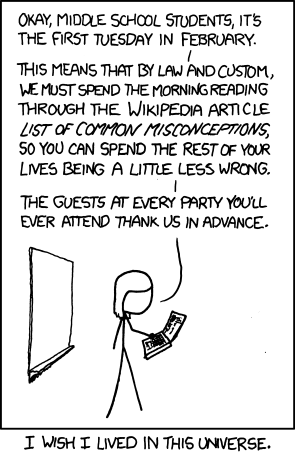
Combating misconceptions.

Educators have a slight problem when it comes to Wikipedia. On the one hand, it is a quick place to find answers to some random questions that inevitably pop up in the minds of the curious or the forgetful. (What is "zeugma"? Will that be on the test?)

A common misconception among students is that the word "research" means "spending five minutes on Google". And "writing a research paper" means paraphrasing the first five items that pop up. 

Many teachers do not allow their kids to use Wikipedia as a source for research papers, though its reference lists can be a good place to find some sources.  The idea is to force them to actually look around for information from sources that carry some academic weight.

But, perhaps there is a place in the secondary education universe for Wikipedia after all:

(http://xkcd.com/843/)