Showing posts with label G.K. Chesterton. Show all posts

Monday, July 18, 2011

Chesterton On Slapstick Comedy

"All the jokes about men sitting down on their hats are really theological jokes; they are concerned with the Dual Nature of Man. They refer to the primary paradox that man is superior to all the things around him and yet is at their mercy."

~G.K. Chesterton. "Cockneys and Their Jokes" 


Sunday, July 10, 2011

Courage and Contempt. And Chesterton

The following excerpt from The Well and the Shallows was posted today at the American Chesterton Society, and I enjoyed it so much I am shamelessly re-posting the entire thing here.
(Photo Source)
I hope it is not a secret arrogance to say that I do not think I am exceptionally arrogant; or if I were, my religion would prevent me from being proud of my pride. Nevertheless, for those of such a philosophy, there is a very terrible temptation to intellectual pride, in the welter of wordy and worthless philosophies that surround us today. Yet there are not many things that move me to anything like a personal contempt. I do not feel any contempt for an atheist, who is often a man limited and constrained by his own logic to a very sad simplification. I do not feel any contempt for a Bolshevist, who is a man driven to the same negative simplification by a revolt against very positive wrongs. But there is one type of person for whom I feel what I can only call contempt. And that is the popular propagandist of what he or she absurdly describes as Birth-Control.


I despise Birth-Control first because it is a weak and wobbly and cowardly word. It is also an entirely meaningless word; and is used so as to curry favour even with those who would at first recoil from its real meaning. The proceeding these quack doctors recommend does not control any birth. It only makes sure that there shall never be any birth to control. It cannot for instance, determine sex, or even make any selection in the style of the pseudo-science of Eugenics. Normal people can only act so as to produce birth; and these people can only act so as to prevent birth. But these people know perfectly well as I do that the very word Birth-Prevention would strike a chill into the public, the instant it was blazoned on headlines, or proclaimed on platforms, or scattered in advertisements like any other quack medicine. They dare not call it by its name, because its name is very bad advertising. Therefore they use a conventional and unmeaning word, which may make the quack medicine sound more innocuous.


Second, I despise Birth-Control because it is a weak and wobbly and cowardly thing. It is not even a step along the muddy road they call Eugenics; it is a flat refusal to take the first and most obvious step along the road of Eugenics. Once grant that their philosophy is right, and their course of action is obvious; and they dare not take it; they dare not even declare it. If there is no authority in things which Christendom has called moral, because their origins were mystical, then they are clearly free to ignore all the difference between animals and men; and treat men as we treat animals. They need not palter with the stale and timid compromise and convention called Birth-Control. Nobody applies it to the cat. The obvious course for Eugenists is to act towards babies as they act towards kittens. Let all the babies be born; and then let us drown those we do not like. I cannot see any objection to it; except the moral or mystical sort of objection that we advance against Birth-Prevention. And that would be real and even reasonable Eugenics; for we could then select the best, or at least the healthiest, and sacrifice what are called the unfit. By the weak compromise of Birth-Prevention, we are very probably sacrificing the fit and only producing the unfit. The births we prevent may be the births of the best and most beautiful children; those we allow, the weakest or worst. Indeed, it is probable; for the habit discourages the early parentage of young and vigorous people; and lets them put off the experience to later years, mostly from mercenary motives. Until I see a real pioneer and progressive leader coming out with a good, bold, scientific programme for drowning babies, I will not join the movement.


But there is a third reason for my contempt, much deeper and therefore more difficult to express; in which is rooted all my reasons for being anything I am or attempt to be; and above all, for being a Distributist. Perhaps the nearest to a description of it is to say this: that my contempt boils over into bad behaviour when I hear the common suggestion that a birth is avoided because people want to be “free” to go to the cinema or buy a gramophone or a loud-speaker. What makes me want to walk over such people like doormats is that they use the word “free.” By every act of that sort they chain themselves to the most servile and mechanical system yet tolerated by men. The cinema is a machine for unrolling certain regular patterns called pictures; expressing the most vulgar millionaires’ notion of the taste of the most vulgar millions. The gramophone is a machine for recording such tunes as certain shops and other organisations choose to sell. The wireless is better; but even that is marked by the modern mark of all three; the impotence of the receptive party. The amateur cannot challenge the actor; the householder will find it vain to go and shout into the gramophone; the mob cannot pelt the modern speaker, especially when he is a loud-speaker. It is all a central mechanism giving out to men exactly what their masters think they should have.


Now a child is the very sign and sacrament of personal freedom. He is a fresh free will added to the wills of the world; he is something that his parents have freely chosen to produce and which they freely agree to protect. They can feel that any amusement he gives (which is often considerable) really comes from him and from them and from nobody else. He has been born without the intervention of any master or lord. He is a creation and a contribution; he is their own creative contribution to creation. He is also a much more beautiful, wonderful, amusing and astonishing thing than any of the stale stories or jingling jazz tunes turned out by the machines. When men no longer feel that he is so, they have lost the appreciation of primary things, and therefore all sense of proportion about the world. People who prefer the mechanical pleasures, to such a miracle, are jaded and enslaved. They are preferring the very dregs of life to the first fountains of life. They are preferring the last, crooked, indirect, borrowed, repeated and exhausted things of our dying Capitalist civilisation, to the reality which is the only rejuvenation of all civilisation. It is they who are hugging the chains of their old slavery; it is the child who is ready for the new world.


Friday, July 8, 2011

What will Governor Moonbeam Do? (Part 2)

Governor Jerry Brown has a controversial  bill on his desk awaiting his response. SB48, according to Equality California (a group which favors this legislation) will:
... amend the Education Code to include social sciences instruction on the contributions of lesbian, gay, bisexual and transgender (LGBT) people. This bill would also prohibit discriminatory instruction and discriminatory materials from being adopted by the State Board of Education.
(The full text of the bill may be found here.)


In my previous post, I discussed the impracticality and even inhumanity of injecting identity politics into the classroom.  The California Catholic Conference voiced its opposition to the bill on those grounds last April.

But the debate over SB48, nicknamed "The Fair, Accurate, Inclusive and Respectful (FAIR) Education Act" is not simply a debate about how to encourage politeness in schoolchildren.   It's not really even about bigotry.

When schools teach about the Women's Suffrage or Civil Rights movement, they usually do so in a manner that constitutes an endorsement. In the process, students rightly learn that institutionalized sexism and racism are dehumanizing and therefore socially unacceptable.  It is wrong to discriminate against human beings because of a state of being such as skin color or gender.  Skin color does not make a person good. It does not affect the state of his or her soul. Women may in general be physically weaker than men, but that does not make us morally inferior. While there may be evidence to suggest that men have more inclinations toward violence, that does not mean human males are born into a state of moral inferiority when compared to women.

A person's moral inferiority comes from choices, not from the way the way he or she was born. A man who, for example, cheats on his wife does so not simply because he has a male inclination for unfathfulness; he does so because he chose act upon it.  The action is where the moral problem lies, not the inclination.

So what will schools be endorsing when they teach about the LGBT movement if it is given the same treatment as the Civil Rights movement?   The LGBT movement's goal is the acceptance of certain behavior, not merely the acceptance of a state of being or an inclination. If the school treats that goal as laudable, it is essentially endorsing the homosexual lifestyle as something morally acceptable. This will most certainly come into conflict with the religious and cultural values of many students in California schools.

That is what makes this issue different. It is not simply about how one is born, or whether a person has certain desires, tendencies, drives, or inclinations.  It is about how one chooses to live and act, and whether a school, as an agent of the State, has the right to tell parents and students how to define sin.


In short, the debate over SB 48 is a debate about the role of the state in defining the sexual morality of private citizens and their children.

This becomes an especially sticky issue because teachings on sexual morality are often (though not always) faith based, which means this is also a question of free exercise of religion.

Though schools are often important for the social development of children, parents are the first and most important educators, especially in matters of faith and morals, and they are right to object when a particular school or and entire school system seeks to undermine what they teach their children in good conscience. 

It gets even stickier when students become old enough to choose whether or not to believe as they were raised.  It is not unheard of for a student to be raised in one faith, but convert to another in her teens. At the secondary level, a public school has to avoid infringing upon the constitutional rights of the student as well as the parents. The state has no business telling a student that she cannot believe what her faith teaches.


Schools and their employees cannot fulfill the requirements of this bill, and remain neutral with respect to the morality of homosexual behavior. This creates serious problems for parents, teachers, and students, whose reasoned moral objections to homosexuality and the LGBT movement come in conflict with this legislation.  Whether legislators in California like it or not, individual citizens do have a right to work in an environment that does not force them to choose between their consciences and their employment or education. It is not the place of the public schools to engage in social engineering or to judge the beliefs and opinions of students, though efforts to do so are nothing new, historically speaking. It is a practice that goes as far back as the 19th century.

As I pointed out in my last post, the state is much more likely to reach its stated goal of reducing bullying if it sticks to the more neutral path of instructing students in the very useful principle of respect for one's fellow human beings.  It is actually possible to teach kids to be polite to others, even in the face of serious disagreement or even fear, without injecting oneself into the religious instruction the student receives from his or her family.

Specific moral instruction is best left in the purview of parents, but there are many in education and in politics who believe they and the schools have a duty to subvert parental teachings with which they do not agree, especially if those parents embrace traditional Judeo-Christian morality.  In my own experiences at multiple public schools, I observed that this prejudice is so pervasive within the world of public education, that many of my colleagues were not even conscious of how it affected their attitudes toward parents and even toward their own students.

Contrary to what some among my former colleagues believe, it is possible to have strenuous moral objections to someone else's choices, actions, or lifestyle, without losing sight of that person's humanity.  With effort, one can even express such disagreements politely. It is even possible for young people to manage this with proper instruction.   But the purveyors of "tolerance" seem as unable to tolerate this concept as to tolerate the suggestion that there is even such a thing as objective morality.

Tolerating the idea of objective morality means living with the possibility of falling from grace, and this is not terribly compatible with modern thinking.

In fact, our fallen nature is really our most ancient and universally recognized trait.  From Shakespeare's plays to Lord of the Rings, fall and redemption make up the thematic material of some of the greatest literature ever written.  Even the Ancient Greeks had their own story of  a "fall" in the form of Pandora and the infamous box of furies. As G.K. Chesterton noted, it wasn't until recently that people began to suggest that there is no such thing as sin:

Whether or no man could be washed in miraculous waters, there was no doubt at any rate that he wanted washing. But certain religious leaders in London, not mere materialists, have begun in our day not to deny the highly disputable water, but to deny the indisputable dirt. Certain new theologians dispute original sin, which is the only part of Christian theology which can really be proved. Some followers of the Reverend R. J. Campbell, in their almost too fastidious spirituality, admit divine sinlessness, which they cannot see even in their dreams. But they essentially deny human sin, which they can see in the street. The strongest saints and the strongest sceptics alike took positive evil as the starting-point of their argument. If it be true (as it certainly is) that a man can feel exquisite happiness in skinning a cat, then the religious philosopher can only draw one of two deductions. He must either deny the existence of God, as all atheists do; or he must deny the present union between God and man, as all Christians do. The new theologians seem to think it a highly rationalistic solution to deny the cat. (Orthodoxy)
 
I suspect that this bill is less about bullying, and more a part of an effort to teach the next generations to deny both dirt and cat.


-----------------------------------------------------------------
Update: Read about what Archbishop Gomez has to say on this topic.

Thursday, July 7, 2011

What Will Governor Moonbeam Do?

Identity politics took a central place in the political discourse of our nation during the last presidential election.  It seemed to me that this did more to reinforce racial division in the country than it did to heal it. I suspect it may have even served to undo some of the progress that has been made over the past couple of decades. One of my eleventh graders that year said to me one day that she never felt divided from anyone because of race, until she witnessed the national tension during that campaign season. She discovered unity is more difficult  when people are determined to carry out the dehumanizing practice of sorting themselves and others into competing victim groups.

This brings me to the issue of identity politics, and its influence on education as we know it.

As many of you are no doubt already aware, a piece of legislation is about to hit the governor's desk in California that, as the San Francisco Gate puts it, "would make the state the first requiring public schools to include the contributions of gays and lesbians in social studies curriculum".  It further explains that the bill "adds lesbian, gay, bisexual and transgender people as well as people with disabilities to the list of groups that schools must include in the lessons. It also would prohibit material that reflects adversely on gays."


So, if Jerry Brown signs SB48, the good news is English teachers will have to stop ignoring Walt Whitman and Oscar Wilde.

Wait a minute...  They are already in the curriculum!


And if since the bill also covers historical figures with disabilities, history teachers will have to stop leaving out FDR.


Wait...    Never mind. He's already there too.

We remember writers, mathematicians, scientists, and historical figures, not because they are token figures of a certain group, but because of their influence for good or ill.  We read Mary Shelley's Frankenstein because it is a great novel, not merely because a woman wrote it.  We study FDR's presidency because it was unique and historically important, not simply because he was in a wheelchair.  While someone's ethnicity, disability, or gender will contribute to who she is, it is not her only definitive characteristic. Even for historical figures whose identity is very important, such as Frederick Douglass or Martin Luther King, great accomplishment and historical influence are still the primary reasons why we remember them.


Many suggest that the debate over homosexuality in America is no different from the questions of race that our nation faced over the past century. Even if, for the sake of argument, we concede this point, this legislation still remains impractical in light of certain realities in the classroom.

Nobody who has ever spent significant time in a school can deny that kids are pretty good at dividing themselves along arbitrary lines, whether it be race, class, fashion, glasses, or grades.  I have seen students treat one another better after meaningful personal interaction.  I have never seen a student decide that he is going to quit making fun of someone because a great author or historical figure had the same trait as the "other".  A student who bullies his classmate because said classmate is "a brain", for instance, isn't going to change his behavior because Einstein was "a brain" too. In fact, he is more likely to write off Einstein as well as his classmate, and go on his merry, anti-brain way.  I have never seen  a token minority author or historical figure serve to eliminate racism, nor a lesson on a token woman cure anyone of misogyny.

As someone whose curriculum consisted mostly of old books written by people who are now dead, I found the question of prejudice to be a very relevant one for my classroom.   If students cannot see the human dignity of those living human beings sitting next to them in class, they aren't going to be able to see it in fictional characters created by long-deceased authors. After all, can there be a greater divide between people than between the living and the dead?  Students must learn to see the inherent human dignity of those around them before they will be able to see it in people and characters from the past. Mark Twain showed us this more than a century ago: it is the lesson that we learn from reading Huckleberry Finn.  It is the time they spend on the river together that allows Huck to see Jim as a man and a friend, and not merely as a slave.

Tolerance is not a false pretense that people have no significantly different beliefs, backgrounds, and ideas.  It is not a hypocritical assertion that we are all the same.  It is a learned skill. It is, essentially, a form of patience that allows us to live and work with people whom we do not entirely understand, or with whom we fundamentally disagree, without losing our sanity or our awareness of each others humanity.


A curriculum that emphasizes differences and token representatives of politically fashionable classes of human beings does more to undermine a culture of acceptance in schools  than it does to create one. Students need no reminders that there are stark differences among them. Drawing attention to labels provides those unneeded reminders, and reinforces the false and dehumanizing notion that students cannot relate to anyone who does not have some arbitrary identifying characteristic in common.

The bill is also intended to add the history of the LGBT movement, but prohibits any material that could reflect poorly upon it.  This bears more resemblance to propaganda than it does to an honest approach to history. If similar legal injunctions existed with respect to study of the movement for racial equality, many activities of groups such as the Black Panthers and the more controversial comments of Louis Farrakhan would be forbidden material.  The fact that some people working for racial equality behaved badly has not undone the appreciation most people currently have for the progress our nation has made in race relations over the past five decades.  Human history, like the human beings in it, is full of behavior that "reflects badly" on someone. We can learn as much from those as we can from the moments when heroic people did something gloriously right.

In charity, I can only hope that those who are promoting this bill are unaware of the practical problems outlined above.

If they are aware of them, one needs to ask why they think a curricular emphasis on the LGBT movement will will change the value students place on their classmates or on Walt Whitman's literary achievements.  I shall deal with that question later.

Tuesday, June 14, 2011

Surviving the Economy and Avoiding the Servile State

It seems like everyone is talking about the economy and what ails it. Some blame big government and socialist thinking and policies. Others blame capitalism, republicans, and big business. They are both right. They are also both wrong.

Neither big government nor big business have the needs of human beings as their central concern.  Big business is too busy with its profits,  big government is too busy holding onto its power, and very often they are both too busy cooperating with each other to reach their respective goals to have any time left to take human dignity into account.  When Hilaire Belloc published The Servile State, he was concerned that trends at the time would lead to "the establishment of compulsory labour legally enforceable upon those who do not own the means of production for the advantage of those who do". Were he alive today, I think he would still be worried.

At the time, Belloc was more alarmed about big business running amok, but he also pointed out that an out of control government would ultimately lead to the same end: a society in which a few have total legal and economic power over the many (see the illustration below for a visual representation of this concept).  Considering the size of the government at present, as well as the current state of big business, we may have even more reason for concern than did Belloc and his contemporaries.


Belloc argued that the best way to halt our advancement toward the "servile state" was to encourage policies that favor keeping both government and business small, and ownership of the means of production (i.e. land, tools, equipment, skills, etc.) as widespread as possible.   The ideal economy, he believed, would be one consisting primarily of small, independent, family owned businesses. He reasoned that this would lead to a more human (and humane) workplace as well as a more just society. This economic ideal, which is neither capitalist nor socialist, is commonly called Distributism.

Over at The Huffington Post, Thom Hartmann is trying to make sense of the present economy.  He is right that, historically speaking, "There's Nothing "Normal" About A Middle Class".  His observation that social upheaval precedes two historical surges in the middle class population is also worth considering. But there are two flaws in his approach as he tries to figure out why a middle class is able to sustain itself in certain periods of history and not in others.

The first problem is that he fails to take into account the existence of widespread ownership of the means of production during the historical periods he cites. Without this, the middle class could not have grown as it did.

Hartmann points to the depopulation of the European continent during the plague, and the colonization of the Americas as points in history that allowed a middle class to form. These instances of social upheaval lead to movement away from a servile society to a more democratic one. Hartmann attributes this movement to the changed ratio of people to resources, but there is more to it than that.  This social upheaval led to the absence of landowning nobility, allowing the common man to take ownership of the resources around him.

Whether plague survivors or colonists, people in both periods of history Hartmann cites would have found themselves in a position much more favorable to ownership and self-sufficiency because they would have been able to control the land on which they lived and worked.  Stake out a plot of land, plant a few crops, teach your kids how to farm, and you have a family business. Or, at least, you have the means to feed yourself even if you can't make money selling what you grow.

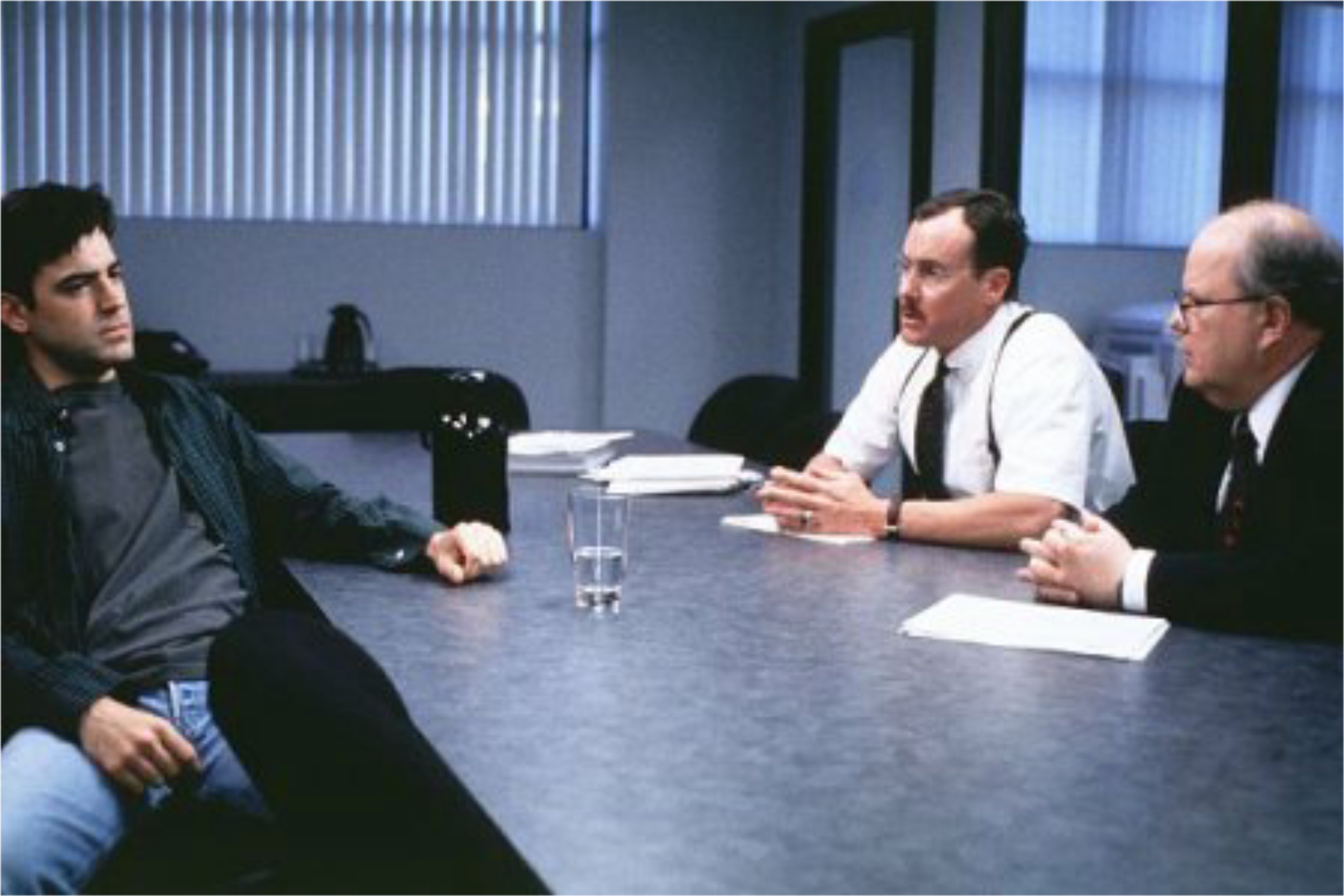
Like commoners living in a feudal society, corporate and government employees of today spend their labors working with resources that are not their own.  What does this mean for employees? I offer the following dialogue from "Office Space" as an answer to that:


Peter Gibbons: The thing is, Bob, it's not that I'm lazy, it's that I just don't care.
Bob Porter: Don't... don't care?
Peter Gibbons: It's a problem of motivation, all right? Now if I work my a** off and Initech ships a few extra units, I don't see another dime, so where's the motivation? And here's something else, Bob: I have eight different bosses right now.
Bob Slydell: I beg your pardon?
Peter Gibbons: Eight bosses.
Bob Slydell: Eight?
Peter Gibbons: Eight, Bob. So that means that when I make a mistake, I have eight different people coming by to tell me about it. That's my only real motivation is not to be hassled, that and the fear of losing my job. But you know, Bob, that will only make someone work just hard enough not to get fired.

In other words, employment is not the problem for the middle class. Nor is unemployment.  The problem is dependence, either on government or employers.


This leads to Hartmann's second problem: he ignores what the "middle class" was, and does not think carefully enough about what it is now.

In the past, the middle classes were those who were able to make a living for themselves without being born into the wealthy upper classes. Socially, they were commoners. Economically they were not, because they owned the fruits of their labors. That left them somewhere in between the two.

In present political discourse we are generally inclined to define the middle class as those who have an income that is--well--in the middle.  We do not often consider how many of those people do not depend on either government or corporate employment for their "middle class" status. Hartmann compares the merchant classes of the middle ages to present-day middle class citizens. Many merchants of that period (such as the father of St. Francis of Assisi) certainly made a tidy income. But they did so as owners of their own small businesses.  Small farmers would have been able to feed themselves without depending on corporate food distributors to provide groceries. They would have earned money selling their goods to the local community without having to contract with a large corporation in order to survive.  Farmers and merchants in pre-industrialized society were not at the mercy of an indifferent bureaucracy to "create jobs". They created their own.

G.K. Chesterton wrote "Too much capitalism does not mean too many capitalists, but too few." The social gap that ought to concern us today is not merely between rich and poor. It is between employers and employees. There are far too few of the former.

Unfortunately, we have a long way to go before we can change the structure of our economy.  Our culture and our education system still train us and our children to become employees rather than entrepreneurs or independent thinkers. Our political system thrives on the votes our politicians buy from us using our own tax dollars.
 
The solution to our present economic problem is not "investment in infrastructure" through another "New Deal".  This merely makes the government another big employer.  Nor is the solution to  give existing big employers more latitude to do whatever they want regardless of the human cost.   Common sense and a renewal of an independent human spirit is the answer.

I only hope that it won't take another bubonic plague to make us regain ours. 


--------------------------------------------------------------------------------------
Further Reading:

Pope Leo XIII, Rerum Novarum
Hilaire Belloc, The Servile State
G.K. Chesterton, Orthodoxy
G.K. Chesterton, What’s Wrong with the World

Sunday, May 15, 2011

What Draws the Young to Old Things?

Vintage is in.

Perhaps it would be more accurate to say that it never went out.

Many people under 35 are currently fascinated with everything from the vintage to the ancient. Why?  Aren't young people supposed to be wholly preoccupied with the latest and greatest?

This is not just true for thrift store shoppers and fashion bloggers. Within the Catholic Church there are many young people gravitating toward traditional liturgy and practices that, to some of our elders of the baby-boomer generation, seem a little antiquated and possibly somewhat baffling. Most of the women I see in veils at mass each week appear to be under 35.  The religious orders that are getting high numbers of vocations from the young are those with the most traditional attitudes. 

Oddly enough, we can turn to an antique book for an explanation of this youthful preference for tradition. As usual, G.K. Chesterton can shed some light on the matter in a single paragraph:
"To each man one soul only is given; to each soul only is given a little power--the power at some moments to outgrow and swallow up the stars. If age after age that power comes upon men, whatever gives it to them is great. Whatever makes men feel old is mean--an empire or a skin-flint shop. Whatever makes men feel young is great--a great war or a love-story. And in the darkest of the books of God there is written a truth that is also a riddle. It is of the new things that men tire--of fashions and proposals and improvements and change. It is the old things that startle and intoxicate. It is the old things that are young. There is no sceptic who does not feel that many have doubted before. There is no rich and fickle man who does not feel that all his novelties are ancient. There is no worshipper of change who does not feel upon his neck the vast weight of the weariness of the universe. But we who do the old things are fed by nature with a perpetual infancy. No man who is in love thinks that any one has been in love before. No woman who has a child thinks that there have been such things as children. No people that fight for their own city are haunted with the burden of the broken empires. Yes, O dark voice, the world is always the same, for it is always unexpected." (The Napoleon of Notting Hill, 1904)

St. Peter's Basilica, Rome.

Sunday, May 8, 2011

On Sin and the Opression of Women

John Paul II wrote the following in his encyclical Mulieris Dignitatem (On the Dignity of Women):

Jesus enters into the concrete and historical situation of women, a situation which is weighed down by the inheritance of sin. One of the ways in which this inheritance is expressed is habitual discrimination against women in favour of men. This inheritance is rooted within women too. From this point of view the episode of the woman "caught in adultery" (cf. Jn 8:3-11) is particularly eloquent. In the end Jesus says to her: "Do not sin again", but first he evokes an awareness of sin in the men who accuse her in order to stone her, thereby revealing his profound capacity to see human consciences and actions in their true light. Jesus seems to say to the accusers: Is not this woman, for all her sin, above all a confirmation of your own transgressions, of your "male" injustice, your misdeeds?

This truth is valid for the whole human race. The episode recorded in the Gospel of John is repeated in countless similar situations in every period of history. A woman is left alone, exposed to public opinion with "her sin", while behind "her" sin there lurks a man - a sinner, guilty "of the other's sin", indeed equally responsible for it. And yet his sin escapes notice, it is passed over in silence: he does not appear to be responsible for "the others's sin"! Sometimes, forgetting his own sin, he even makes himself the accuser, as in the case described. How often, in a similar way, the woman pays for her own sin (maybe it is she, in some cases, who is guilty of the "others's sin" - the sin of the man), but she alone pays and she pays all alone! How often is she abandoned with her pregnancy, when the man, the child's father, is unwilling to accept responsibility for it? And besides the many "unwed mothers" in our society, we also must consider all those who, as a result of various pressures, even on the part of the guilty man, very often "get rid of" the child before it is born. "They get rid of it": but at what price? Public opinion today tries in various ways to "abolish" the evil of this sin. Normally a woman's conscience does not let her forget that she has taken the life of her own child, for she cannot destroy that readiness to accept life which marks her "ethos" from the "beginning".

Early feminists such as Mary Wollstonecraft called for a higher moral standard for men, knowing that to do so would not only improve life for women, but also elevate the entire human race.  They too opposed the contraceptive mentality that made women the playthings of immoral men, and the pattern of exploitation and abandonment that left women bearing the weight not only of their own sins, but those of men who used them.  They believed rightly that this pattern must be broken.   Here, Bl. Pope John Paul II offers us the same challenge, this time woven into the great tapestry of Biblical theology.

It is worthwhile to note his explicit linking of the fallenness of humanity with the phenomenon of gender-based oppression. This is a connection largely missed by the more recent incarnations of the feminist movement, which have instead suggested that women must be just like men (including adopting their supposedly congenital sexual depravity) in order to be "equal".  In short, they have themselves bought into a lie that has its roots in our very fallenness as human beings: a lie invented by men (or passed to them by the Father of Lies) in order to "keep women in their place".

What is this lie?  That anything uniquely female is also inherently inferior, and that only male behavior and male-defined success, and male power is real and legitimate.


G.K. Chesterton addressed that lie in What's Wrong with the World:
The shortest way of summarizing the position is to say that woman stands for the idea of Sanity; that intellectual home to which the mind must return after every excursion on extravagance. The mind that finds its way to wild places is the poet's; but the mind that never finds its way back is the lunatic's. There must in every machine be a part that moves and a part that stands still; there must be in everything that changes a part that is unchangeable. And many of the phenomena which moderns hastily condemn are really parts of this position of the woman as the center and pillar of health. Much of what is called her subservience, and even her pliability, is merely the subservience and pliability of a universal remedy; she varies as medicines vary, with the disease. She has to be an optimist to the morbid husband, a salutary pessimist to the happy-go-lucky husband. She has to prevent the Quixote from being put upon, and the bully from putting upon others. ...

...


The final fact which fixes this is a sufficiently plain one. Supposing it to be conceded that humanity has acted at least not unnaturally in dividing itself into two halves, respectively typifying the ideals of special talent and of general sanity (since they are genuinely difficult to combine completely in one mind), it is not difficult to see why the line of cleavage has followed the line of sex, or why the female became the emblem of the universal and the male of the special and superior. Two gigantic facts of nature fixed it thus: first, that the woman who frequently fulfilled her functions literally could not be specially prominent in experiment and adventure; and second, that the same natural operation surrounded her with very young children, who require to be taught not so much anything as everything. Babies need not to be taught a trade, but to be introduced to a world. To put the matter shortly, woman is generally shut up in a house with a human being at the time when he asks all the questions that there are, and some that there aren't. It would be odd if she retained any of the narrowness of a specialist. Now if anyone says that this duty of general enlightenment (even when freed from modern rules and hours, and exercised more spontaneously by a more protected person) is in itself too exacting and oppressive, I can understand the view. I can only answer that our race has thought it worth while to cast this burden on women in order to keep common-sense in the world. But when people begin to talk about this domestic duty as not merely difficult but trivial and dreary, I simply give up the question. For I cannot with the utmost energy of imagination conceive what they mean. When domesticity, for instance, is called drudgery, all the difficulty arises from a double meaning in the word. If drudgery only means dreadfully hard work, I admit the woman drudges in the home, as a man might drudge at the Cathedral of Amiens or drudge behind a gun at Trafalgar. But if it means that the hard work is more heavy because it is trifling, colorless and of small import to the soul, then as I say, I give it up; I do not know what the words mean. To be Queen Elizabeth within a definite area, deciding sales, banquets, labors and holidays; to be Whiteley within a certain area, providing toys, boots, sheets, cakes and books, to be Aristotle within a certain area, teaching morals, manners, theology, and hygiene; I can understand how this might exhaust the mind, but I cannot imagine how it could narrow it. How can it be a large career to tell other people's children about the Rule of Three, and a small career to tell one's own children about the universe? How can it be broad to be the same thing to everyone, and narrow to be everything to someone? No; a woman's function is laborious, but because it is gigantic, not because it is minute. I will pity Mrs. Jones for the hugeness of her task; I will never pity her for its smallness.

Chesterton recognized the vast and profound importance of women, especially in their role as mothers.  He does not, as many people suppose Christian men do, view us as mere incubators, as playthings, or as servants.  We are the center of the most important place in the world: the home, the fundamental unit of society, and as such may be said to be, in a sense, the center of the human universe!  One may contribute to society in the workplace, but one creates society in the home.

Instead of using gender differences as a bludgeon to keep women down,  as an excuse to deprive one half of the population of education and social power, Catholic teaching and common sense challenge us to elevate women without diminishing our uniqueness, leaving us free to influence the world around us as God meant us to do.   As a culture we must "keep women in their place", not as slaves to men, but as partners.


------------------------------------------------

Related reading:
Psychology Today: Why Do So Many Women Experience The "Impostor Syndrome"?

Saturday, April 30, 2011

Common Sense Thought for the Day

“As an apologist I am the reverse of apologetic. So far as a man may be proud of a religion rooted in humility, I am very proud of my religion; I am especially proud of those parts of it that are most commonly called superstition. I am proud of being fettered by antiquated dogmas and enslaved by dead creeds. (as my journalistic friends repeat with so much tenacity), for I know very well that it is the heretical creeds that are dead, and that it is only the reasonable dogma that lives long enough to be called antiquated.”

-G.K. Chesterton

Wednesday, April 27, 2011

G.K. Chesterton on "The Superstiton of School"

"The snag in it is this: that the self-educated think far too much of education. I might add that the half-educated always think everything of education. That is not a fact that appears on the surface of the social plan or ideal; it is the sort of thing that can only be discovered by experience. When I said that I wanted the popular feeling to find political expression, I meant the actual and autochthonous popular feeling as it can be found in third-class carriages and bean-feasts and bank-holiday crowds; and especially, of course (for the earnest social seeker after truth), in public-houses. I thought, and I still think, that these people are right on a vast number of things on which the fashionable leaders are wrong. The snag is that when one of these people begins to "improve himself" it is exactly at that moment that I begin to doubt whether it is an improvement. He seems to me to collect with remarkable rapidity a number of superstitions, of which the most blind and benighted is what may be called the Superstition of School. He regards School, not as a normal social institution to be fitted in to other social institutions, like Home and Church and State; but as some sort of entirely supernormal and miraculous moral factory, in which perfect men and women are made by magic. To this idolatry of School he is ready to sacrifice Home and History and Humanity, with all its instincts and possibilities, at a moment's notice. To this idol he will make any sacrifice, especially human sacrifice. And at the back of the mind, especially of the best men of this sort, there is almost always one of two variants of the same concentrated conception: either "If I had not been to School I should not be the great man I am now", or else "If I had been to school I should be even greater than I am". Let none say that I am scoffing at uneducated people; it is not their uneducation but their education that I scoff at. Let none mistake this for a sneer at the half-educated; what I dislike is the educated half. But I dislike it, not because I dislike education, but because, given the modern philosophy or absence of philosophy, education is turned against itself, destroying that very sense of variety and proportion which it is the object of education to give. No man who worships education has got the best out of education; no man who sacrifices everything to education is even educated. ... What is wrong is a neglect of principle; and the principle is that without a gentle contempt for education, no gentleman's education is complete."

Read the entire essay here.

Monday, November 1, 2010

Priorities

"How can it be a large career to tell other people’s children about the Rule of Three, and a small career to tell one’s own children about the universe? How can it be broad to be the same thing to everyone, and narrow to be everything to someone?"

--G.K. Chesterton, The Emancipation of Domesticity


Tip of the Schoolmarm Ruler to Emily Lunsford of the Distributist Review.

Tuesday, June 10, 2008

Language Crimes and Murder by Boredom.

I loved watching the Prime Minister's questions when Tony Blair was in office, sheerly for the fun of watching the lively verbal thrashings British statesmen give each other. It was so interesting to see them have actual conversations that required wit, as well as familiarity with what (appeared to one not intimately familiar with British politics) to be halfway decent evidence for their arguments.

Flash over to the United States. Turn on C-span. Watch live coverage of the US House of Representatives. You'll be asleep in ten minutes after you hear the same speeches and buzzwords hypnotically repeated over and over and over and over and over...

And then there is the issue of public speaking skills.

From presidents who smoked but didn't inhale and was uncertain as to what the definition of "is" is, to the current president who, in spite of his better qualities, cannot seem to get the hang of "nuclear", we seem to have a plague of poor speaking. As if to put a the proverbial cherry on top, a certain Mr. Kucinich suggested that he had once seen a UFO.

Our two front running presidential candidates do not appear to have any intention of improving this problem.

One cannot seem to hide when he is reading from a teleprompter, thereby making an otherwise well-structured speech sound robotic. And then he accidentally said he would ban beer.

The other, however brilliant he may sound with a written speech, cannot seem to put two sentences of sense together without a script. Senator Obama did, on the occasion of his Memorial Day address say that he saw our country's "fallen heroes" in the audience. Who knew our messianic candidate was also connected to the "other side"? Then there was this instance in which he lamented the inability of children with asthma to access their "breathalyzers" (oops, make that "inhalators") .To make matters worse, his speechwriter often produces work that, while grammatical, sounds more like something my students would write than something crafted by a highly educated person with vast political experience.

Oh, yes, and if I continue to hear the words "hope" and "change" recycled more often than post-consumer paper products, I cannot be held responsible for what I may do to my television.

Yes, yes policy is more important than posturing. Substance is more important than speechmaking.

Instead of a candidate who says something badly and another who says nothing very well, I would prefer someone with both substance and wit. Perhaps a person with the common sense of G.K. Chesterton, the gentle charisma of Pope John Paul II and the wit of Tony Blair.

Or the wit of Jane Austen even. :)

Thursday, February 21, 2008

A little Chesterton

There are two rooted spiritual realities out of which grow all kinds of democratic conception or sentiment of human equality. There are two things in which all men are manifestly and unmistakably equal. They are not equally clever or equally muscular or equally fat, as the sages of the modern reaction (with piercing insight) perceive. But this is a spiritual certainty, that all men are tragic. And this, again, is an equally sublime spiritual certainty, that all men are comic. No special and private sorrow can be so dreadful as the fact of having to die. And no freak or deformity can be so funny as the mere fact of having two legs. Every man is important if he loses his life; and every man is funny if he loses his hat, and has to run after it. And the universal test everywhere of whether a thing is popular, of the people, is whether it employs vigorously these extremes of the tragic and the comic.

-- G. K. Chesterton, Charles Dickens

Nod: PhatCatholic

Tuesday, January 22, 2008

35 years

I sat down at my computer a few minutes ago to write a brilliant post on the 35th Anniversary of Roe v. Wade. 35 is a round number, it seems like it demands something special.

But as I sit here wondering what to say, thinking about the great weight of those 35 years, I find myself just feeling tired. Maybe those nice round numbers are heavier than others.

But I will share this: I was reminded today of the beautiful job F. Scott Fitzgerald did when he wrote The Great Gatsby. He lived at a time when modern culture as we know it was just beginning to emerge, and carelessness, consumerism, and corruption were tarnishing the American Dream. Two of his characters are charming yet vapid, prejudiced, selfish people who wouldn't know the dignity of others if it walked up and slapped them in the face, or surprised them with a sincere gesture of affection. They break people the way spoiled children break toys, and after a brief moment of shock at the consequences, they move on to the next bigger, better human toy without so much as a backward glance, and it is the powerless who pay the greatest price.

Gatsby is a warning. Materialistic hedonism destroys, and in the Great Gatsby, it destroys human life.

G.K. Chesterton saw this coming too, before Fitzgerald even published Gatsby. Dale Ahlquist very eloquently explains:

Eugenics and abortion is about the tyranny of the elite deciding who shall live and who shall die. And if it's about the elite, it's about money. It was the Rockefellers and the Carnegies and other capitalist lords who funded eugenics research in the early 20th century. They went on to be major supporters of Planned Parenthood. Chesterton says that wealth, and the social science supported by wealth tries inhuman experiments, and when they fail, they try even more inhuman experiments. They are inhuman because they are godless. But they are godless because they don't want to face how inhuman they are. The wealthy industrialist became agnostic, says Chesterton, "not so much because he did not know where he was, as because he wanted to forget. Many of the rich took to scepticism exactly as the poor took to drink; because it was a way out."


Chesterton foresaw that society would begin to view human beings as commodities. That school children would eventually be seen as industrial tools to be churned out by public institutions, rather than thinking individuals; that the poor and the weak and the elderly would be seen as unsightly burdens, to be abandoned and left to the care of government bureaucracies; that women, facing untimely pregnancies would be bombarded with messages telling them that their usefulness to themselves and society (or their unborn child's usefulness) will be reduced to nothing if they embrace motherhood and give birth.

I am the child of a "crisis" pregnancy, born after the Roe decision, in a state where abortion was already legal before the infamous Supreme Court case made its mark on American history. In the time since Roe, over 48 million human beings, many of whom might have been my friends, have lost their lives. It is true that we in the post-Roe generation have not lived in a world without legalized abortion, and we do not remember what a world without it would be like. But we do know that in an age of legalized abortion, we are lucky to be alive at all.

I cannot embrace the hopeless and selfish utilitarian attitude of the age in which I live, and the society that tried to convince my mother it would have been okay to kill me in the womb. I and the many young people who have been and will be marching for life this week every year will not give in to "the tyranny of the elite deciding who shall live and who shall die". We want to say to our children, "See? We have given you a world that will protect your very life--your entire life, more than it protected ours."

Related:
Pro-life feminist Serrin Foster on the betrayal of women by the "pro-choice" cause.
Dale Ahlquist's lecture one Chesterton's "Eugenics and other Evils"

Wednesday, December 26, 2007

More Chesterton on Christmas

"There is no more dangerous or disgusting habit than that of celebrating Christmas before it comes, as I am doing in this article. It is the very essence of a festival that it breaks upon one brilliantly and abruptly, that at one moment the great day is not and the next moment the great day is. ..."

Read the rest here: http://catholic-forum.com/saints/gkc16035.htm


Via Tito.

Tuesday, December 25, 2007

Merry Christmas!

In the round of our rational and mournful year one festival remains out of all those ancient gaieties that once covered the whole earth. Christmas remains to remind us of those ages, whether Pagan or Christian, when the many acted poetry instead of the few writing it. In all the winter in our woods there is no tree in glow but the holly.

--G.K. Chesterton

Tuesday, November 6, 2007

The verbal irony of "progressive" thinking, part 2

(Click here for Part 1)

Many in my generation, and the current one now breathlessly awaiting its own entry into the "real world" were left to start from scratch as they discover the world for themselves. Some were left there by those who told them they did not need to listen to authority, and never heard anyone say otherwise. Many others listened to that message and clung to it for their own convenience. These found themselves stranded by their own refusal to listen to wisdom when it was offered.

In both cases, they are now moving in any random direction, often anywhere but forward.

It is forward one must go in order to be "progressive" by definition, as Chesterton explains.

"Progress, properly understood, has, indeed, a most dignified and legitimate meaning. But as used in opposition to precise moral ideals, it is ludicrous. So far from it being the truth that the ideal of progress is to be set against that of ethical or religious finality, the reverse is the truth. Nobody has any business to use the word "progress" unless he has a definite creed and a cast-iron code of morals. Nobody can be progressive without being doctrinal; I might almost say that nobody can be progressive without being infallible--at any rate, without believing in some infallibility."

Here is where many modern progressives run into a snag. Their fear of all authority, whether it be their own in their homes and classrooms, or someone else's in the workplace or the government, makes them balk at the notion that anybody else can advise them, much less authoritatively direct them, in any matter--especially in matters of faith.

No journey is going to lead anyplace if one refuses to decide where to start.

Fortunately, not all who wander stay lost. Some eventually find common sense (or have it knocked into them as St. Paul did). Some even find Chesterton. Ultimately, they begin to find Truth.

And that is when they find God.


--------------------------------
Related posts by Alan at Ad Altare Dei:
Independent "free" thought can never be progressive.
Is Dogma so Constraining?
Dogma is a Progressive Good!


Monday, November 5, 2007

The verbal irony of "progressive" thinking, part 1

How many times have we said to our parents that they should leave us alone and let us learn from our own mistakes?

Not an easy thing for a parent to do, especially one who has had enough life experience to know that there simply isn't time to make and learn from all of the available mistakes on one's own.

Part of learning to think for oneself is learning that the perspectives, experiences and advice of others are worth considering, especially when it is offered with our own well being in mind. If we can learn from the errors and successes of those who have come before us, this frees us up to do things right the first time.

G.K. Chesterton wrote the following on this issue in 1909:

The modern man says, "Let us leave all these arbitrary standards and embrace liberty." This is, logically rendered, "Let us not decide what is good, but let it be considered good not to decide it." He says, "Away with your old moral formulae; I am for progress."This, logically stated, means, "Let us not settle what is good; but let us settle whether we are getting more of it." He says, "Neither in religion nor morality, my friend, lie the hopes of the race, but in education." This, clearly expressed, means, "We cannot decide what is good, but let us give it to our children.

The case of the general talk of "progress" is, indeed, an extreme one. ... We meet every ideal of religion, patriotism, beauty, or brute pleasure with the alternative ideal of progress--that is to say, we meet every proposal of getting something that we know about, with an alternative proposal of getting a great deal more of nobody
knows what."


Decades after Chesterton published the above words, Baby Boomers were teaching my generation to "question everything". This made things very difficult for those parents who actually tried to provide answers to many of those questions--it made it a lot easier for us children not to listen.

By the time we reached our legal adutlhood, the 'question everything" mentality left most of us in two categories: those who questioned everything with the intent (and eventually the result) of settling on answers, and those who found themselves in a state of aimless wandering--with lots of questions, little curiosity (or at least little of the necessary patience for satisfying it)and no answers to use as a foothold for their lives.


Within the Church, those in the former category often confound their elders by becoming interested in things that used to be part of the "establishment"--traditional liturgy, for one; traditional Catholic morality for another. The tables have turned. "Question Everything" is now the establishment--the standard set out by a slowly (and reluctantly) aging preceding generation. We hear it from parents, teachers, and even the occasional authority figure within our parishes.

Those in the latter, wandering category are...well... all over the place. Many no longer even in the Church, often carrying the spiritual baggage of those who came just before us.

Sunday, November 4, 2007

Saturday, November 3, 2007

Taking refuge in common sense.

Today, I found this little passage from Chesterton highly relevant:

It is commonly the loose and latitudinarian Christians who pay quite indefensible compliments to Christianity. They talk as if there had never been any piety or pity until Christianity came, a point on which any mediaeval would have been eager to correct them. ... Christianity was the answer to a riddle, not the last truism uttered after a long talk. Only the other day I saw in an excellent weekly paper of Puritan tone this remark, that Christianity when stripped of its armour of dogma (as who should speak of a man stripped of his armour of bones), turned out to be nothing but the Quaker doctrine of the Inner Light. Now, if I were to say that Christianity came into the world specially to destroy the doctrine of the Inner Light, that would be an exaggeration. But it would be very much nearer to the truth.

... That Jones shall worship the god within him turns out ultimately to mean that Jones shall worship Jones. Let Jones worship the sun or moon, anything rather than the Inner Light; let Jones worship cats or crocodiles, if he can find any in his street, but not the god within. Christianity came into the world firstly in order to assert with violence that a man had not only to look inwards, but to look outwards, to behold with astonishment and enthusiasm a divine company and a divine captain. The only fun of being a Christian was that a man was not left alone with the Inner Light, but definitely recognized an outer light, fair as the sun, clear as the moon, terrible as an army with banners.

All the same, it will be as well if Jones does not worship the sun and moon. If he does, there is a tendency for him to imitate them; to say, that because the sun burns insects alive, he may burn insects alive. He thinks that because the sun gives people sun-stroke, he may give his neighbour measles. He thinks that because the moon is said to drive men mad, he may drive his wife mad. ... Nature worship is natural enough while the society is young, or, in other words, Pantheism is all right as long as it is the worship of Pan. But Nature has another side which experience and sin are not slow in finding out, and it is no flippancy to say of the god Pan that he soon showed the cloven hoof. The only objection to Natural Religionis that somehow it always becomes unnatural. A man loves Nature in the morning for her innocence and amiability, and at nightfall, if he is loving her still, it is for her darkness and her cruelty. He washes at dawn in clear water as did the Wise Man of the Stoics, yet, somehow at the dark end of the day, he is bathing in hot bull's blood, as did Julian the Apostate. The mere pursuit of health always leads to something unhealthy. Physical nature must not be made the direct object of obedience; it must be enjoyed, not worshipped. Stars and mountains must not be taken seriously. If they are, we end where the pagan nature worship ended. Because the earth is kind,we can imitate all her cruelties. Because sexuality is sane, we can all go mad about sexuality. Mere optimism had reached its insane and appropriate termination. The theory that everything was good had become an orgy of everything that was bad.


--G.K. Chesterton, Orthodoxy

Thursday, October 25, 2007

More fun with Chesterton:

"I have always imagined myself to be a lover of all animals, because I have never met any animal that I definitely disliked. Most people draw the line somewhere. Lord Roberts disliked cats; the best woman I know objects to spiders; a Theosophist I know protects, but detests, mice; and many leading humanitarians have an objection to human beings."

--G.K. Chesterton, Dogs