Showing posts with label Popular Culture. Show all posts

Friday, August 12, 2011

Gladiators Clash at the Colosseum

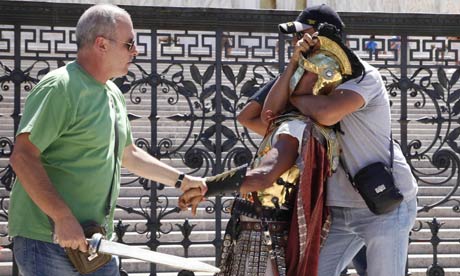
The MSNBC reports that violent turf wars have begun between groups of gladiator impersonators in Rome, leading to an undercover sting operation, arrests, and even---swordfights?

One of the more amusing photos from the arrests is one of a costumed gladiator in a headlock, courtesy of an officer in plain clothes.

If you have been to Rome, you've probably seen these guys hanging about outside the Colosseum, charging tourists absurd amounts of money to pose for pictures. 

(Photo Source)

According to the reports, they've been fighting over the most lucrative spots and even intimidating customers. The Telegraph says:
Authorities said the replica gladiators and Roman legionaries came from seven families who jealously guarded their turf, seeing off rivals with verbal threats and, if necessary, physical intimidation.

The undercover operation was launched after police received complaints from bona fide tourist operators about the "gladiators'" abusive behaviour.


Also covering this story:
BBC
The Guardian
Fox News

Friday, July 8, 2011

What will Governor Moonbeam Do? (Part 2)

Governor Jerry Brown has a controversial  bill on his desk awaiting his response. SB48, according to Equality California (a group which favors this legislation) will:
... amend the Education Code to include social sciences instruction on the contributions of lesbian, gay, bisexual and transgender (LGBT) people. This bill would also prohibit discriminatory instruction and discriminatory materials from being adopted by the State Board of Education.
(The full text of the bill may be found here.)


In my previous post, I discussed the impracticality and even inhumanity of injecting identity politics into the classroom.  The California Catholic Conference voiced its opposition to the bill on those grounds last April.

But the debate over SB48, nicknamed "The Fair, Accurate, Inclusive and Respectful (FAIR) Education Act" is not simply a debate about how to encourage politeness in schoolchildren.   It's not really even about bigotry.

When schools teach about the Women's Suffrage or Civil Rights movement, they usually do so in a manner that constitutes an endorsement. In the process, students rightly learn that institutionalized sexism and racism are dehumanizing and therefore socially unacceptable.  It is wrong to discriminate against human beings because of a state of being such as skin color or gender.  Skin color does not make a person good. It does not affect the state of his or her soul. Women may in general be physically weaker than men, but that does not make us morally inferior. While there may be evidence to suggest that men have more inclinations toward violence, that does not mean human males are born into a state of moral inferiority when compared to women.

A person's moral inferiority comes from choices, not from the way the way he or she was born. A man who, for example, cheats on his wife does so not simply because he has a male inclination for unfathfulness; he does so because he chose act upon it.  The action is where the moral problem lies, not the inclination.

So what will schools be endorsing when they teach about the LGBT movement if it is given the same treatment as the Civil Rights movement?   The LGBT movement's goal is the acceptance of certain behavior, not merely the acceptance of a state of being or an inclination. If the school treats that goal as laudable, it is essentially endorsing the homosexual lifestyle as something morally acceptable. This will most certainly come into conflict with the religious and cultural values of many students in California schools.

That is what makes this issue different. It is not simply about how one is born, or whether a person has certain desires, tendencies, drives, or inclinations.  It is about how one chooses to live and act, and whether a school, as an agent of the State, has the right to tell parents and students how to define sin.


In short, the debate over SB 48 is a debate about the role of the state in defining the sexual morality of private citizens and their children.

This becomes an especially sticky issue because teachings on sexual morality are often (though not always) faith based, which means this is also a question of free exercise of religion.

Though schools are often important for the social development of children, parents are the first and most important educators, especially in matters of faith and morals, and they are right to object when a particular school or and entire school system seeks to undermine what they teach their children in good conscience. 

It gets even stickier when students become old enough to choose whether or not to believe as they were raised.  It is not unheard of for a student to be raised in one faith, but convert to another in her teens. At the secondary level, a public school has to avoid infringing upon the constitutional rights of the student as well as the parents. The state has no business telling a student that she cannot believe what her faith teaches.


Schools and their employees cannot fulfill the requirements of this bill, and remain neutral with respect to the morality of homosexual behavior. This creates serious problems for parents, teachers, and students, whose reasoned moral objections to homosexuality and the LGBT movement come in conflict with this legislation.  Whether legislators in California like it or not, individual citizens do have a right to work in an environment that does not force them to choose between their consciences and their employment or education. It is not the place of the public schools to engage in social engineering or to judge the beliefs and opinions of students, though efforts to do so are nothing new, historically speaking. It is a practice that goes as far back as the 19th century.

As I pointed out in my last post, the state is much more likely to reach its stated goal of reducing bullying if it sticks to the more neutral path of instructing students in the very useful principle of respect for one's fellow human beings.  It is actually possible to teach kids to be polite to others, even in the face of serious disagreement or even fear, without injecting oneself into the religious instruction the student receives from his or her family.

Specific moral instruction is best left in the purview of parents, but there are many in education and in politics who believe they and the schools have a duty to subvert parental teachings with which they do not agree, especially if those parents embrace traditional Judeo-Christian morality.  In my own experiences at multiple public schools, I observed that this prejudice is so pervasive within the world of public education, that many of my colleagues were not even conscious of how it affected their attitudes toward parents and even toward their own students.

Contrary to what some among my former colleagues believe, it is possible to have strenuous moral objections to someone else's choices, actions, or lifestyle, without losing sight of that person's humanity.  With effort, one can even express such disagreements politely. It is even possible for young people to manage this with proper instruction.   But the purveyors of "tolerance" seem as unable to tolerate this concept as to tolerate the suggestion that there is even such a thing as objective morality.

Tolerating the idea of objective morality means living with the possibility of falling from grace, and this is not terribly compatible with modern thinking.

In fact, our fallen nature is really our most ancient and universally recognized trait.  From Shakespeare's plays to Lord of the Rings, fall and redemption make up the thematic material of some of the greatest literature ever written.  Even the Ancient Greeks had their own story of  a "fall" in the form of Pandora and the infamous box of furies. As G.K. Chesterton noted, it wasn't until recently that people began to suggest that there is no such thing as sin:

Whether or no man could be washed in miraculous waters, there was no doubt at any rate that he wanted washing. But certain religious leaders in London, not mere materialists, have begun in our day not to deny the highly disputable water, but to deny the indisputable dirt. Certain new theologians dispute original sin, which is the only part of Christian theology which can really be proved. Some followers of the Reverend R. J. Campbell, in their almost too fastidious spirituality, admit divine sinlessness, which they cannot see even in their dreams. But they essentially deny human sin, which they can see in the street. The strongest saints and the strongest sceptics alike took positive evil as the starting-point of their argument. If it be true (as it certainly is) that a man can feel exquisite happiness in skinning a cat, then the religious philosopher can only draw one of two deductions. He must either deny the existence of God, as all atheists do; or he must deny the present union between God and man, as all Christians do. The new theologians seem to think it a highly rationalistic solution to deny the cat. (Orthodoxy)
 
I suspect that this bill is less about bullying, and more a part of an effort to teach the next generations to deny both dirt and cat.


-----------------------------------------------------------------
Update: Read about what Archbishop Gomez has to say on this topic.

Thursday, June 30, 2011

Movie and Book Recommendation: "Flipped"


We literature nerds will always tell you that the book is better than the movie.

In the case of Flipped, I'd say it's a toss up.

Written by Wendelin Van Draanen, the author of the Sammy Keyes mysteries, Flipped tells the story of Bryce Loski,  Juli Baker, and their first real crushes--on each other.  As readers, we get to experience our two protagonists' changing attitudes toward each other as the novel deftly switches back and forth from Bryce's point of view to Juli's. 

Bryce is very much concerned with surface appearances and fitting in, something he learns from his parents, especially his father. When they meet he finds Juli's open and unguarded manner to be bewildering and embarrassing, just as his father is annoyed with her family's unkempt lawn, her brothers' noisy band, and her father's painting hobby.  

Juli, who, like her father has an innate love of beauty, is at first infatuated with bryce when she sees his "dazzling eyes".   Each character has a distinct and believable voice, and as each learns to see beyond his or her own point of view, the reader is reminded by their differing perspectives that there is always more than one side to any story. 

Like any child's life, the novel is populated with quirky parents, irritating but lovable siblings, friends, rivalries, and plenty of amusing and yet painfully awkward moments.

As Juli and Bryce awkwardly navigate the social minefields of early adolescence, their school and their suburban neighborhood, they take their families and the reader with them. 

The film follows the book very closely. The only significant change is a shift in the setting. The novel takes place in the late 1990's, while the movie has a nostalgic 1950's backdrop.  Rob Reiner did an absolutely remarkable job of preserving the integrity and universality of the original story.  In translating the book to film, and with the help of a talented cast, Reiner artfully captures the realism of Van Draanen's characters and their complicated lives, which is central to the story's appeal.  The result is a visually captivating, deeply moving, and universally appealing story that manages to be wholesome without being saccharine or pedantic.


So, if you're looking for something to do over the Independence Day weekend that smacks of wholesome all-American goodness, grab a copy of the novel and watch the movie. Hey, it's a holiday weekend. You'll have time for both. 


The MPAA rating for Flipped is PG. Because of some very tense family situations, and a few instances of crass dialogue, the Catholic News Service gives this film a rating of A-III (Adults).  I have to say, however, that I believe the movie is also appropriate for older teens. The novel is intended for readers who find themselves anywhere between middle school and middle age (and even beyond). 

For artfully rendered characters and themes and fantastic writing, this schoolmarm gives both book and film an A+.

Friday, June 17, 2011

Conan Does Dartmouth

If one has to invite a speaker to talk for half an hour at a graduation ceremony without putting people to sleep, an accomplished comedian is a good choice.

Conan O'Brien's commencement address this year at Dartmouth is probably one of the most honest and entertaining commencement speeches I have ever heard. It is worth a listen.


(Warning: Some profanity.)

Wednesday, June 8, 2011

Fashion Trend Trivializes Rosary

One of my favorite gifts that I received for my confirmation was a beautiful rosary bracelet.  I felt that wearing it provided me with  a way to express my faith publicly but not ostentatiously, and on occasion it became a conversation piece that allowed me to share my faith with others who do not know what the rosary is.  It also came in very handy if I happened to forget to bring a full-sized rosary with me when I might have need of one.

(Photo Source)
Those who wear their beads with genuine devotion are in good company. After all, many religious wear their rosaries in their cinctures, keeping them available at all times.  In our human frailty, keeping our rosaries where we can see them is probably the best way many of us have to remind ourselves to actually use them.

But, we have to be careful about how we do so, lest they become Pharisaical display or mere superficial ornaments.

I have noticed over the past few years that many more people, especially teens and young adults, are wearing rosaries as fashion statements.  Even Justin Bieber has jumped on this bandwagon.

Unfortunately, the comportment and dress of some of some forces me to doubt that they are wearing rosaries as devotionals.  Many celebrities whose public behavior is, shall we say, less than in line with Catholic morality,  have popularized rosary beads as superficial fashion statements.   Britney Spears and Madonna are among the most prominent examples.

At the most extreme end of this problem is the inclusion of rosaries worn around the neck in the attire of gang members.  This has even caught the attention of schools, law enforcement, and news media. The San Antonio Police Department Youth Crime Service Unit "Gang Awareness" handbook and USA Today both report that rosary beads are now common components of gang-related attire.


More recently I have seen items labeled as "rosary necklaces" for sale in shops that cater to the more unsavory trends in youth fashion.  These usually have features that are rather different from the real thing.  Hot Topic, a mall chain that features some of the more edgy fashions popular among suburban teens, offers a so-called "rosary necklace" with a charm that looks like a pair of brass knuckles where the crucifix should be, and a gun-shaped center.   Such items are especially appealing to teens and young adults who buy into the glorified images of street culture so common in entertainment media

On the one hand, it could be argued that if  someone is going to wear a rosary as a mere fashion statement, it is less disrespectful to wear a bad knock-off than an actual sacred object. On the other hand, calling the bad knock-off a rosary, instead of something else, mocks the real thing and suggests that it is OK to pervert an item that is sacred into a profane fad.  Either way, this trend displays a great lack of respect for Catholic beliefs and practices, especially when worn by those who have no interest in even the appearance of using them for actual prayer or following Catholic teaching.  This public trivialization of one of our most distinctive spiritual tools should be of great concern to those who understand its true value.

Pope John Paul II called the rosary "an effective spiritual weapon against the evils afflicting society" (Rosarium Virginis Mariae).  No weapon, whether temporal or spiritual is of any use if we do not understand it or know how to use it.

It may seem like I am splitting hairs here. It may seem like I am nitpicking when I express concern about this. After all, we have much to be concerned about when it comes to our kids and what they do and what they see on television.  The fact that Lady Gaga wears something resembling a rosary around her neck (or eats one) may seem trivial compared to everything else she wears (or doesn't) and the things she says and does.

But I'm not alone here. Even the bishops find this trend to be disturbing, and have encouraged efforts to catechize people who walk into Catholic shops looking for rosaries, and thinking they are merely buying a necklace. Some business owners have begun giving out free leaflets on how to pray the rosary to the customers who purchase them, hoping that this will at least encourage respect for it, and maybe even teach people something.

If prayer, and the rosary in particular, is the most powerful tool we have to combat all of those evils that threaten our children (and he who is behind them), we must be concerned if people begin to forget what the rosary is for.

Imagine if every celebrity, twenty-something, and teen who wore something like the absurd piece of jewelry above actually learned to pray a real rosary. 

Tuesday, June 7, 2011

Catholic Feminism: Common Sense or Oxymoron?

Husbands, love your wives, even as Christ loved the church and handed himself over for her to sanctify her, cleansing her by the bath of water with the word, that he might present to himself the church in splendor, without spot or wrinkle or any such thing, that she might be holy and without blemish. So (also) husbands should love their wives as their own bodies. He who loves his wife loves himself. For no one hates his own flesh but rather nourishes and cherishes it, even as Christ does the church, because we are members of his body. (Eph. 5: 25-30)


During my engagement, I found myself explaining to a professional colleague (not a Catholic, nor, to my knowledge a practicing Christian of any kind at the time) that the passage above is, when taken in historical context, a feminist statement. In ancient times, men were expected to love their wives about as much as they were expected to love their cattle.   This message of Paul's was probably a bit of a surprise to them.

In the end, I told my colleague, if husbands do indeed follow the model above, women could safely "submit" to them without fear or loss of dignity, as the end result would be a mutual relationship in which each spouse places the other first.   If both strive for the ideal St. Paul lays out for us, neither spouse will be able to habitually treat the other as a mere object for exploitation.

This would also mean that both spouses should object to social and cultural trends that encourage violations of human dignity, and especially those trends which encourage gender-based exploitation and discrimination.

Simcha Fisher, a self-described Catholic feminist and blogger for the National Catholic Register, explains what Catholic feminist ideals look like in the present world in a recent post:

My husband says I’m a feminist. I know many liberal feminists would recoil in horror at that assessment: After all, I have all these kids, and I’m a member in good standing with that horrible old misogynistic Church, with its oppressive rules about reproduction and obedience. I’m pro-life and wholeheartedly follow the Magisterium’s teaching on the male priesthood and contraception, and try to make the Blessed Virgin my model.

So what makes me a feminist? Some would say that all faithful Catholics are feminists, because the Church is the most pro-woman organization around: The Church honors and values the particular gifts of women, and demands that men treat women with dignity and even a little bit of fear. John Paul II famously called himself a “feminist pope”; and in practical terms, the Church has probably done more for the physical well-being of women around the world than any other charitable organization.

Catholics who are feminists recognize that, while so many true wrongs have been righted in the last 50 years, the poor treatment of women in America has just been displaced, not eradicated. So now, instead of corsets and disenfranchisement, we have widespread pornography, abortion, and abandonment of every kind. We have gained some necessary ground, but lost so much else that is valuable in the process. Most of my Catholic friends see the world this way.

...

What change would I like to see? From the secular world: Stop thinking of women as sex objects; but at the same time, stop thinking of women as identical to men. Stop treating fertility like a disease; but stop pretending that women can be full-time mothers and full-time careerists. Stop blaming men for everything that is wrong with the world. It’s tiresome and counterproductive.

From my fellow Catholics: Stop thinking of women as objects who are here to save you from personal sexual sin; and stop thinking of women as intellectually inferior to men. Stop assuming that all women are meant to bear child after child no matter what; and stop pretending that if women just tried a little harder, men would be happy all the time. Stop blaming women for everything that is wrong with the Church. It’s cowardly and childish.

That’s for starters.

But feminism is not all about complaining and protesting. What I would like most of all is for women to ask themselves honestly, without worrying about history or politics, “What is it that I, as a woman, can do especially well? How can I help other women do what they do well?”

Read more: http://www.ncregister.com/blog/what-is-a-catholic-feminist/#ixzz1Oe03Z7Ui

Friday, April 22, 2011

Kiss the Green Light Goodbye

The 20,000 square foot mansion said to be F. Scott Fitzgerald's inspiration for Tom and Daisy Buchanan's opulent East Egg home is no more.  Carolyn Kellogg of the L.A. Times reports that the 1902 home was demolished this week to make way for five custom homes to be sold at roughly ten million dollars apiece. (Click here for photos of the place before its demise.). 


Supposedly, this house is where Fitzgerald attended parties hosted by the mansion's owner, renowned journalist Herbert Bayard Swope.

Fitzgerald drew heavily on his own life when he wrote The Great GatsbyDaisy Buchanan herself bears a rather interesting resemblance to Fitzgerald's wife Zelda, who came from a prominent Montgomery, Alabama family just as Daisy herself is a wealthy Southern Belle.  His experiences with the "idle rich" in New York shape those of Nick Carraway and Jay Gatsby in the novel.

After the start of the Great Depression, Fitzgerald's novel lost popularity for a time, as the difficult economy seemed to make it less relevant. It was rediscovered, strangely enough, after the United States began to regain its prosperity, and the "American Dream" once again seemed attainable.

The novel seems more relevant than ever today, even with the so-called "Great Recession" dominating our headlines.  The American Dream, though continually changing with the times, still holds sway over the way we raise our children. On top of this, the culture of entitlement, decadence, carelessness, and conspicuous consumerism that dominates the fictionalized West and East Egg, and bleeds even into the impoverished recesses of the Valley of Ashes bears an uncomfortable resemblance to the world we live in today.

Perhaps this is why, when I taught this novel, I thought it so important to encourage my students to think critically about the culture they live in, and to examine their own goals for their lives as they read. Adolescence is a period of time in which many young people face the tension between what others think and expect, and their own individual needs and ideals. It is a time when they crave freedom, often without fully understanding what that means, or what relationship freedom has to responsibility.  Reading Gatsby gives them an opportunity to look at what they want, and decide what is worth the effort in the end: to realize that "it profits a man nothing to give his soul for the whole world", much less for Wales. Or Daisy.

The American Dream, once a simple little house and picket fence, a mild feeling of contentment, a decent job, and a life in which we are free to do what we ought, has given way to something more complicated, less attainable, and a touch more sinister.  A mixture of wealth, fame, power, and a life in which we are free, like Tom and Daisy, to do whatever we want, regardless of who or what is damaged in the process, is now the American Dream of too many.  Like Gatsby, we pour our whole selves into ambitious pursuits, or like Myrtle Wilson with her apartment cluttered with oversized furniture and her borrowed lover, we fill our lives with out of place surface details that we think will impress others.  From reality show stars, to teenagers posting what they ate for lunch on Twitter, we all have our own ways of trying to be important in the eyes of the world. Some people give their lives and their sanity to this end. Others, with an excessive sense of entitlement,  waste their lives waiting for "success" to be handed to them.

Jay Gatsby spends his life chasing a dream version of himself in order to make himself worthy of that to which his ambition leads: Daisy, a shadow from his past; the woman whose alluring voice is "full of money".  What makes Gatsby "great" is his "heightened sensitivity to the promises of life": his capacity to dream and pursue his dream with his whole heart. His tragedy is "what foul dust floated in the wake of his dreams" and the great waste of his "romantic readiness". Deluded by his own ideals, he pursues an object that is hollow, unreachable, and without lasting significance.  American Reality got in the way of Gatsby's American Dream.  The "fresh, green breast of the new world" which nurtured the dreams of our country's founders, had given way by Fitzgerald's time to mansions, skyscrapers, and the Valley of Ashes.

It is funny, then, that the demise of a home like that in which Tom and Daisy lived is going to make way for five more that can only be afforded by the stupendously wealthy.  Five more Tom and Daisy Buchanans?  Possibly.  But even though carelessness and corruption still permeate the world, idealism still has its place.  Let us hope--and work--for something better.

Monday, January 3, 2011

Cybill Shepherd on going on The Pill

"... I became sexually active as a teenager. One day, my mom took me to my family doctor. He wrote something on a prescription pad and said, ‘Take one of these every day, and all your periods will be regular.’ What a thrill! He didn’t even tell me it was birth control.”

It's a thrill to have your doctor lie to you?  Really?

Shouldn't she be completely offended at the sexist attitude of her doctor, whose behavior suggests that he believed women (especially young ones) can't handle a simple explanation of what medications actually do?

I know I'm offended as much by her attitude toward herself, as by his attitude toward women.


Shepherd's comments are cited in a New York Magazine article entitled "Waking Up from the Pill".  Interesting reading, as it shows that some people in secular culture are questioning the cost of such technological interventions in a woman's fertility, even if they are not yet ready to admit that they may have overestimated their value.


----------------------------------------

Update: Ms. Shepherd also made similar remarks about her first birth control pills in an interview with Larry King:

KING: You've always been pro-choice, right?

SHEPHERD: Always been pro-choice.

KING: Even growing up in an area where pro-life would have been sacrosanct?

SHEPHERD: I was very lucky. Very close family friend in 1966, a doctor, prescribed me birth control pills without telling my mother and without telling me. Just went for my first gynecological appointment, and he said, "Do you have a boyfriend?" I said yes. He said, "Do you love him?" I said, "Yes, we're going to get married?"

He said: "Well, you know, your periods have been a little irregular here. I'm going to give you a prescription of something that's going to make your periods real regular."

I was very fortunate, and that is why I feel compelled to stand up for the young women in this country now who are not allowed to control their own fertility, their bodily fertility. People keep wanting to take away from women our right to control our pleasure and our bodies and our reproductive health. And for this, I will always continue to fight wherever it is. 

KING: Are you Catholic?

SHEPHERD: No, I'm not. I was raised Episcopal.

I still cannot understand how a "pro-choice" woman could be so excited about this, since her doctor made the choice for her.

Sunday, January 4, 2009

Kirk and King Arthur

Let's have some fun!

Star Trek Meets Monty Python:


Python Trek:


Picard sings the 'Alphabet song'

Monday, December 29, 2008

Cat Captions

ICanHasCheezburger.com is a blog devoted almost exclusively to funny cat pictures and their captions. Captions usually include some form of phonetic spelling.

Here's one to which I relate quite well:

If you're a cat fan with a sense of humor, it is worth a look.

For Star Wars fans, a similar website exists: http://www.icanhasforce.com/

Thanks to Michelle for telling me about ICanHasForce.com.

Thursday, October 23, 2008

In this week's fashion rant:

Why "new" fashions are marketed to the under 21 crowd:

They can't remember far back enough to know when things are being recycled.

Case in point:


Leg warmers!!!!!!!!!


(These are sold at Rue 21 stores.)


Now, when things came back in fashion that my mother remembered wearing, I thought, OK. I can deal with that, we're about a generation apart.


But leggings and leg warmers? Hold on a second! My high school aged students, who are nowhere near young enough to be my own kids, are wearing things that I remember wearing as a child. What's odd is these are being recycled at the same time as the things my mother (and her age group) remembers wearing in high school.

It's not that I have a problem with retro. I'll wear tunics. I'll wear flared pants. I'll take almost any dress that might have been worn by Grace Kelly or Audrey Hepburn before 1975. But there are a few things I definitely do not miss: massive shoulder pads, tapered leg relaxed fit jeans (especially the printed ones), leggings, and **shudder** leg warmers.

At least these aren't hot pink.

Can't we have a few more years before the 80's come back?

Friday, September 19, 2008

Anne Rice: The Importance of Not Being Howard

I posted before on my reactions to Anne Rice's Interview with the Vampire, which I believe could only be written by a person immersed in Catholicism throughout her life (even if at the time she found herself at odds with her faith).

Now closer to the Church, Rice discusses her memoirs Called out of Darkness and the influence her faith has had on her life and writings:


Rice's experience of beauty is a great illustration of the need for beautiful artwork in our places of worship. She was affected by it even before she could read! A good picture (or a statue, for that matter) really can be worth a thousand or more words. Art is a form of catechesis that is accessible to everyone.

Through this she picked up on the richness of Catholicism, which she would come to apprecciate more fully later in life.

Beauty and pain are strangely (and perhaps wonderfully) united in Catholic art and Catholic theology. There is perhaps no better example of this than in the cross itself, an image which Rice mentions in this interview.


Sacrifice is beautiful, though it may include suffering. The incarnation is beautiful. The Resurrection is beautiful, but the beauty of the Resurrection would be incomplete without the torturous sacrifice that came before it.


J.R.R Tolkien put it quite well:

The Gospels...contain many marvels--peculiarly artistic, beautiful, and moving: "mythical" in their perfect, self-contained significance, and among the marvels is the greatest and most complete conceivable eucatastrophe. But this story has entered history and the primary world... The Birth of Christ is the eucatastrophe of Man's history. The Resurrection is the eucatastrophe of the story of the Incarnation. This story begins and ends in joy. .... There is no tale ever told that men would rather find was true, and none which so many skeptical men have accepted as true on its own merits. for the Art of it has the supremely convincing tone of Primary art, that is, of Creation. ...


Though human artistry could never perfectly depict divine beauty, skilled artisans can still come close enough to leave a profound impression.

Tip of the Ruler to: Alan

Thursday, February 14, 2008

Birds, Bushes, and Blooms

It's Valentine's Day!

Here is my post from last year on the origins of the holiday and its connection to the bird mating season.


In some regions, Valentine's day is the time to prune any rose bushes in your garden.


With that thought, I shall leave you with a lovely rose photograph taken by my brother:

Sunday, January 13, 2008

Notes to the Fashion Industry: Or, Why I love Sewing

I hate department stores.

I hope the corporate offices of the major ones are reading this, because I know I am not the only woman who is beginning to detest the monumental waste of time and energy that shopping for clothes is becoming.

Granted, we are part of the problem. We'll stay in those stores for two or three hours sometimes hoping against hope that we will find that particular shirt or that elusive pair of perfect jeans. Men (at least most of the ones that I know) do not generally do this. If they can't find the item they want within 20 minutes, they often leave the store. I think I actually see more women in the men's department than actual men. The fashion industry knows this, and so far has done nothing but made the hunt for female attire more and more difficult, thought it works so hard to give the appearance of the contrary.

Since when did the American Dream get twisted in to this exhausting chase after life, liberty, and the perfect little black dress?

This is why I now own a sewing machine. To decrease my dependence on a fashion industry gone berserk.

So here are a few suggestions I offer to the makers and sellers of ladies' clothing, should they wish to make their places of business more pleasant for their customers, in case they wish to win back the business of those who share my frustrations.

  1. Clearly labeled Sizing. When my husband needs jeans, undershirts, or anything else, he can match the size of his clothing to his (listen carefully now) ACTUAL MEASUREMENTS for his chest, waist, inseam, or whatever. We women, on the other hand, have to deal with obscure sizes like '2' and 'medium', with no reference whatsoever to the actual size and shape of our person. This leads to endless time spent trying on garments that do not fit.
  2. End Size Creep. To make matters worse, the actual size of a '2' or a '6' or whatever can vary from one brand to another, and even from one year to an other. When I was I was 12 , I wore a number size distinctly larger than what I am now, and despite the increase in my physical size, the number on my jeans has actually gone down. This could only be possible if there were size creep going on. Don't try to flatter my by telling me I'm smaller. My tape measure doesn't lie. But the label on my pants probably does.
  3. Petites are young people too. Why is it that most of the petite items look like they were made for someone's grandma? I hope to be one someday, but let's not get ahead of ourselves now.
  4. While we are on the subject of height, women come in a variety of height, width and shape combinations. There is, for instance, such a thing as a tall thin person. I don't happen to be tall myself, but I know a tall woman who has a really hard time finding tall pants in a size 6. .
  5. Speaking of shapes, curvy women come in all sizes too. (Jean designers should pay especially close attention to this. The back waist of a pair of jeans should not leave enough extra space for me to carry a sandwich. Ladies, you know what I mean.
  6. Spandex should be illegal. Especially in regions with hot, humid summers. Why on earth is is so hard to make 100% cotton jeans and tank tops?
  7. Quality. As a garment sewer I am learning what this looks like, and I hate to say that I am seeing cheap work in stores that should know better. Seams should hold. Fabrics should be pre-shrunk. Colors should stay. Period.
  8. Value. I should not have to pay $100 for a garment that fits me. That may work for fashion magazines and makeover shows, but it sure adds up fast out here in the real world. This kind of pricing becomes especially ridiculous to the person who knows she can custom make a similar item for herself for half the money, and a quarter of the frustration.
  9. Brand power does not mean as much as you'd like to think. I'll put it to you this way. If you think the chest of my shirt or the butt of my jeans are advertising space, you the company should be paying me for the use of it. That means you, Tommy Hillfiger, Abercrombie, Nike, and Hollister. (and Esprit, back in the 80's) I am certainly not paying you extra money for the privilege of giving you free marketing.

There it is, fashion marketing executives. Free of charge, though you are welcome to pay me if you like.

I must end this post, though with a call to women to stand up for themselves here. Nobody said you have to waste your life at the mall looking for something that isn't there, probably putting enough strain on your feet to require a visit to a podiatrist. If you can't find what you are looking for in 30-60 minutes, politely inform the manager that the store needs to be more friendly to the needs of its busy female customers, and leave with your hard-earned money still in your wallet.

Maybe you'll save enough for a sewing machine.

Wednesday, January 9, 2008

What to teach your kids about Myspace.

I think "Online" by Brad Paisely sums it up nicely. The video, complete with celebrity cameos, makes the message even clearer. (Click here to watch it on YouTube--there is some mature humor, by the way.)


Here are the lyrics:

I work down at the pizza pit
And I drive and old Hundai
I still live with my mom and dad
I 5'3 and overweight

I'm a Sci-fi fantatic
Mild athsmatic
Never been to 2nd base
But there's a whole nother me
That you need to see
Go check out MySpace

Cause online I'm down in Hollywood
I'm 6'5 and I look damn good
I drive a Mazarati
I'm a black belt in Karate
And I love a good glass of wine

It turns girls on that I'm mysterious
I tell 'em I don't want nothing serious
Cause even on a slow day I can have a three way
Chat with two women at one time

I'm so much cooler online
So much cooler online

I get home, I kiss my mom
And she fixes me a snack
I head down to my basement bedroom
And fire up the mac

In real life, the only time I
Ever even been to LA
Was when I got the chance with the marching band
To play tuba in the Rose Parade.

Online I live in Malibu
I posed for Calvin Kline, I've been in GQ
I'm single and I'm rich
And I got a set of six pack abs that'll blow your mind

It turns girls on that I'm mysterious
I tell 'em I don't want nothing serious
Cause even on a slow day I can have a three way
Chat with two women at one time

I'm so much cooler online
Yeah I'm cooler online

When you got my kinda stacks, it's hard to get a date
Let alone a real girlfriend
But I grow another foot
And I lose a bunch of weight everytime I log in

Online I'm out in Hollywood
I'm 6'5 and I look damn good
Even on a slow day, I can have a three way
Chat with two women at one time

I'm so much cooler online
Yeah I'm cooler online
I'm so much cooler online
Yeah I'm cooler online

Tuesday, December 18, 2007

Potential droolfest for fans of Peter Jackson

Today's "Spit Happens" moment is brought to us by Peter Jackson and New Line Cinema, via Jeff Miller:


Jackson and New Line have apparently just reached an agreement for Jackson to make "The Hobbit".

See, I warned you. I'll wait while you run for a bib.

...

Having enjoyed "The Lord of the Rings" very much, I would have to say that I am looking forward to seeing the results. I do have to admit, however, that my enjoyment was somewhat marred by the more drastic liberties good ol' "P.J." took with plot and character in "The Two Towers" and "Return of the King". I thought the story lost a little of its original depth. Still, the films were revolutionary in their special effects, unless I'm mistaken, and I absolutely loved the visual depiction of Middle Earth. While the changes took some of the meaning out, Jackson still made considerable effort to remain true to the thematic material--much more effort than most filmmakers, in my opinion. To be fair, it should also be said that it would be nearly impossible to capture the fullness of Tolkien's work in any movie.

I have to echo Jeff Miller's hope that Sir Ian McKellen will be willing to participate in this again. I also hope that there will be some continuity between Ian Holm's version of Bilbo, and whatever new performances may be in the new movie.

At the very least, this is a good opportunity for New Line to redeem itself after The Golden Compass.

At the most, this could be one butt-kicking movie. :)

Saturday, December 15, 2007

Belated Post: The rising cost of higher education...

I saved this post for publication a few days before I was admitted to the hospital for appendicitis. That was about three months ago now. I never got around to making my final edits and hitting the "Publish" button. Whoops. :) It's all done now:


----------------------------------------


The rising cost of higher education apparently includes stupid behavior.


To women seeking higher education:

College is meant for education. While it's a bit silly (o.k. VERY silly) to go just to find a husband, at least it isn't completely illogical and counterproductive. College education can and often does come in handy when one is a wife and mother.

However, there is no point in going if all you are going to do while you are there is turn yourself into a mindless sex object for some guy(s). There is no use improving your brain if you don't plan to use it.

Speaking of brains, for those of you who think you have to be "doing it" along with all of the other college lemmings, here's something to put in your bong and smoke while you still have parts of your brain left:

It is possible to live without sex. It is impossible to get pregnant if you aren't having any. Think about that before you start whining to your university about how much your birth control costs. What's next? Asking the university to provide beer and pot money?

Rats, I'm probably giving someone ideas.

Your college budget would be better spent on a class in accounting or economics.

*End rant.*

Hat tip: Catholic Mom.

Related: Reasons to stay away from birth control Pills, Brain Chemistry and bonding During Sex

Wisdom from Across the Pond

In a refreshing display of real tolerance, non-Christian religious leaders in the UK defend the right of Christians to celebrate Christmas as freely and openly as they themselves would wish to celebrate their own holidays.

"It's time to stop being daft about Christmas. It's fine to celebrate and it's fine for Christ to be star of the show," said Trevor Phillips, chairman of the Equality and Human Rights Commission.

It's nice to see people with enough common sense to realize that a society that is willing to tell Christians to celebrate in the closet will probably be willing to harass people of other faiths as soon as it becomes fashionable or politically correct to do so. It is in everyone's best interest to defend religious freedom, even for people who do not share one's own beliefs.

Maybe Rep. Gary Ackerman (D-NY), Rep. Yvette Clarke (D-NY), Rep. Diana DeGette (D-CO), Rep. Alcee Hastings (D-FL) (FL), Rep. Barbara Lee (D-CA), Rep. Jim McDermott (D-WA), Rep. Bobby Scott (D-VA), Rep. Pete Stark (D-CA), and Rep. Lynn Woolsey (D-CA), and anyone who will still vote for them after recent events, should listen.

Hat Tips: Modern Commentaries, Pertinacious Papist