Showing posts with label Government. Show all posts

Monday, August 29, 2011

Teachers, Social Media, and the Constitution

Today, the School Law Blog reported the following:

A state judge has issued an injunction blocking a Missouri law that would have barred teachers from communicating with students over websites such as Facebook and Twitter.

...The teachers' union filed a lawsuit challenging the social-networking prohibition, which was passed this year as part of a larger bill designed to protect children from sexual abuse in schools.

...Judge Beetem found that social networking is used "extensively" by educators, and the Missouri measure could even bar communications between teachers and their own children. The injunction says that teachers who engage in social networking with students may not be disciplined, even if the court order is later overturned.

The Associated Press reports here that another union, the Missouri National Education Association, has been trying to work with legislators to revise the law, but that any such changes are not likely before the Missouri legislature's next regular session in January.

Having students on one's facebook friends list, even after they have graduated, can lead to problems, if one uses Facebook to publicly express personal opinions, as Florida Teacher of the Year Jerry Buell recently discovered.

Some teachers use social media to communicate with students and parents about classroom issues (a practice with which I am not personally comfortable). Others use it to keep in touch with those former students who wish to do so.

So how should teachers handle this issue? The Blue Skunk Blog has a handy list of guidelines:

  • Do not accept students as friends on personal social networking sites. Decline any student-initiated friend requests.
  • Do not initiate friendships with students
  • Remember that people classified as “friends” have the ability to download and share your information with others.
  • Post only what you want the world to see. Imagine your students, their parents, your administrator, visiting your site. It is not like posting something to your web site or blog and then realizing that a story or photo should be taken down. On a social networking site, basically once you post something it may be available, even after it is removed from the site.
  • Do not discuss students or coworkers or publicly criticize school policies or personnel. (My Note: this goes for non-anonymous blogs, too, as Natalie Munroe found out.)
  • Visit your profile’s security and privacy settings. At a minimum, educators should have all privacy settings set to “only friends”. “Friends of friends” and “Networks and Friends” open your content to a large group of unknown people. Your privacy and that of your family may be a risk.

(Read the complete Networking Guidelines for Teachers)

If you feel you must "friend" former students and colleagues, on Facebook, use the customized privacy settings to restrict their access to your wall posts.

So, while the constitution protects the personal freedom of educators using social media, it's in our own interests to exercise a little common sense and professional decorum.

Tuesday, July 12, 2011

New Hampshire PP's Priorities

In spite of the fact that New Hampshire has cut medicaid funding to Planned Parenthood, they still seem perfectly able to function, as long as they remain in the highly profitable business of providing abortions.

See the story on Reuters.

Now, in every day life, people make choices about what is important to them when they decide how to earn and spend their money. A person who wants to make a six-figure income is not going to pursue a career as a school teacher. If someone decides that feeding her children healthy (if slightly more expensive) food  is of great importance because it reduces health problems and medical expenses, she will arrange her budget to reflect that priority, and elect to spend less money on something else. In short, we choose what allows us to survive in a manner that is as close to our ideals as possible.

The same is true of businesses and non-profits. Sell what works, spend on what is important.

Whenever anyone suggests cutting public funding for abortions, the response is always, "but they do so many other things!" and, "but they provide birth control, and that prevents abortions!" We are also told that Planned Parenthood of America only makes about 15% of their money from actual abortions.

The impression this gives is that Planned Parenthood is the only place where women can obtain reproductive health care. It also suggests that Planned Parenthood's first priority is making sure everyone gets her birth control pills and her annual pap smear, and that abortion is only a secondary concern. On top of that, it leads us to believe that profits from abortions do not make a significant contribution to their income.

Given the above impression, one would think that, if abortions were the least important and profitable  part of their services, they would be willing to confine themselves to birth control and health screenings in order to keep their public funding. Yet, they have not done so. Instead they continue to provide abortions, and scrap everything else, leaving one with the impression that abortion provides Planned Parenthood with the best chances of financial survival. So much for the idea that they don't make much money from that.
 
Furthermore, if Planned Parenthood really believed that things like pelvic exams, pap smears, and birth control pills were so essential to the survival and well being of women, they would find a way to provide them.  One would think this would be especially important if they really believed they were the only place for women to get pap smears and breast exams. They could, perhaps, use the money they make from those abortions which appear to be keeping them in business, despite the lack of public funds. 

Instead, they have eliminated their "other essential health services" altogether.


Just sayin'.


Ruler wave to: Live Action

Friday, July 8, 2011

What will Governor Moonbeam Do? (Part 2)

Governor Jerry Brown has a controversial  bill on his desk awaiting his response. SB48, according to Equality California (a group which favors this legislation) will:
... amend the Education Code to include social sciences instruction on the contributions of lesbian, gay, bisexual and transgender (LGBT) people. This bill would also prohibit discriminatory instruction and discriminatory materials from being adopted by the State Board of Education.
(The full text of the bill may be found here.)


In my previous post, I discussed the impracticality and even inhumanity of injecting identity politics into the classroom.  The California Catholic Conference voiced its opposition to the bill on those grounds last April.

But the debate over SB48, nicknamed "The Fair, Accurate, Inclusive and Respectful (FAIR) Education Act" is not simply a debate about how to encourage politeness in schoolchildren.   It's not really even about bigotry.

When schools teach about the Women's Suffrage or Civil Rights movement, they usually do so in a manner that constitutes an endorsement. In the process, students rightly learn that institutionalized sexism and racism are dehumanizing and therefore socially unacceptable.  It is wrong to discriminate against human beings because of a state of being such as skin color or gender.  Skin color does not make a person good. It does not affect the state of his or her soul. Women may in general be physically weaker than men, but that does not make us morally inferior. While there may be evidence to suggest that men have more inclinations toward violence, that does not mean human males are born into a state of moral inferiority when compared to women.

A person's moral inferiority comes from choices, not from the way the way he or she was born. A man who, for example, cheats on his wife does so not simply because he has a male inclination for unfathfulness; he does so because he chose act upon it.  The action is where the moral problem lies, not the inclination.

So what will schools be endorsing when they teach about the LGBT movement if it is given the same treatment as the Civil Rights movement?   The LGBT movement's goal is the acceptance of certain behavior, not merely the acceptance of a state of being or an inclination. If the school treats that goal as laudable, it is essentially endorsing the homosexual lifestyle as something morally acceptable. This will most certainly come into conflict with the religious and cultural values of many students in California schools.

That is what makes this issue different. It is not simply about how one is born, or whether a person has certain desires, tendencies, drives, or inclinations.  It is about how one chooses to live and act, and whether a school, as an agent of the State, has the right to tell parents and students how to define sin.


In short, the debate over SB 48 is a debate about the role of the state in defining the sexual morality of private citizens and their children.

This becomes an especially sticky issue because teachings on sexual morality are often (though not always) faith based, which means this is also a question of free exercise of religion.

Though schools are often important for the social development of children, parents are the first and most important educators, especially in matters of faith and morals, and they are right to object when a particular school or and entire school system seeks to undermine what they teach their children in good conscience. 

It gets even stickier when students become old enough to choose whether or not to believe as they were raised.  It is not unheard of for a student to be raised in one faith, but convert to another in her teens. At the secondary level, a public school has to avoid infringing upon the constitutional rights of the student as well as the parents. The state has no business telling a student that she cannot believe what her faith teaches.


Schools and their employees cannot fulfill the requirements of this bill, and remain neutral with respect to the morality of homosexual behavior. This creates serious problems for parents, teachers, and students, whose reasoned moral objections to homosexuality and the LGBT movement come in conflict with this legislation.  Whether legislators in California like it or not, individual citizens do have a right to work in an environment that does not force them to choose between their consciences and their employment or education. It is not the place of the public schools to engage in social engineering or to judge the beliefs and opinions of students, though efforts to do so are nothing new, historically speaking. It is a practice that goes as far back as the 19th century.

As I pointed out in my last post, the state is much more likely to reach its stated goal of reducing bullying if it sticks to the more neutral path of instructing students in the very useful principle of respect for one's fellow human beings.  It is actually possible to teach kids to be polite to others, even in the face of serious disagreement or even fear, without injecting oneself into the religious instruction the student receives from his or her family.

Specific moral instruction is best left in the purview of parents, but there are many in education and in politics who believe they and the schools have a duty to subvert parental teachings with which they do not agree, especially if those parents embrace traditional Judeo-Christian morality.  In my own experiences at multiple public schools, I observed that this prejudice is so pervasive within the world of public education, that many of my colleagues were not even conscious of how it affected their attitudes toward parents and even toward their own students.

Contrary to what some among my former colleagues believe, it is possible to have strenuous moral objections to someone else's choices, actions, or lifestyle, without losing sight of that person's humanity.  With effort, one can even express such disagreements politely. It is even possible for young people to manage this with proper instruction.   But the purveyors of "tolerance" seem as unable to tolerate this concept as to tolerate the suggestion that there is even such a thing as objective morality.

Tolerating the idea of objective morality means living with the possibility of falling from grace, and this is not terribly compatible with modern thinking.

In fact, our fallen nature is really our most ancient and universally recognized trait.  From Shakespeare's plays to Lord of the Rings, fall and redemption make up the thematic material of some of the greatest literature ever written.  Even the Ancient Greeks had their own story of  a "fall" in the form of Pandora and the infamous box of furies. As G.K. Chesterton noted, it wasn't until recently that people began to suggest that there is no such thing as sin:

Whether or no man could be washed in miraculous waters, there was no doubt at any rate that he wanted washing. But certain religious leaders in London, not mere materialists, have begun in our day not to deny the highly disputable water, but to deny the indisputable dirt. Certain new theologians dispute original sin, which is the only part of Christian theology which can really be proved. Some followers of the Reverend R. J. Campbell, in their almost too fastidious spirituality, admit divine sinlessness, which they cannot see even in their dreams. But they essentially deny human sin, which they can see in the street. The strongest saints and the strongest sceptics alike took positive evil as the starting-point of their argument. If it be true (as it certainly is) that a man can feel exquisite happiness in skinning a cat, then the religious philosopher can only draw one of two deductions. He must either deny the existence of God, as all atheists do; or he must deny the present union between God and man, as all Christians do. The new theologians seem to think it a highly rationalistic solution to deny the cat. (Orthodoxy)
 
I suspect that this bill is less about bullying, and more a part of an effort to teach the next generations to deny both dirt and cat.


-----------------------------------------------------------------
Update: Read about what Archbishop Gomez has to say on this topic.

Thursday, July 7, 2011

What Will Governor Moonbeam Do?

Identity politics took a central place in the political discourse of our nation during the last presidential election.  It seemed to me that this did more to reinforce racial division in the country than it did to heal it. I suspect it may have even served to undo some of the progress that has been made over the past couple of decades. One of my eleventh graders that year said to me one day that she never felt divided from anyone because of race, until she witnessed the national tension during that campaign season. She discovered unity is more difficult  when people are determined to carry out the dehumanizing practice of sorting themselves and others into competing victim groups.

This brings me to the issue of identity politics, and its influence on education as we know it.

As many of you are no doubt already aware, a piece of legislation is about to hit the governor's desk in California that, as the San Francisco Gate puts it, "would make the state the first requiring public schools to include the contributions of gays and lesbians in social studies curriculum".  It further explains that the bill "adds lesbian, gay, bisexual and transgender people as well as people with disabilities to the list of groups that schools must include in the lessons. It also would prohibit material that reflects adversely on gays."


So, if Jerry Brown signs SB48, the good news is English teachers will have to stop ignoring Walt Whitman and Oscar Wilde.

Wait a minute...  They are already in the curriculum!


And if since the bill also covers historical figures with disabilities, history teachers will have to stop leaving out FDR.


Wait...    Never mind. He's already there too.

We remember writers, mathematicians, scientists, and historical figures, not because they are token figures of a certain group, but because of their influence for good or ill.  We read Mary Shelley's Frankenstein because it is a great novel, not merely because a woman wrote it.  We study FDR's presidency because it was unique and historically important, not simply because he was in a wheelchair.  While someone's ethnicity, disability, or gender will contribute to who she is, it is not her only definitive characteristic. Even for historical figures whose identity is very important, such as Frederick Douglass or Martin Luther King, great accomplishment and historical influence are still the primary reasons why we remember them.


Many suggest that the debate over homosexuality in America is no different from the questions of race that our nation faced over the past century. Even if, for the sake of argument, we concede this point, this legislation still remains impractical in light of certain realities in the classroom.

Nobody who has ever spent significant time in a school can deny that kids are pretty good at dividing themselves along arbitrary lines, whether it be race, class, fashion, glasses, or grades.  I have seen students treat one another better after meaningful personal interaction.  I have never seen a student decide that he is going to quit making fun of someone because a great author or historical figure had the same trait as the "other".  A student who bullies his classmate because said classmate is "a brain", for instance, isn't going to change his behavior because Einstein was "a brain" too. In fact, he is more likely to write off Einstein as well as his classmate, and go on his merry, anti-brain way.  I have never seen  a token minority author or historical figure serve to eliminate racism, nor a lesson on a token woman cure anyone of misogyny.

As someone whose curriculum consisted mostly of old books written by people who are now dead, I found the question of prejudice to be a very relevant one for my classroom.   If students cannot see the human dignity of those living human beings sitting next to them in class, they aren't going to be able to see it in fictional characters created by long-deceased authors. After all, can there be a greater divide between people than between the living and the dead?  Students must learn to see the inherent human dignity of those around them before they will be able to see it in people and characters from the past. Mark Twain showed us this more than a century ago: it is the lesson that we learn from reading Huckleberry Finn.  It is the time they spend on the river together that allows Huck to see Jim as a man and a friend, and not merely as a slave.

Tolerance is not a false pretense that people have no significantly different beliefs, backgrounds, and ideas.  It is not a hypocritical assertion that we are all the same.  It is a learned skill. It is, essentially, a form of patience that allows us to live and work with people whom we do not entirely understand, or with whom we fundamentally disagree, without losing our sanity or our awareness of each others humanity.


A curriculum that emphasizes differences and token representatives of politically fashionable classes of human beings does more to undermine a culture of acceptance in schools  than it does to create one. Students need no reminders that there are stark differences among them. Drawing attention to labels provides those unneeded reminders, and reinforces the false and dehumanizing notion that students cannot relate to anyone who does not have some arbitrary identifying characteristic in common.

The bill is also intended to add the history of the LGBT movement, but prohibits any material that could reflect poorly upon it.  This bears more resemblance to propaganda than it does to an honest approach to history. If similar legal injunctions existed with respect to study of the movement for racial equality, many activities of groups such as the Black Panthers and the more controversial comments of Louis Farrakhan would be forbidden material.  The fact that some people working for racial equality behaved badly has not undone the appreciation most people currently have for the progress our nation has made in race relations over the past five decades.  Human history, like the human beings in it, is full of behavior that "reflects badly" on someone. We can learn as much from those as we can from the moments when heroic people did something gloriously right.

In charity, I can only hope that those who are promoting this bill are unaware of the practical problems outlined above.

If they are aware of them, one needs to ask why they think a curricular emphasis on the LGBT movement will will change the value students place on their classmates or on Walt Whitman's literary achievements.  I shall deal with that question later.

Monday, June 27, 2011

Missing: 160 Million Girls

It's not every day that the New York Times publishes an op. ed. piece with which I agree.  Today's "160 Million and Counting," in which Ross Douthat discusses the problem of sex-selective abortion and its impact worldwide is one of those rare pieces. Specifically, his article revolves around Mara Hvistendahl's recent book Unnatural Selection: Choosing Boys Over Girls, and the Consequences of a World Full of Men.

Though Hvistendahl describes herself as "pro-abortion", her work is gaining attention from many different spheres. For those who favor abortion as a means of empowering women and for those who also favor population control, her findings are raising some very necessary questions.  For those who are pro-life, and especially for pro-life feminists, it confirms fears that (politically and eugenically motivated) American-sponsored abortion and population control programs in the third world would backfire, creating social change that actually leads to greater violence and increased  oppression of women.

Douthat discusses the implications of her findings in his article. He writes:
The spread of sex-selective abortion is often framed as a simple case of modern science being abused by patriarchal, misogynistic cultures. Patriarchy is certainly part of the story, but as Hvistendahl points out, the reality is more complicated — and more depressing.

Thus far, female empowerment often seems to have led to more sex selection, not less. In many communities, she writes, “women use their increased autonomy to select for sons,” because male offspring bring higher social status. In countries like India, sex selection began in “the urban, well-educated stratum of society,” before spreading down the income ladder.

Moreover, Western governments and philanthropic institutions have their fingerprints all over the story of the world’s missing women.

...

...A self-proclaimed agnostic about when life begins, Hvistendahl insists that she hasn’t written “a book about death and killing.” But this leaves her struggling to define a victim for the crime that she’s uncovered.

It’s society at large, she argues, citing evidence that gender-imbalanced countries tend to be violent and unstable. It’s the women in those countries, she adds, pointing out that skewed sex ratios are associated with increased prostitution and sex trafficking.


Read the rest at the New York Times
.


Hvistendahl's book has exposed the consequences of the kind of feminism that early American feminists opposed: the kind that says that women must be like men to be equal to them, and must sacrifice the lives of their children as a condition of participation in society.

Hopefully, in light of this, more people will begin to realize that some choices are wrong.

Schoolmarm ruler wave to The Institute for Marriage and Public Policy
For more on pro-life feminism, visit Feminists for Life of America.

Friday, June 17, 2011

State-Sponsored Eugenics in America

In our national conversations about the history of racism in the United States, I have rarely heard the Eugenics movement mentioned, much less properly condemned.

The machinations of eugenicists have affected real people in real ways, not just in far away places, but here in our own country. The frightening part is the extent to which the eugenics movement has influenced both our national conscience and public policy.

Maybe the following story will get us thinking and talking a bit more.


From BBC News:
Sterilisation: North Carolina grapples with legacy


More than 60,000 Americans were sterilised, many against their will, as part of a eugenics movement that finished in 1979, aimed at keeping the poor and mentally ill from having children. Now, decades on, one state is considering compensation.

In 1968, Elaine Riddick was raped by a neighbour who threatened to kill her if she told what happened.

She was 13, the daughter of violent and abusive parents in the desperately poor country town of Winfall, in the US state of North Carolina.

While she was in hospital giving birth, the state violated her a second time, she says.

A social worker who had deemed her "feeble-minded" petitioned the state Eugenics Board to have her sterilised.

Officials coerced her illiterate grandmother into signing an "x" on an authorisation form. After performing a Caesarean section, doctors sterilised her "just like cutting a hog", she says.


Read the rest at BBCNews 


Interestingly, sterilization of the "feeble minded", minorities, and other populations was one of the central goals of the American Birth Control League founded by Margaret Sanger.  Over the years that organization has remade its image to keep up with changing times.  Since the early 1940's, when eugenics began to lose its political popularity, that organization that began as the American Birth Control League has gone by the slightly friendlier name of Planned Parenthood.


Tip of the Schoolmarm Ruler to the Institute for Marriage and Public Policy

Tuesday, June 14, 2011

Surviving the Economy and Avoiding the Servile State

It seems like everyone is talking about the economy and what ails it. Some blame big government and socialist thinking and policies. Others blame capitalism, republicans, and big business. They are both right. They are also both wrong.

Neither big government nor big business have the needs of human beings as their central concern.  Big business is too busy with its profits,  big government is too busy holding onto its power, and very often they are both too busy cooperating with each other to reach their respective goals to have any time left to take human dignity into account.  When Hilaire Belloc published The Servile State, he was concerned that trends at the time would lead to "the establishment of compulsory labour legally enforceable upon those who do not own the means of production for the advantage of those who do". Were he alive today, I think he would still be worried.

At the time, Belloc was more alarmed about big business running amok, but he also pointed out that an out of control government would ultimately lead to the same end: a society in which a few have total legal and economic power over the many (see the illustration below for a visual representation of this concept).  Considering the size of the government at present, as well as the current state of big business, we may have even more reason for concern than did Belloc and his contemporaries.


Belloc argued that the best way to halt our advancement toward the "servile state" was to encourage policies that favor keeping both government and business small, and ownership of the means of production (i.e. land, tools, equipment, skills, etc.) as widespread as possible.   The ideal economy, he believed, would be one consisting primarily of small, independent, family owned businesses. He reasoned that this would lead to a more human (and humane) workplace as well as a more just society. This economic ideal, which is neither capitalist nor socialist, is commonly called Distributism.

Over at The Huffington Post, Thom Hartmann is trying to make sense of the present economy.  He is right that, historically speaking, "There's Nothing "Normal" About A Middle Class".  His observation that social upheaval precedes two historical surges in the middle class population is also worth considering. But there are two flaws in his approach as he tries to figure out why a middle class is able to sustain itself in certain periods of history and not in others.

The first problem is that he fails to take into account the existence of widespread ownership of the means of production during the historical periods he cites. Without this, the middle class could not have grown as it did.

Hartmann points to the depopulation of the European continent during the plague, and the colonization of the Americas as points in history that allowed a middle class to form. These instances of social upheaval lead to movement away from a servile society to a more democratic one. Hartmann attributes this movement to the changed ratio of people to resources, but there is more to it than that.  This social upheaval led to the absence of landowning nobility, allowing the common man to take ownership of the resources around him.

Whether plague survivors or colonists, people in both periods of history Hartmann cites would have found themselves in a position much more favorable to ownership and self-sufficiency because they would have been able to control the land on which they lived and worked.  Stake out a plot of land, plant a few crops, teach your kids how to farm, and you have a family business. Or, at least, you have the means to feed yourself even if you can't make money selling what you grow.

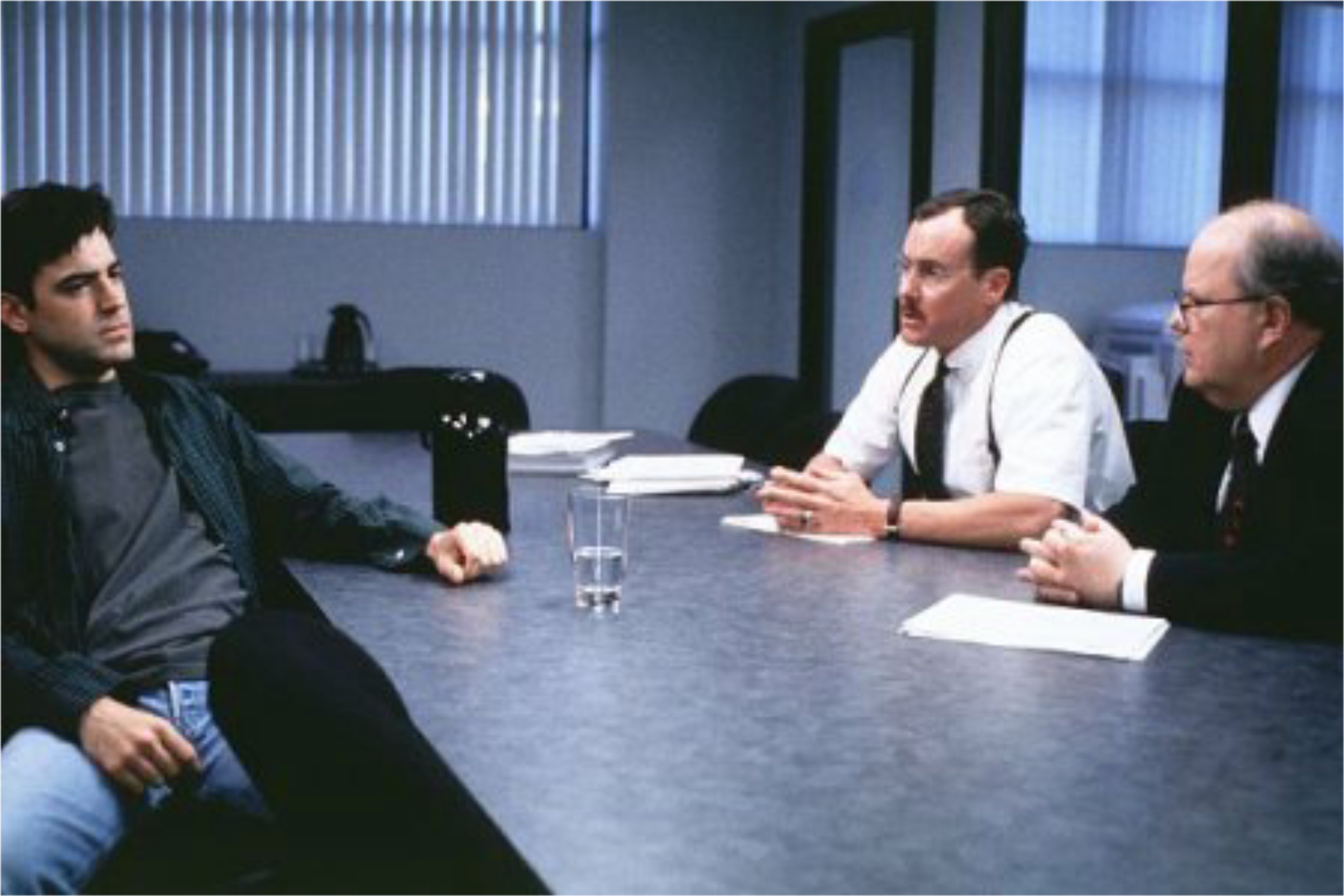
Like commoners living in a feudal society, corporate and government employees of today spend their labors working with resources that are not their own.  What does this mean for employees? I offer the following dialogue from "Office Space" as an answer to that:


Peter Gibbons: The thing is, Bob, it's not that I'm lazy, it's that I just don't care.
Bob Porter: Don't... don't care?
Peter Gibbons: It's a problem of motivation, all right? Now if I work my a** off and Initech ships a few extra units, I don't see another dime, so where's the motivation? And here's something else, Bob: I have eight different bosses right now.
Bob Slydell: I beg your pardon?
Peter Gibbons: Eight bosses.
Bob Slydell: Eight?
Peter Gibbons: Eight, Bob. So that means that when I make a mistake, I have eight different people coming by to tell me about it. That's my only real motivation is not to be hassled, that and the fear of losing my job. But you know, Bob, that will only make someone work just hard enough not to get fired.

In other words, employment is not the problem for the middle class. Nor is unemployment.  The problem is dependence, either on government or employers.


This leads to Hartmann's second problem: he ignores what the "middle class" was, and does not think carefully enough about what it is now.

In the past, the middle classes were those who were able to make a living for themselves without being born into the wealthy upper classes. Socially, they were commoners. Economically they were not, because they owned the fruits of their labors. That left them somewhere in between the two.

In present political discourse we are generally inclined to define the middle class as those who have an income that is--well--in the middle.  We do not often consider how many of those people do not depend on either government or corporate employment for their "middle class" status. Hartmann compares the merchant classes of the middle ages to present-day middle class citizens. Many merchants of that period (such as the father of St. Francis of Assisi) certainly made a tidy income. But they did so as owners of their own small businesses.  Small farmers would have been able to feed themselves without depending on corporate food distributors to provide groceries. They would have earned money selling their goods to the local community without having to contract with a large corporation in order to survive.  Farmers and merchants in pre-industrialized society were not at the mercy of an indifferent bureaucracy to "create jobs". They created their own.

G.K. Chesterton wrote "Too much capitalism does not mean too many capitalists, but too few." The social gap that ought to concern us today is not merely between rich and poor. It is between employers and employees. There are far too few of the former.

Unfortunately, we have a long way to go before we can change the structure of our economy.  Our culture and our education system still train us and our children to become employees rather than entrepreneurs or independent thinkers. Our political system thrives on the votes our politicians buy from us using our own tax dollars.
 
The solution to our present economic problem is not "investment in infrastructure" through another "New Deal".  This merely makes the government another big employer.  Nor is the solution to  give existing big employers more latitude to do whatever they want regardless of the human cost.   Common sense and a renewal of an independent human spirit is the answer.

I only hope that it won't take another bubonic plague to make us regain ours. 


--------------------------------------------------------------------------------------
Further Reading:

Pope Leo XIII, Rerum Novarum
Hilaire Belloc, The Servile State
G.K. Chesterton, Orthodoxy
G.K. Chesterton, What’s Wrong with the World

Thursday, May 5, 2011

It's About Time

You may recall that the University of Notre Dame was the center of a much publicized scandal some time back.  Much to the chagrin of every serious Catholic associated with the institution and the outrage of many other serious Catholics who are not,  they invited President Obama to speak a their 2009 commencement, despite the fact that his positions on many fundamental social issues are directly contrary to Church teachings. (See the video below or read the Voter's Guide for Serious Catholics for more on which issues these are and why they are important.)


It could be argued that a Catholic university could legitimately invite a public figure who disagrees with church teaching to speak in a debate on issues of life and family. But, to invite President Obama to be a commencement speaker, and to award him an honorary degree while he was there, was a strange gesture for a Catholic university to make, to say the least. This is especially so when one considers the USCCB's 2004 statement on "Catholics in Political Life" which says:

"The Catholic community and Catholic institutions should not honor those who act in defiance of our fundamental moral principles. They should not be given awards, honors or platforms which would suggest support for their actions."


Not surprisingly, Obama's remarks on the occasion, while full of words like "common ground", essentially asked Catholics and others with traditional Judeo-Christian values to set aside their consciences and follow his own moral views. (My response to his speech here.)  Genuinlely conciliatory? I think not.

(Source)
Protestors who came to speak out against this scandalous invitation were arrested for trespassing.

Those charges have now, two years later, been dropped, thanks to the efforts of the Thomas More Society, the president of which happens to be a Notre Dame graduate.

Links:

Thomas More Society’s Relentless Legal Pursuit Wins Justice for Pro-Life Activists at Notre Dame
WDNU News: Charges Dropped in Notre Dame Protest
LifeNews.com: Charges Dropped Against Notre Dame-Obama Speech Protestors


Tip of the Schoolmarm Ruler to: Joseph Bottum at CatholicVote.org.

Sunday, May 1, 2011

On Victories

St. George and The Dragon (Raphael)
"War must be, while we defend our lives against a destroyer who would devour all; but I do not love the bright sword for its sharpness, nor the arrow for its swiftness, nor the warrior for his glory. I love only that which they defend..."

--Faramir in J.R.R. Tolkien's The Lord of the Rings: The Two Towers

Monday, April 11, 2011

Food Fight!

Remember the processed swill that passed for food in your school cafeteria?

Imagine if someone told you that was all you could have for lunch?

According to the Chicago Tribune, that's exactly what is happening under a new policy at Chicago's Little Village Academy.

I took bag lunches most of the time in elementary school for two reasons:  One, my school cafeteria only made two dishes that were actually palatable: pizza and hamburgers.  Two, it was actually more affordable for my mom to send a healthy bag lunch from home.  I switched to bag lunches entirely in junior high.


Unsulfured Dried California Apricots
I suppose my mom might have been a little ahead of her time, really. Feeding healthy food to kids is all the rage now, but my mom was already doing it before it was cool. My lunch usually consisted of a sandwich on whole wheat bread, and some unsulphured dried fruit, and maybe some yogurt. Occasionally, there would be some blue corn chips and a do-it-yourself alternative to a Lunchable consisting of meats and cheeses my mom sliced herself, and some organic crackers or blue corn chips.


Blue Corn Chips
Yes, occasionally my friends would make remarks about my food.  They had never seen blue corn chips before, much less an unsulfured dried apricot.  I told them the apricots were really leather boot heels, and the blue corn chips were made of granite.  I have to say that I got kind of a kick out of their horrified reactions, espeically since I knew my food tasted better theirs. My mother encouraged this.  Frankly, I think this little lesson in the joys of being a little different was highly beneficial to me later on.

To this day, I detest the taste of fruit preserved with sulfur dioxide (a food preservative and an industrial pollutant, by the way), and I prefer to avoid processed cheese.

If someone had told me I was now required to eat the revolting mess that passed for a "sloppy joe" at my school, I think I would have reacted exactly the same way as these kids in Chicago:

Fernando Dominguez cut the figure of a young revolutionary leader during a recent lunch period at his elementary school.

"Who thinks the lunch is not good enough?" the seventh-grader shouted to his lunch mates in Spanish and English.

Dozens of hands flew in the air and fellow students shouted along: "We should bring our own lunch! We should bring our own lunch! We should bring our own lunch!"

Fernando waved his hand over the crowd and asked a visiting reporter: "Do you see the situation?"


Call the detention supervisor! We have a food rebellion!


Really, after looking at what passes for "enchiladas" in the Chicago Tribune picture, I completely understand.  It looks like it's been used already. Yuck.

The school's principal states that this policy was implemented after she saw a lot of junk food brought along on field trips.  What does she call that stuff in the photo?

Even if the kids' everyday lunches aren't any better than cafeteria food, the school is still imposing a financial burden on parents by requiring them to purchase a school lunch everyday for their kids.  Many families who do not qualify for free or reduced lunches still have to watch their budgets closely, and bag lunches are usually cheaper.

And then there is the question of whether cafeteria food is actually healthy.  The nutritional value of the food is open to doubt, as is the safety and cleanliness of many cafeterias. Just serving under-ripened fruit and a carton of milk with that greasy pile of slop that they call "enchiladas"  doesn't make it a healthy meal.

Interestingly, the Tribune follows the money:

Any school that bans homemade lunches also puts more money in the pockets of the district's food provider, Chartwells-Thompson. The federal government pays the district for each free or reduced-price lunch taken, and the caterer receives a set fee from the district per lunch.
 
First they tell parents the school lunches are the healthiest option, even though their contents barely resemble actual food,  and then they force people to buy them?  I'm surprised more parents aren't questioning this rather convenient collusion between big government and big business.  Smells like yesterday's mystery fish tacos to me.

If the school sincerely wants to improve students' health, its officials should consider treating the parents like intelligent human beings instead of assuming they're too ignorant or apathetic to feed their own children.

Some people don't know how to eat well, but sincerely wish to learn!   Most parents do actually want healthy children, many are receptive to useful information about how to achieve this. In most urban communities, there are local organizations dedicated to promoting healthy eating.  The school could offer information on such organizations, or even invite them into the school to talk to interested parents. (What a concept! A school promoting education!)

Real parenting and real food sound like the healthiest combination to me.


------------------------------

Update: "Real Food" activists and political conservatives are equally outraged by this bag lunch ban. See this post by "WellnessMama", and this by Jenn Savage at the "Mother Nature Network".

Saturday, March 5, 2011

Support the Ohio Heartbeat Bill!

Proposed legislation in Ohio would protect all unborn children with a heartbeat detectable by ultrasound.

Click here for more information.


And then tell your pro-life friends!

 
(A woman Listens to the heartbeat of her unborn baby at 12 1/2 weeks gestation)

Tuesday, March 1, 2011

Wisconsin Woes

(Source)
I suppose it is about time I said something about Wisconsin.

I have spent most of the last few weeks listening.  Mostly to a lot of hotheaded responses on both sides.

On one end of the spectrum, liberals accuse conservatives of inventing and even creating budget deficits in order to keep the working man down in favor of fascism,  greedy corporations, and the great anti-feminist conspiracy.   Some compare the striking teachers to the demonstrators in Egypt. Others, who appear to have forgotten some details of world history, compare the Wisconsin teachers to the Solidarity Movement in Poland.  (Wait, wasn't the solidarity movement working against collectivism?)

Even some of my fellow conservatives have let their tempers override their reason. Some accuse teachers of being greedy statist shills, and distort information about their compensation, suggesting that they make $80,000-$100,000 per year, conveniently never bothering to mention that this figure includes the estimated value of their benefits. The Madison school district website states that their salary ranges from $32,913 to $64,681.  A fairly typical range for a public school teacher salary schedule. Rachel Alexander at TownHall reports that the average salary in Wisconsin is around $56,000.  Depending on whom one asks, the national average is somewhere between $40,000-$50,000 per year.


Sheesh.

This self-described "Crazy Schoolmarm" will now try to offer a sane reflection on the issue from the perspective of an educator.

When I initially entered this field, it was with full knowledge that I would be making much less  money than friends in other fields with similar education and experience. I assumed I would be driving used cars, and renting a small apartment for most (if not all ) of the rest of my life.   Contrary to rumor, my home state of California does not pay a higher salary to its public school teachers to compensate for the cost of living. In fact, because of the cost of living, I expected that if I were ever able to own a home, it would not be until my retirement.   In fact, I considered myself fortunate that I could even afford to pay rent on my own 500 square foot apartment while I taught in that state, instead of living with relatives or half a dozen roommates.  (My apartment was smaller than my classroom, by the way.)   I have two things to thank for my ability to rent that quiet apartment where I could retreat to grade papers in peace. One is the highly sensible upbringing I received from my parents. The other, I must suppose, is  the teacher's union, whose machinations led, no doubt, to the very affordable health benefits in my district which freed up more of my monthly budget  for rent.

This would probably be the right time to mention that I have been a (reluctant) card-carrying member of the California Teacher's Association (CTA), and therefore also of the NEA.

You are probably asking, "So, how did a nice conservative Catholic blogger like you end up in a union like that?".  Read on.

California, like Wisconsin, is not what we call a "Right to Work" state. What this meant for me as a public school teacher was that union dues were deducted from my paycheck whether I joined the union or not. The only way to have any say in how this money was used was to (yes, you guessed it!) join the union! This way, I could check the little box on the membership form that told them to keep my money out of political activity, and I had a vote. Unfortunately, my vote would not be enough to change the Union's socially liberal bias.  As Black Adder points out in his post at American Catholic, this does not exactly honor one's right to freely associate. I would have much preferred to take my money to the  Association of American Educators, which offers similar membership benefits, without the liberal politics.

In principle, I am not actually opposed to Teacher's unions, so long as they do what all unions were originally meant to do, which is protect their members from unjust treatment in the workplace.  Those who have never worked in a school may not realize how intensely dysfunctional and even hostile internal school politics can become, and the level to which unprofessional behavior can, in certain unfortunate cases, dominate a school and drive out skilled teachers.  (In fact, I would guess that this is the greatest reason for most problems with teacher retention.)

In practice, however, I have mostly found that the dysfunctional internal politics in schools has merely spread to the union.  As a result, I felt I needed a union to protect me from my union, more than from my employer. The problem is that the mainstream teacher's unions have been overstepping their bounds for some time, and function more as ideological advocacy groups than as professional associations protecting the rights of workers and the integrity of the profession at the same time.   (Did I mention that we were sometimes requested to picket against legislation, regardless of our personal opinions?--I quietly stayed out of that, by the way.)

When working as a public school teacher, I often wondered how much the district was paying for the highly affordable (for me) health benefits I mentioned before. There is, after all, "no such thing as a free lunch".  I wondered how the state was able to afford it. Now I know.

It couldn't.

California now faces a problem similar to, and perhaps even more dire than, that of Wisconsin.  High cost of living and a troubled economy continue to contribute to declining enrollment in public schools. Declining enrollment means less funding, and less funding means a system-wide budget crisis, and severely reduced job security for teachers.  Even before I left, schools were pink-slipping many teachers every spring, just in case they couldn't afford to keep them the next year. Shortly after, there was speculation that some teachers might have to be payed in IOU's!

As in Wisconsin, the CTA often demands that the state continue the dubious practice of spending money it doesn't have.  Many state employees forget that the state's money comes from taxpayers, including themselves. Others do not forget, and actually ask for increased taxes.  The problem is, taxes can only go so high before everyone starts to suffer. This is usually when they start moving somewhere else, as my husband and I did, and the declining enrollment problem only gets worse! If I were still living on my own in my home state, even given the tightness of my personal budget at the time, I would have been willing to pay a higher premium on my health benefits, if it meant a greater likelihood that I would actually still have a job and said benefits in future years.

As far as I have been able do discover, the cost of living in Wisconsin is considerably less than that in California, making it much more likely that someone, even in her first years in the classroom, will be able to support herself there on her take-home pay.  A slight increase in one's health care premium is, under the circumstances, a small price to pay for increased job security, especially if one is still able to eat and have a roof over one's head.  Furthermore, interrupting the education of thousands of children, and even using false doctor's notes (video link) to do so, is poor role modeling and in violation of what should be the generally accepted ethics of the profession.

There is, of course, the question of collective bargaining rights. Governor Walker's bill does limit these. So far as I can tell though, it does not do so sufficiently to warrant the outrage we have seen. In fact, it looks like it will do something to protect union members from misuse of their money, and prevent unions from making unreasonable demands on the state budget. If you are interested, here is a summary of what the bill will do, and if you are really interested, the full text of the actual bill (a very lengthy PDF document).

In short, I believe the following:

Public workers, like other workers have the right to unionize. What they do not have is the right to  force  dues out of public employees who do not wish to join them, and then to use that money for ends contrary to the consciences of those from whom they obtained it. They do not have the right to make demands or perform actions that are contrary to the public good. Since public worker strikes often mean serious harm to the public good, I do not think striking is a moral option under most circumstances, including those in Wisconsin. (See what the Catechism of the Catholic Church says about strikes here)

The state, as an employer, does have the duty to respect the rights of its employees, and during the budgeting process should make a reasonable effort to pay them a just wage. It also has the duty to protect the society in general, and the economic welfare of the taxpayer, and part of this is keeping an eye on the budget and not taxing the private sector out of existence.  It is wrong, as Chris Christie tried to point out to the New Jersey firefighters,  for politicians to make promises of benefits and perks for which the state cannot pay, leaving future generations to deal with rising debt and tempers.

A good salary and great benefits are very welcome things, but not if they lead to general ruin.

Sanity restored.

Maybe.

Back to business.


__________________________________
Related reading:
A Statement by the Bishop of the Diocese of Madison

Sunday, February 20, 2011

It isn't all Wal-Mart's Fault

My two favorite locally-owned cafés recently went out of business.  It's too bad. They both had great atmosphere and some really dangerous desserts, not to mention very friendly people behind the counter who actually bothered to recognize the faces and habits of their regular customers. Now the nearest place for me to get an herbal tea and my chocolate fix is the place Dave Ramsey loves to call "Fivebucks".

My first summer job in high school was also at a locally-owned coffee place back in my hometown.  My boss told me that the place pretty much lived hand-to-mouth most of the time, and it had been in business for almost a decade at that point, and had a steady flow of loyal customers!

It's tough owning a small business, which is probably why I have never yet actually done it. I have imagined.  I have fantasized. I have even done a little research on the matter.  But then I always get a nice cold dose of reality. Like this story earlier this month involving a man who was shot in a Seattle-area Denny's.  He was shot, as it happens, by another customer who had a bad temper, and even worse aim.  Tragically, he ended up a paraplegic as a result of his injuries. The shooter went to prison, and the victim went to court--and took Denny's with him.

Denny's settled out of court for $13 million, which saved it from the $46  million the jury was about to award. According to the article, "The jury found the company failed to provide security even though police had responded many times to reports of violent crimes at the restaurant."

Now, I do not wish to minimize the genuine pain and suffering of the victim.  It does seem like someone ought to compensate him for that which he has lost, but I am not certain that it is the restaurant who has the responsibility, and I am greatly concerned about what such a ruling means for restaurant owners who do not have thirteen million dollars lying around to pay to injured customers.  Even with security present, there is no guarantee that some hothead with a firearm isn't going to start shooting.  If they can't hire their own security guard, will mom and pop and grandma have to go to court, too?  Should business owners move if the neighborhood starts to decline, in order to avoid liability?

Small businesses do not only have to contend with cuthroat competition from impersonal big-box stores and monster coffee chains. They also have to face the increasingly high cost of doing business in a lawsuit-happy society.  Along with small restaurants and coffee shops we are watching the gradual disappearance of   small,  medical practices and other types of businesses. Small private schools have to dedicate ridiculous amounts of time and paperwork to keeping their legal backsides covered in every detail. Why? Because people are just as happy to sue them as Wal-mart, and for the same large amounts.  Maybe the big guys can take it. But I don't know about mom and pop and grandma.

Maybe that's why internet businesses are becoming so popular. No buildings for people to be injured in.

Wednesday, June 9, 2010

Woman Power in the Primaries

 This blog would like to offer its congratulations to Meg Whitman and Carly Fiorina.  I hope they beat the pants off of Jerry Brown and Barbara Boxer.


No doubt there will be much discussion of pro-life feminism (versus the more well-known pro-abortion feminism we have seen in this country over the past 50 years) over the months between now and the election.   Marjorie Dannenfelser, president of the Susan B. Anthony List, rightfully recognizes that abortion, instead of empowering women, has instead created a cultural atmosphere that makes it easier for men to use us as playthings for their own pleasure, and requires us to sacrifice our natural femininity as a condition of full participation in society.  I excerpt her comments below:
 

It’s surprising, really, that abortion-rights feminists are so unequivocal in their insistence that “pro-life feminism” is an oxymoron. After all, the pro-life feminist argument relies upon feminism’s better angels. It is a communitarian argument for one thing.

The pro-life feminist looks out for the interests of other people affected by her decisions. She refuses to take terrible advantage of another vulnerable group - the unborn - in order to advance her own case. She makes the “both/and” argument: both the woman and the unborn child deserve respect.

Secondly, the pro-life feminist relies upon empirical and scientific datum. She makes a rational argument about when life begins or about the psychological or physical harm some women suffer after abortion; she is not shouting down or pressuring her opponents, or belittling them personally.

Finally, she insists that what women alone are capable of doing – bearing and mothering children–– merits more respect than it presently receives. Abortion rights have unburdened men from the fathering role. His freedom from sexual responsibility is premised on the woman's choice to abort or not.

It is no coincidence, suggests the pro-life feminist, that 37 years after women were granted the “right to abortion,” the number of women and children living without the presence or the support of the father is at an all-time high. She thinks it’s no accident that elite jobs are regularly populated by women who, often with regret, felt pressured, with no support available to them, to avoid parenting in order to advance in their career.

Sunday, March 21, 2010

Blue Dogs fall for New Trick.

Via Christopher Blosser and Donald McClarey at American Catholic:


US Catholic Bishops: Executive Order Deal A Non-Starter:
We’ve consulted with legal experts on the specific idea of resolving the abortion funding problems in the Senate bill through executive order. We know Members have been looking into this in good faith, in the hope of limiting the damage done by abortion provisions in the bill. We believe, however, that it would not be fair to withhold what our conclusion was, as it may help members in assessing the options before them:

“One proposal to address the serious problem in the Senate health care bill on abortion funding, specifically the direct appropriating of new funds that bypass the Hyde amendment, is to have the President issue an executive order against using these funds for abortion. Unfortunately, this proposal does not begin to address the problem, which arises from decades of federal appellate rulings that apply the principles of Roe v. Wade to federal health legislation. According to these rulings, such health legislation creates a statutory requirement for abortion funding, unless Congress clearly forbids such funding. That is why the Hyde amendment was needed in 1976, to stop Medicaid from funding 300,000 abortions a year. The statutory mandate construed by the courts would override any executive order or regulation. This is the unanimous view of our legal advisors and of the experts we have consulted on abortion jurisprudence. Only a change in the law enacted by Congress, not an executive order, can begin to address this very serious problem in the legislation.”

Richard Doerflinger
U.S. Conference of Catholic Bishops


A further roundup of commentary from other sources here.

One would think that a politician would know all of the tricks in the book well enough to avoid falling for one.

It's too bad we'll have to wait till November to vote these people out of office.

Thursday, July 9, 2009

Thursday, May 21, 2009

"Not that I loved Caesar less"...

My kids just finished reading "Julius Caesar".


I was particularly fascinated by Brutus and his conscience this year, perhaps because he seems so relevant to our present political discussions. Though he tries to be noble, Brutus's conscience and his sense of logic both fail him when he chooses to commit objective evil in order to promote what he believes to be the "greater good".

It was "not that I loved Caesar less," he claims. "But that I loved Rome more."

Loved Rome. Patriotism so great that it overcame his basic sense of right and wrong. And the wages of his sin, as one might expect in a Shakespearean tragedy, is death. Lots of it.

At Notre Dame, President Obama presented us with a great deal of talk about unity and common ground. Overcoming differences. Appealing to our ideals as Catholics, he tried to convince us that he is willing to work together to reduce abortion, AIDS, poverty. "Why can't we all just get along?" he seemed to ask plaintively.

I will tell you why, Mr. President. When Brutus betrayed his friend by murdering him in the name of patriotism, he unleashed chaos. "Liberty, freedom, and enfranchisement" do not come when we shuffle off moral authority. The death of Caesar did not mean the beginning of a new republic. Instead, it brought civil war and the tyranny of the mob.

We are happy to work with you, Mr. President, to change our country for the better. If you want to fund adult stem cell research, adoption programs, homes for unwed mothers, and pre-natal care for pregnant women in crisis we are with you. If you want to make it easeir for citizens to take care of each other through local (even faith-based) organizations, you have our full support.

But as long as the FDA thwarts ethical adult stem cell research on your watch, your words are empty. While you support the abortion industry without holding it accountable for its bad behavior, your logic holds no water. As long as you continue to ignore the sanctity of marriage, the value of abstinence, and the consciences of health care workers, we cannot trust your policies. When you send our money overseas to fund abortions over our objections, and your Homeland Security officcials brand us as extremists and terrorists, we cannot take your words seriously, however "fair minded" they may be.

Your diplomatic rhetoric does not match your actions, sir, though surely you are an honorable man.

The other conspirators asked Brutus to set aside his qualms and murder Caesar with them.

You, Mr. President, are asking us to do worse. You are asking us to set aside our qualms, not to eliminate a potential tyrant (though some of your friends might think a child in the womb is such.) You are asking us to set aside our moral convictions and allow the murder of children in the womb and spiritual harm to those outside of it.

You are presenting us with a false choice between our consciences and the "greater good". You may not literally be placing the dagger in our hands, but you are asking us to become accessories to the actions of those who have it.

When it comes to the sanctity of human life, and the true dignity of marriage and women, our answer to you and any other president is the same: Consequentialism is not compatible with Christianity.

We love our country too much to destroy its soul.

We will not be made conspirators, Mr. President.


Tips of the Schoolmarm Ruler to: Real Choice, Ad Altare Dei, The American Catholic, William Shakespeare

Monday, May 11, 2009

Pro-Life Democrats

No, it's not an oxymoron.

I actually live in a district with a pro-life Catholic Democrat representing us in our state legislature. I voted to re-elect her this last fall, since she puts her votes where her mouth is, in spite of the criticism of colleagues in her party.

Here's a post at The American Catholic by another Pro-Life Democrat, this time from Florida. Everyone in the movement should read his post.

Life should not be a partisan issue, people.