Showing posts with label Education. Show all posts

Friday, September 2, 2011

Evolution before Darwin

Father Juan Ignacio Molina, a Jesuit priest from Chile, was a naturalist, geographer, and historian whose work so benefited his home country that they named a city after him and put his face on a stamp.   Less known to many is that he proposed his own theory of evolution in 1815, when Charles Darwin was only six years old:
Juan described an analogy between living organisms and minerals. He proposed an idea of the gradual evolution of human beings, thereby anticipating Darwin's theory of evolution. In an 1815 work on nature's three kingdoms (mineral, vegetable and animal) he describes the Creator's plan for a continuous seamless chain of life from mineral life to vegetable life to animal life with no discrete discontinuous steps. Crystalline minerals tend to gather together in preparation for the higher form of vegetable life which then evolve into animal life. John showed unusual insight as well as care to maintain the scientific method, basing his claims on scientific observations. Called a heretic by some observers, he was ordered by the Archbishop of Bologna to hand over his findings to a committee of 18 theologians. The latter found no difficulty with John's work and approved publication. (Source)


For more on the Catholic perspective on evolution, I suggest reading Pope John Paul II's 1996 address to the Pontifical Academy of Sciences.


-----------------------------------------------------------------------------
Read more about Juan Molina, SJ.
Click here for a list of other Jesuit scientists and mathematicians.

Monday, August 29, 2011

Teachers, Social Media, and the Constitution

Today, the School Law Blog reported the following:

A state judge has issued an injunction blocking a Missouri law that would have barred teachers from communicating with students over websites such as Facebook and Twitter.

...The teachers' union filed a lawsuit challenging the social-networking prohibition, which was passed this year as part of a larger bill designed to protect children from sexual abuse in schools.

...Judge Beetem found that social networking is used "extensively" by educators, and the Missouri measure could even bar communications between teachers and their own children. The injunction says that teachers who engage in social networking with students may not be disciplined, even if the court order is later overturned.

The Associated Press reports here that another union, the Missouri National Education Association, has been trying to work with legislators to revise the law, but that any such changes are not likely before the Missouri legislature's next regular session in January.

Having students on one's facebook friends list, even after they have graduated, can lead to problems, if one uses Facebook to publicly express personal opinions, as Florida Teacher of the Year Jerry Buell recently discovered.

Some teachers use social media to communicate with students and parents about classroom issues (a practice with which I am not personally comfortable). Others use it to keep in touch with those former students who wish to do so.

So how should teachers handle this issue? The Blue Skunk Blog has a handy list of guidelines:

  • Do not accept students as friends on personal social networking sites. Decline any student-initiated friend requests.
  • Do not initiate friendships with students
  • Remember that people classified as “friends” have the ability to download and share your information with others.
  • Post only what you want the world to see. Imagine your students, their parents, your administrator, visiting your site. It is not like posting something to your web site or blog and then realizing that a story or photo should be taken down. On a social networking site, basically once you post something it may be available, even after it is removed from the site.
  • Do not discuss students or coworkers or publicly criticize school policies or personnel. (My Note: this goes for non-anonymous blogs, too, as Natalie Munroe found out.)
  • Visit your profile’s security and privacy settings. At a minimum, educators should have all privacy settings set to “only friends”. “Friends of friends” and “Networks and Friends” open your content to a large group of unknown people. Your privacy and that of your family may be a risk.

(Read the complete Networking Guidelines for Teachers)

If you feel you must "friend" former students and colleagues, on Facebook, use the customized privacy settings to restrict their access to your wall posts.

So, while the constitution protects the personal freedom of educators using social media, it's in our own interests to exercise a little common sense and professional decorum.

Monday, August 1, 2011

Images from the Vatican Observatory

The Horsehead Nebula

Planetary Nebula M27, the Dumbbell Nebula; image by Matt Nelson, taken at the VATT


Head over to the Vatican Observatory website to see more.


Ruler tip: Alive and Young

Wednesday, July 27, 2011

The Value of Student Teaching

While in my first "real" teaching job, our school took on a small group of student teachers. It didn't take long for  me to identify them in the hallways. Student teachers are generally a little overdressed, and so worn out that they appear to be sleepwalking.  I'm sure I once appeared to be in a similarly zombie-like state, given that I somehow managed to survive my last semester of graduate school on four hours of sleep per night (sometimes less). My first year of full time teaching, busy as it was, was easy by comparison.


A recent post at the HechingerEd blog draws attention to a recent study of the current state of student teaching:
A new study by the National Council on Teacher Quality out this week finds fault with the way many schools of education run their student teaching programs, however. Among other issues, the NCTQ criticizes a common set up in many teacher training programs where schools, not the colleges, get to pick which mentor teachers will get student teachers assigned to them. (The NCTQ would prefer that schools of education pick the teacher mentors.) It also points out that often these mentors aren’t required to be highly qualified or good at mentoring.

Student teaching and mentorship in the first years of one's career are crucial to new teacher quality and retention. While classes grounded in theory are quite valuable, student teaching provides an opportunity to apply theory to practice, much the same way immediate use of new vocabulary allows for speedier mastery of a new language. One of the reasons I enrolled in a 1-year credentialing program was because I wanted to do my student teaching and my coursework together, so that I might immediately apply my training.

I can't speak for every program, but I can say that my own student teaching experience tells me that the issues raised in the study are worthy of consideration.  The mentorship my cohort received from our cooperating teachers was surprisingly uneven, in spite of (and in some unfortunate cases no thanks to) efforts of supervisors and administrators. It ranged ranged from brilliant to blatantly negligent.  All of the teachers with whom we were paired were very good at making their own classrooms work. What varied was their level of interest and skill when it came to mentoring a new teacher. Some lacked experience as cooperating teachers, others lacked time or motivation. At one of the school sites our program worked with, the culture of the school was out of step with the culture of the teacher education program.

This last problem is the easiest to address. The university can (and sometimes does) choose not to send student teachers to schools that are not able to provide the kind of mentorship that is needed. 

So what to do about issues of time, skill, and motivation? Cooperating teachers need to be interested in the future of the profession. They should take on student teachers willingly, not as a favor to someone, or because their principals tell them to do so.  They should be models of professional behavior who have the respect of their colleagues. Teacher education programs need to take into account the number of interested cooperating teachers available when deciding how large a class to admit every year.  It might be worth considering some brief training for cooperating teachers with minimal experience. 

Student teachers also need to have a voice when problems arise.  Most are at the bottom of the political pecking order in their school sites, are overworked and sleep-deprived, and may not feel comfortable reporting problems to supervisors or administrators. Student teachers should not have to worry about endangering their carreers when faced with bad mentorship. Programs need to have procedures in place to ensure this. Student teachers are, after all, adults, and should be taken seriously as such when they have a legitimate grievance.

Whatever the solutions, they need to be researched-based, effective, and (for pity's sake) minimal on the paperwork. 

Student teachers and their mentors have enough paperwork already.


The good news, I suppose, is that, while good mentorship is invaluable (and can be pleasant and even exciting),  even bad mentorship can be instructive to a motivated person.   If nothing else, it reminds the often naïve student teacher that the world of education, like everything else that is human, has its frustrations and flaws.

Ruler tip to: EducationNews.org

Friday, July 15, 2011

So much for penmanship.

The state of Indiana no longer includes cursive writing in its curricular standards.

From TribStar.com:

State officials sent school leaders a memo April 25 telling them that instead of cursive writing, students will be expected to become proficient in keyboard use.

The memo says schools may continue to teach cursive as a local standard, or they may decide to stop teaching cursive altogether.

(Read the rest.)

Could this be the beginning of the end of cursive for the next generation of students?

I don't think schools will have to spend more time on keyboarding now than they have in the past. It may be they'll need less, considering how many kids these days seem to be using computers practically from infancy.

Handwritten assignments are still a fact of life in schools, and are a key part of many standardized tests, including Advanced Placement exams.  Even in college, there are essay questions on midterm exams that require handwritten responses. Professors and test readers have little patience for unreadable work.

As many a secondary-level teacher can tell you, once those penmanship lessons from elementary school end, it is all downhill when it comes to neatly written work. The decline often reaches the point where some students give whole new meaning to the term chicken scratch.  I'm not kidding. I had a student once whose printed writing literally looked like it was produced by actual chickens. The teaching of cursive seems worthwhile if only for the development (and maybe extended maintenance) of the fine motor skills that help students avoid this.

Let's hope high school teachers in Indiana can still read their students' work in ten more years.

Tip of the ruler to: Curriculum Matters

Monday, July 11, 2011

Dave Barry Goes to Spain...

...with a horde of 5th graders.  This naturally makes good comic material for his column from yesterday:


Recently I helped chaperone a group of fifth-graders on an educational school trip to Spain, a foreign country located in Europe. Our group consisted of four dads, 18 moms and approximately 27,000 children. There was no way to get an exact count: They move too fast.

Read more: http://www.miamiherald.com/2011/07/10/2305404/a-field-trip-to-spain.html#ixzz1Rpzf6uqh

Friday, July 8, 2011

What will Governor Moonbeam Do? (Part 2)

Governor Jerry Brown has a controversial  bill on his desk awaiting his response. SB48, according to Equality California (a group which favors this legislation) will:
... amend the Education Code to include social sciences instruction on the contributions of lesbian, gay, bisexual and transgender (LGBT) people. This bill would also prohibit discriminatory instruction and discriminatory materials from being adopted by the State Board of Education.
(The full text of the bill may be found here.)


In my previous post, I discussed the impracticality and even inhumanity of injecting identity politics into the classroom.  The California Catholic Conference voiced its opposition to the bill on those grounds last April.

But the debate over SB48, nicknamed "The Fair, Accurate, Inclusive and Respectful (FAIR) Education Act" is not simply a debate about how to encourage politeness in schoolchildren.   It's not really even about bigotry.

When schools teach about the Women's Suffrage or Civil Rights movement, they usually do so in a manner that constitutes an endorsement. In the process, students rightly learn that institutionalized sexism and racism are dehumanizing and therefore socially unacceptable.  It is wrong to discriminate against human beings because of a state of being such as skin color or gender.  Skin color does not make a person good. It does not affect the state of his or her soul. Women may in general be physically weaker than men, but that does not make us morally inferior. While there may be evidence to suggest that men have more inclinations toward violence, that does not mean human males are born into a state of moral inferiority when compared to women.

A person's moral inferiority comes from choices, not from the way the way he or she was born. A man who, for example, cheats on his wife does so not simply because he has a male inclination for unfathfulness; he does so because he chose act upon it.  The action is where the moral problem lies, not the inclination.

So what will schools be endorsing when they teach about the LGBT movement if it is given the same treatment as the Civil Rights movement?   The LGBT movement's goal is the acceptance of certain behavior, not merely the acceptance of a state of being or an inclination. If the school treats that goal as laudable, it is essentially endorsing the homosexual lifestyle as something morally acceptable. This will most certainly come into conflict with the religious and cultural values of many students in California schools.

That is what makes this issue different. It is not simply about how one is born, or whether a person has certain desires, tendencies, drives, or inclinations.  It is about how one chooses to live and act, and whether a school, as an agent of the State, has the right to tell parents and students how to define sin.


In short, the debate over SB 48 is a debate about the role of the state in defining the sexual morality of private citizens and their children.

This becomes an especially sticky issue because teachings on sexual morality are often (though not always) faith based, which means this is also a question of free exercise of religion.

Though schools are often important for the social development of children, parents are the first and most important educators, especially in matters of faith and morals, and they are right to object when a particular school or and entire school system seeks to undermine what they teach their children in good conscience. 

It gets even stickier when students become old enough to choose whether or not to believe as they were raised.  It is not unheard of for a student to be raised in one faith, but convert to another in her teens. At the secondary level, a public school has to avoid infringing upon the constitutional rights of the student as well as the parents. The state has no business telling a student that she cannot believe what her faith teaches.


Schools and their employees cannot fulfill the requirements of this bill, and remain neutral with respect to the morality of homosexual behavior. This creates serious problems for parents, teachers, and students, whose reasoned moral objections to homosexuality and the LGBT movement come in conflict with this legislation.  Whether legislators in California like it or not, individual citizens do have a right to work in an environment that does not force them to choose between their consciences and their employment or education. It is not the place of the public schools to engage in social engineering or to judge the beliefs and opinions of students, though efforts to do so are nothing new, historically speaking. It is a practice that goes as far back as the 19th century.

As I pointed out in my last post, the state is much more likely to reach its stated goal of reducing bullying if it sticks to the more neutral path of instructing students in the very useful principle of respect for one's fellow human beings.  It is actually possible to teach kids to be polite to others, even in the face of serious disagreement or even fear, without injecting oneself into the religious instruction the student receives from his or her family.

Specific moral instruction is best left in the purview of parents, but there are many in education and in politics who believe they and the schools have a duty to subvert parental teachings with which they do not agree, especially if those parents embrace traditional Judeo-Christian morality.  In my own experiences at multiple public schools, I observed that this prejudice is so pervasive within the world of public education, that many of my colleagues were not even conscious of how it affected their attitudes toward parents and even toward their own students.

Contrary to what some among my former colleagues believe, it is possible to have strenuous moral objections to someone else's choices, actions, or lifestyle, without losing sight of that person's humanity.  With effort, one can even express such disagreements politely. It is even possible for young people to manage this with proper instruction.   But the purveyors of "tolerance" seem as unable to tolerate this concept as to tolerate the suggestion that there is even such a thing as objective morality.

Tolerating the idea of objective morality means living with the possibility of falling from grace, and this is not terribly compatible with modern thinking.

In fact, our fallen nature is really our most ancient and universally recognized trait.  From Shakespeare's plays to Lord of the Rings, fall and redemption make up the thematic material of some of the greatest literature ever written.  Even the Ancient Greeks had their own story of  a "fall" in the form of Pandora and the infamous box of furies. As G.K. Chesterton noted, it wasn't until recently that people began to suggest that there is no such thing as sin:

Whether or no man could be washed in miraculous waters, there was no doubt at any rate that he wanted washing. But certain religious leaders in London, not mere materialists, have begun in our day not to deny the highly disputable water, but to deny the indisputable dirt. Certain new theologians dispute original sin, which is the only part of Christian theology which can really be proved. Some followers of the Reverend R. J. Campbell, in their almost too fastidious spirituality, admit divine sinlessness, which they cannot see even in their dreams. But they essentially deny human sin, which they can see in the street. The strongest saints and the strongest sceptics alike took positive evil as the starting-point of their argument. If it be true (as it certainly is) that a man can feel exquisite happiness in skinning a cat, then the religious philosopher can only draw one of two deductions. He must either deny the existence of God, as all atheists do; or he must deny the present union between God and man, as all Christians do. The new theologians seem to think it a highly rationalistic solution to deny the cat. (Orthodoxy)
 
I suspect that this bill is less about bullying, and more a part of an effort to teach the next generations to deny both dirt and cat.


-----------------------------------------------------------------
Update: Read about what Archbishop Gomez has to say on this topic.

Thursday, July 7, 2011

What Will Governor Moonbeam Do?

Identity politics took a central place in the political discourse of our nation during the last presidential election.  It seemed to me that this did more to reinforce racial division in the country than it did to heal it. I suspect it may have even served to undo some of the progress that has been made over the past couple of decades. One of my eleventh graders that year said to me one day that she never felt divided from anyone because of race, until she witnessed the national tension during that campaign season. She discovered unity is more difficult  when people are determined to carry out the dehumanizing practice of sorting themselves and others into competing victim groups.

This brings me to the issue of identity politics, and its influence on education as we know it.

As many of you are no doubt already aware, a piece of legislation is about to hit the governor's desk in California that, as the San Francisco Gate puts it, "would make the state the first requiring public schools to include the contributions of gays and lesbians in social studies curriculum".  It further explains that the bill "adds lesbian, gay, bisexual and transgender people as well as people with disabilities to the list of groups that schools must include in the lessons. It also would prohibit material that reflects adversely on gays."


So, if Jerry Brown signs SB48, the good news is English teachers will have to stop ignoring Walt Whitman and Oscar Wilde.

Wait a minute...  They are already in the curriculum!


And if since the bill also covers historical figures with disabilities, history teachers will have to stop leaving out FDR.


Wait...    Never mind. He's already there too.

We remember writers, mathematicians, scientists, and historical figures, not because they are token figures of a certain group, but because of their influence for good or ill.  We read Mary Shelley's Frankenstein because it is a great novel, not merely because a woman wrote it.  We study FDR's presidency because it was unique and historically important, not simply because he was in a wheelchair.  While someone's ethnicity, disability, or gender will contribute to who she is, it is not her only definitive characteristic. Even for historical figures whose identity is very important, such as Frederick Douglass or Martin Luther King, great accomplishment and historical influence are still the primary reasons why we remember them.


Many suggest that the debate over homosexuality in America is no different from the questions of race that our nation faced over the past century. Even if, for the sake of argument, we concede this point, this legislation still remains impractical in light of certain realities in the classroom.

Nobody who has ever spent significant time in a school can deny that kids are pretty good at dividing themselves along arbitrary lines, whether it be race, class, fashion, glasses, or grades.  I have seen students treat one another better after meaningful personal interaction.  I have never seen a student decide that he is going to quit making fun of someone because a great author or historical figure had the same trait as the "other".  A student who bullies his classmate because said classmate is "a brain", for instance, isn't going to change his behavior because Einstein was "a brain" too. In fact, he is more likely to write off Einstein as well as his classmate, and go on his merry, anti-brain way.  I have never seen  a token minority author or historical figure serve to eliminate racism, nor a lesson on a token woman cure anyone of misogyny.

As someone whose curriculum consisted mostly of old books written by people who are now dead, I found the question of prejudice to be a very relevant one for my classroom.   If students cannot see the human dignity of those living human beings sitting next to them in class, they aren't going to be able to see it in fictional characters created by long-deceased authors. After all, can there be a greater divide between people than between the living and the dead?  Students must learn to see the inherent human dignity of those around them before they will be able to see it in people and characters from the past. Mark Twain showed us this more than a century ago: it is the lesson that we learn from reading Huckleberry Finn.  It is the time they spend on the river together that allows Huck to see Jim as a man and a friend, and not merely as a slave.

Tolerance is not a false pretense that people have no significantly different beliefs, backgrounds, and ideas.  It is not a hypocritical assertion that we are all the same.  It is a learned skill. It is, essentially, a form of patience that allows us to live and work with people whom we do not entirely understand, or with whom we fundamentally disagree, without losing our sanity or our awareness of each others humanity.


A curriculum that emphasizes differences and token representatives of politically fashionable classes of human beings does more to undermine a culture of acceptance in schools  than it does to create one. Students need no reminders that there are stark differences among them. Drawing attention to labels provides those unneeded reminders, and reinforces the false and dehumanizing notion that students cannot relate to anyone who does not have some arbitrary identifying characteristic in common.

The bill is also intended to add the history of the LGBT movement, but prohibits any material that could reflect poorly upon it.  This bears more resemblance to propaganda than it does to an honest approach to history. If similar legal injunctions existed with respect to study of the movement for racial equality, many activities of groups such as the Black Panthers and the more controversial comments of Louis Farrakhan would be forbidden material.  The fact that some people working for racial equality behaved badly has not undone the appreciation most people currently have for the progress our nation has made in race relations over the past five decades.  Human history, like the human beings in it, is full of behavior that "reflects badly" on someone. We can learn as much from those as we can from the moments when heroic people did something gloriously right.

In charity, I can only hope that those who are promoting this bill are unaware of the practical problems outlined above.

If they are aware of them, one needs to ask why they think a curricular emphasis on the LGBT movement will will change the value students place on their classmates or on Walt Whitman's literary achievements.  I shall deal with that question later.

Saturday, July 2, 2011

Kids These Days...

...are more receptive to chant than many adults give them credit for. These are second-graders, folks.


When I was six, I remember the children's choir at my parish mostly sang things like Carey Landry's "Bloom Where You're Planted", a song which I haven't heard in over 20 years, and probably for good reason, but which has annoyingly remained lodged in my brain since. Chant would have been much better, but wasn't really given much consideration. I have serious doubts that it would have even occurred to anyone to teach us Latin.

Learning chant and other forms of early music gives children an opportunity to learn about musical theory and history at a period in their development when their brains are particularly receptive.  Latin instruction not only allows them to understand the words that they are singing, it also gives them a linguistic foundation that will help them learn other romance languages and maybe even raise their reading comprehension skills and their SAT scores down the road.

Our Greek Orthodox brothers and sisters make a point of preserving their liturgical heritage, and teaching their children the language of their liturgy. There is no reason that we Roman Catholics cannot do the same for our kids.

------------------------------------------------------------------

Update: Looks like this video has gained the notice of Fr. Z, The New Liturgical Movement, and the Curt Jester. Is it going viral? One can only hope so.

Friday, June 17, 2011

Conan Does Dartmouth

If one has to invite a speaker to talk for half an hour at a graduation ceremony without putting people to sleep, an accomplished comedian is a good choice.

Conan O'Brien's commencement address this year at Dartmouth is probably one of the most honest and entertaining commencement speeches I have ever heard. It is worth a listen.


(Warning: Some profanity.)

Wednesday, June 8, 2011

Fashion Trend Trivializes Rosary

One of my favorite gifts that I received for my confirmation was a beautiful rosary bracelet.  I felt that wearing it provided me with  a way to express my faith publicly but not ostentatiously, and on occasion it became a conversation piece that allowed me to share my faith with others who do not know what the rosary is.  It also came in very handy if I happened to forget to bring a full-sized rosary with me when I might have need of one.

(Photo Source)
Those who wear their beads with genuine devotion are in good company. After all, many religious wear their rosaries in their cinctures, keeping them available at all times.  In our human frailty, keeping our rosaries where we can see them is probably the best way many of us have to remind ourselves to actually use them.

But, we have to be careful about how we do so, lest they become Pharisaical display or mere superficial ornaments.

I have noticed over the past few years that many more people, especially teens and young adults, are wearing rosaries as fashion statements.  Even Justin Bieber has jumped on this bandwagon.

Unfortunately, the comportment and dress of some of some forces me to doubt that they are wearing rosaries as devotionals.  Many celebrities whose public behavior is, shall we say, less than in line with Catholic morality,  have popularized rosary beads as superficial fashion statements.   Britney Spears and Madonna are among the most prominent examples.

At the most extreme end of this problem is the inclusion of rosaries worn around the neck in the attire of gang members.  This has even caught the attention of schools, law enforcement, and news media. The San Antonio Police Department Youth Crime Service Unit "Gang Awareness" handbook and USA Today both report that rosary beads are now common components of gang-related attire.


More recently I have seen items labeled as "rosary necklaces" for sale in shops that cater to the more unsavory trends in youth fashion.  These usually have features that are rather different from the real thing.  Hot Topic, a mall chain that features some of the more edgy fashions popular among suburban teens, offers a so-called "rosary necklace" with a charm that looks like a pair of brass knuckles where the crucifix should be, and a gun-shaped center.   Such items are especially appealing to teens and young adults who buy into the glorified images of street culture so common in entertainment media. 

On the one hand, it could be argued that if  someone is going to wear a rosary as a mere fashion statement, it is less disrespectful to wear a bad knock-off than an actual sacred object. On the other hand, calling the bad knock-off a rosary, instead of something else, mocks the real thing and suggests that it is OK to pervert an item that is sacred into a profane fad.  Either way, this trend displays a great lack of respect for Catholic beliefs and practices, especially when worn by those who have no interest in even the appearance of using them for actual prayer or following Catholic teaching.  This public trivialization of one of our most distinctive spiritual tools should be of great concern to those who understand its true value.

Pope John Paul II called the rosary "an effective spiritual weapon against the evils afflicting society" (Rosarium Virginis Mariae).  No weapon, whether temporal or spiritual is of any use if we do not understand it or know how to use it.

It may seem like I am splitting hairs here. It may seem like I am nitpicking when I express concern about this. After all, we have much to be concerned about when it comes to our kids and what they do and what they see on television.  The fact that Lady Gaga wears something resembling a rosary around her neck (or eats one) may seem trivial compared to everything else she wears (or doesn't) and the things she says and does.

But I'm not alone here. Even the bishops find this trend to be disturbing, and have encouraged efforts to catechize people who walk into Catholic shops looking for rosaries, and thinking they are merely buying a necklace. Some business owners have begun giving out free leaflets on how to pray the rosary to the customers who purchase them, hoping that this will at least encourage respect for it, and maybe even teach people something.

If prayer, and the rosary in particular, is the most powerful tool we have to combat all of those evils that threaten our children (and he who is behind them), we must be concerned if people begin to forget what the rosary is for.

Imagine if every celebrity, twenty-something, and teen who wore something like the absurd piece of jewelry above actually learned to pray a real rosary. 

Thursday, May 5, 2011

It's About Time

You may recall that the University of Notre Dame was the center of a much publicized scandal some time back.  Much to the chagrin of every serious Catholic associated with the institution and the outrage of many other serious Catholics who are not,  they invited President Obama to speak a their 2009 commencement, despite the fact that his positions on many fundamental social issues are directly contrary to Church teachings. (See the video below or read the Voter's Guide for Serious Catholics for more on which issues these are and why they are important.)


It could be argued that a Catholic university could legitimately invite a public figure who disagrees with church teaching to speak in a debate on issues of life and family. But, to invite President Obama to be a commencement speaker, and to award him an honorary degree while he was there, was a strange gesture for a Catholic university to make, to say the least. This is especially so when one considers the USCCB's 2004 statement on "Catholics in Political Life" which says:

"The Catholic community and Catholic institutions should not honor those who act in defiance of our fundamental moral principles. They should not be given awards, honors or platforms which would suggest support for their actions."


Not surprisingly, Obama's remarks on the occasion, while full of words like "common ground", essentially asked Catholics and others with traditional Judeo-Christian values to set aside their consciences and follow his own moral views. (My response to his speech here.)  Genuinlely conciliatory? I think not.

(Source)
Protestors who came to speak out against this scandalous invitation were arrested for trespassing.

Those charges have now, two years later, been dropped, thanks to the efforts of the Thomas More Society, the president of which happens to be a Notre Dame graduate.

Links:

Thomas More Society’s Relentless Legal Pursuit Wins Justice for Pro-Life Activists at Notre Dame
WDNU News: Charges Dropped in Notre Dame Protest
LifeNews.com: Charges Dropped Against Notre Dame-Obama Speech Protestors


Tip of the Schoolmarm Ruler to: Joseph Bottum at CatholicVote.org.

Wednesday, April 27, 2011

G.K. Chesterton on "The Superstiton of School"

"The snag in it is this: that the self-educated think far too much of education. I might add that the half-educated always think everything of education. That is not a fact that appears on the surface of the social plan or ideal; it is the sort of thing that can only be discovered by experience. When I said that I wanted the popular feeling to find political expression, I meant the actual and autochthonous popular feeling as it can be found in third-class carriages and bean-feasts and bank-holiday crowds; and especially, of course (for the earnest social seeker after truth), in public-houses. I thought, and I still think, that these people are right on a vast number of things on which the fashionable leaders are wrong. The snag is that when one of these people begins to "improve himself" it is exactly at that moment that I begin to doubt whether it is an improvement. He seems to me to collect with remarkable rapidity a number of superstitions, of which the most blind and benighted is what may be called the Superstition of School. He regards School, not as a normal social institution to be fitted in to other social institutions, like Home and Church and State; but as some sort of entirely supernormal and miraculous moral factory, in which perfect men and women are made by magic. To this idolatry of School he is ready to sacrifice Home and History and Humanity, with all its instincts and possibilities, at a moment's notice. To this idol he will make any sacrifice, especially human sacrifice. And at the back of the mind, especially of the best men of this sort, there is almost always one of two variants of the same concentrated conception: either "If I had not been to School I should not be the great man I am now", or else "If I had been to school I should be even greater than I am". Let none say that I am scoffing at uneducated people; it is not their uneducation but their education that I scoff at. Let none mistake this for a sneer at the half-educated; what I dislike is the educated half. But I dislike it, not because I dislike education, but because, given the modern philosophy or absence of philosophy, education is turned against itself, destroying that very sense of variety and proportion which it is the object of education to give. No man who worships education has got the best out of education; no man who sacrifices everything to education is even educated. ... What is wrong is a neglect of principle; and the principle is that without a gentle contempt for education, no gentleman's education is complete."

Read the entire essay here.

Tuesday, April 26, 2011

Catholic Education in Transition

(Source)
Darwin Catholic offers an insightful post on the cultural forces both within the Church and without that have changed the way Catholic schools relate to the communities they serve. He cites changing demographics within cities, the disappearance of explicitly Protestant culture from public schools, and the shrinking numbers of vocations in teaching orders as highly significant factors.

Having  experienced secondary-level Catholic education from both sides of the teacher's desk, I think he is correct in identifying these as reasons why schools struggle to compete with public schools for students and why they find it increasingly difficult to keep their budgets in the black. Costs go up as fewer religious are available to teach, and more electronic "bells and whistles" are perceived as necessities for education both public and private.

In addition to facing difficulties with enrollment and budgets, the cultural crises within the church can alter the culture of schools as well.  Catholic education was originally meant to serve Catholics for a reason:  parents wanted their children to be instructed in the faith as well as in the core subjects.  Catholic schools provided a place for this. It was especially necessary because public schools were once more influenced by anti-catholic segments of Protestant Christianity.

In communities where there are high numbers of serious Catholic parents, catholic schools have little difficulty maintaining their identity.  It has been my observation that in local communities where there are few serious Catholics, it is much easier for schools to shed their Catholic identity and emphasize their academics instead, as a way to attract enrollment. Parents who are not dedicated to living out the faith in their everyday lives do not usually catechize at home, and often react badly if schools expect students to take the Faith seriously, even to the point of expecting the school to let it slide when students openly violate the school rules and the moral teachings of the church by, say, repeatedly turning in plagiarized work or even showing up drunk at prom, or worse.

As with many questions the Church faces at present, the question of the direction of Catholic education is largely going to be answered by families. Strong Catholic families produce vocations to the religious life, making more priests and religious available to serve in schools.  They influence schools to provide clear catechesis and a strong community of faith for their students. They reinforce this catechesis at home by living out the faith in the daily life of their little "domestic church".

Unfortunately, the Church has not been immune from the general decline of the family in our culture, and many Catholic educators and the institutions that employ them find themselves fighting harder and harder in an uphill battle to maintain themselves, as do the families they serve.  There are no easy answers here, and even the hard answers remain incomplete or elusive.

Friday, April 22, 2011

Real Research means Real Books

I have nothing to add to this:


(Image Source)

Kiss the Green Light Goodbye

The 20,000 square foot mansion said to be F. Scott Fitzgerald's inspiration for Tom and Daisy Buchanan's opulent East Egg home is no more.  Carolyn Kellogg of the L.A. Times reports that the 1902 home was demolished this week to make way for five custom homes to be sold at roughly ten million dollars apiece. (Click here for photos of the place before its demise.). 


Supposedly, this house is where Fitzgerald attended parties hosted by the mansion's owner, renowned journalist Herbert Bayard Swope.

Fitzgerald drew heavily on his own life when he wrote The Great Gatsby.  Daisy Buchanan herself bears a rather interesting resemblance to Fitzgerald's wife Zelda, who came from a prominent Montgomery, Alabama family just as Daisy herself is a wealthy Southern Belle.  His experiences with the "idle rich" in New York shape those of Nick Carraway and Jay Gatsby in the novel.

After the start of the Great Depression, Fitzgerald's novel lost popularity for a time, as the difficult economy seemed to make it less relevant. It was rediscovered, strangely enough, after the United States began to regain its prosperity, and the "American Dream" once again seemed attainable.

The novel seems more relevant than ever today, even with the so-called "Great Recession" dominating our headlines.  The American Dream, though continually changing with the times, still holds sway over the way we raise our children. On top of this, the culture of entitlement, decadence, carelessness, and conspicuous consumerism that dominates the fictionalized West and East Egg, and bleeds even into the impoverished recesses of the Valley of Ashes bears an uncomfortable resemblance to the world we live in today.

Perhaps this is why, when I taught this novel, I thought it so important to encourage my students to think critically about the culture they live in, and to examine their own goals for their lives as they read. Adolescence is a period of time in which many young people face the tension between what others think and expect, and their own individual needs and ideals. It is a time when they crave freedom, often without fully understanding what that means, or what relationship freedom has to responsibility.  Reading Gatsby gives them an opportunity to look at what they want, and decide what is worth the effort in the end: to realize that "it profits a man nothing to give his soul for the whole world", much less for Wales. Or Daisy.

The American Dream, once a simple little house and picket fence, a mild feeling of contentment, a decent job, and a life in which we are free to do what we ought, has given way to something more complicated, less attainable, and a touch more sinister.  A mixture of wealth, fame, power, and a life in which we are free, like Tom and Daisy, to do whatever we want, regardless of who or what is damaged in the process, is now the American Dream of too many.  Like Gatsby, we pour our whole selves into ambitious pursuits, or like Myrtle Wilson with her apartment cluttered with oversized furniture and her borrowed lover, we fill our lives with out of place surface details that we think will impress others.  From reality show stars, to teenagers posting what they ate for lunch on Twitter, we all have our own ways of trying to be important in the eyes of the world. Some people give their lives and their sanity to this end. Others, with an excessive sense of entitlement,  waste their lives waiting for "success" to be handed to them.

Jay Gatsby spends his life chasing a dream version of himself in order to make himself worthy of that to which his ambition leads: Daisy, a shadow from his past; the woman whose alluring voice is "full of money".  What makes Gatsby "great" is his "heightened sensitivity to the promises of life": his capacity to dream and pursue his dream with his whole heart. His tragedy is "what foul dust floated in the wake of his dreams" and the great waste of his "romantic readiness". Deluded by his own ideals, he pursues an object that is hollow, unreachable, and without lasting significance.  American Reality got in the way of Gatsby's American Dream.  The "fresh, green breast of the new world" which nurtured the dreams of our country's founders, had given way by Fitzgerald's time to mansions, skyscrapers, and the Valley of Ashes.

It is funny, then, that the demise of a home like that in which Tom and Daisy lived is going to make way for five more that can only be afforded by the stupendously wealthy.  Five more Tom and Daisy Buchanans?  Possibly.  But even though carelessness and corruption still permeate the world, idealism still has its place.  Let us hope--and work--for something better.

Monday, April 11, 2011

Food Fight!

Remember the processed swill that passed for food in your school cafeteria?

Imagine if someone told you that was all you could have for lunch?

According to the Chicago Tribune, that's exactly what is happening under a new policy at Chicago's Little Village Academy.

I took bag lunches most of the time in elementary school for two reasons:  One, my school cafeteria only made two dishes that were actually palatable: pizza and hamburgers.  Two, it was actually more affordable for my mom to send a healthy bag lunch from home.  I switched to bag lunches entirely in junior high.


Unsulfured Dried California Apricots
I suppose my mom might have been a little ahead of her time, really. Feeding healthy food to kids is all the rage now, but my mom was already doing it before it was cool. My lunch usually consisted of a sandwich on whole wheat bread, and some unsulphured dried fruit, and maybe some yogurt. Occasionally, there would be some blue corn chips and a do-it-yourself alternative to a Lunchable consisting of meats and cheeses my mom sliced herself, and some organic crackers or blue corn chips.


Blue Corn Chips
Yes, occasionally my friends would make remarks about my food.  They had never seen blue corn chips before, much less an unsulfured dried apricot.  I told them the apricots were really leather boot heels, and the blue corn chips were made of granite.  I have to say that I got kind of a kick out of their horrified reactions, espeically since I knew my food tasted better theirs. My mother encouraged this.  Frankly, I think this little lesson in the joys of being a little different was highly beneficial to me later on.

To this day, I detest the taste of fruit preserved with sulfur dioxide (a food preservative and an industrial pollutant, by the way), and I prefer to avoid processed cheese.

If someone had told me I was now required to eat the revolting mess that passed for a "sloppy joe" at my school, I think I would have reacted exactly the same way as these kids in Chicago:

Fernando Dominguez cut the figure of a young revolutionary leader during a recent lunch period at his elementary school.

"Who thinks the lunch is not good enough?" the seventh-grader shouted to his lunch mates in Spanish and English.

Dozens of hands flew in the air and fellow students shouted along: "We should bring our own lunch! We should bring our own lunch! We should bring our own lunch!"

Fernando waved his hand over the crowd and asked a visiting reporter: "Do you see the situation?"


Call the detention supervisor! We have a food rebellion!


Really, after looking at what passes for "enchiladas" in the Chicago Tribune picture, I completely understand.  It looks like it's been used already. Yuck.

The school's principal states that this policy was implemented after she saw a lot of junk food brought along on field trips.  What does she call that stuff in the photo?

Even if the kids' everyday lunches aren't any better than cafeteria food, the school is still imposing a financial burden on parents by requiring them to purchase a school lunch everyday for their kids.  Many families who do not qualify for free or reduced lunches still have to watch their budgets closely, and bag lunches are usually cheaper.

And then there is the question of whether cafeteria food is actually healthy.  The nutritional value of the food is open to doubt, as is the safety and cleanliness of many cafeterias. Just serving under-ripened fruit and a carton of milk with that greasy pile of slop that they call "enchiladas"  doesn't make it a healthy meal.

Interestingly, the Tribune follows the money:

Any school that bans homemade lunches also puts more money in the pockets of the district's food provider, Chartwells-Thompson. The federal government pays the district for each free or reduced-price lunch taken, and the caterer receives a set fee from the district per lunch.
 
First they tell parents the school lunches are the healthiest option, even though their contents barely resemble actual food,  and then they force people to buy them?  I'm surprised more parents aren't questioning this rather convenient collusion between big government and big business.  Smells like yesterday's mystery fish tacos to me.

If the school sincerely wants to improve students' health, its officials should consider treating the parents like intelligent human beings instead of assuming they're too ignorant or apathetic to feed their own children.

Some people don't know how to eat well, but sincerely wish to learn!   Most parents do actually want healthy children, many are receptive to useful information about how to achieve this. In most urban communities, there are local organizations dedicated to promoting healthy eating.  The school could offer information on such organizations, or even invite them into the school to talk to interested parents. (What a concept! A school promoting education!)

Real parenting and real food sound like the healthiest combination to me.


------------------------------

Update: "Real Food" activists and political conservatives are equally outraged by this bag lunch ban. See this post by "WellnessMama", and this by Jenn Savage at the "Mother Nature Network".

Friday, April 8, 2011

Combating misconceptions.

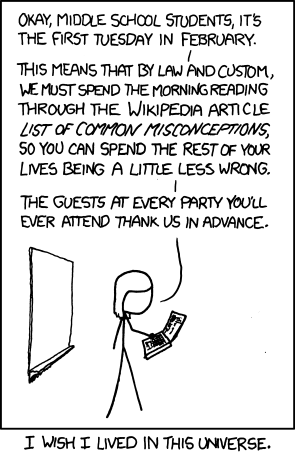
Educators have a slight problem when it comes to Wikipedia. On the one hand, it is a quick place to find answers to some random questions that inevitably pop up in the minds of the curious or the forgetful. (What is "zeugma"? Will that be on the test?)

A common misconception among students is that the word "research" means "spending five minutes on Google". And "writing a research paper" means paraphrasing the first five items that pop up. 

Many teachers do not allow their kids to use Wikipedia as a source for research papers, though its reference lists can be a good place to find some sources.  The idea is to force them to actually look around for information from sources that carry some academic weight.

But, perhaps there is a place in the secondary education universe for Wikipedia after all:

(http://xkcd.com/843/)

Tuesday, March 1, 2011

Wisconsin Woes

(Source)
I suppose it is about time I said something about Wisconsin.

I have spent most of the last few weeks listening.  Mostly to a lot of hotheaded responses on both sides.

On one end of the spectrum, liberals accuse conservatives of inventing and even creating budget deficits in order to keep the working man down in favor of fascism,  greedy corporations, and the great anti-feminist conspiracy.   Some compare the striking teachers to the demonstrators in Egypt. Others, who appear to have forgotten some details of world history, compare the Wisconsin teachers to the Solidarity Movement in Poland.  (Wait, wasn't the solidarity movement working against collectivism?)

Even some of my fellow conservatives have let their tempers override their reason. Some accuse teachers of being greedy statist shills, and distort information about their compensation, suggesting that they make $80,000-$100,000 per year, conveniently never bothering to mention that this figure includes the estimated value of their benefits. The Madison school district website states that their salary ranges from $32,913 to $64,681.  A fairly typical range for a public school teacher salary schedule. Rachel Alexander at TownHall reports that the average salary in Wisconsin is around $56,000.  Depending on whom one asks, the national average is somewhere between $40,000-$50,000 per year.


Sheesh.

This self-described "Crazy Schoolmarm" will now try to offer a sane reflection on the issue from the perspective of an educator.

When I initially entered this field, it was with full knowledge that I would be making much less  money than friends in other fields with similar education and experience. I assumed I would be driving used cars, and renting a small apartment for most (if not all ) of the rest of my life.   Contrary to rumor, my home state of California does not pay a higher salary to its public school teachers to compensate for the cost of living. In fact, because of the cost of living, I expected that if I were ever able to own a home, it would not be until my retirement.   In fact, I considered myself fortunate that I could even afford to pay rent on my own 500 square foot apartment while I taught in that state, instead of living with relatives or half a dozen roommates.  (My apartment was smaller than my classroom, by the way.)   I have two things to thank for my ability to rent that quiet apartment where I could retreat to grade papers in peace. One is the highly sensible upbringing I received from my parents. The other, I must suppose, is  the teacher's union, whose machinations led, no doubt, to the very affordable health benefits in my district which freed up more of my monthly budget  for rent.

This would probably be the right time to mention that I have been a (reluctant) card-carrying member of the California Teacher's Association (CTA), and therefore also of the NEA.

You are probably asking, "So, how did a nice conservative Catholic blogger like you end up in a union like that?".  Read on.

California, like Wisconsin, is not what we call a "Right to Work" state. What this meant for me as a public school teacher was that union dues were deducted from my paycheck whether I joined the union or not. The only way to have any say in how this money was used was to (yes, you guessed it!) join the union! This way, I could check the little box on the membership form that told them to keep my money out of political activity, and I had a vote. Unfortunately, my vote would not be enough to change the Union's socially liberal bias.  As Black Adder points out in his post at American Catholic, this does not exactly honor one's right to freely associate. I would have much preferred to take my money to the  Association of American Educators, which offers similar membership benefits, without the liberal politics.

In principle, I am not actually opposed to Teacher's unions, so long as they do what all unions were originally meant to do, which is protect their members from unjust treatment in the workplace.  Those who have never worked in a school may not realize how intensely dysfunctional and even hostile internal school politics can become, and the level to which unprofessional behavior can, in certain unfortunate cases, dominate a school and drive out skilled teachers.  (In fact, I would guess that this is the greatest reason for most problems with teacher retention.)

In practice, however, I have mostly found that the dysfunctional internal politics in schools has merely spread to the union.  As a result, I felt I needed a union to protect me from my union, more than from my employer. The problem is that the mainstream teacher's unions have been overstepping their bounds for some time, and function more as ideological advocacy groups than as professional associations protecting the rights of workers and the integrity of the profession at the same time.   (Did I mention that we were sometimes requested to picket against legislation, regardless of our personal opinions?--I quietly stayed out of that, by the way.)

When working as a public school teacher, I often wondered how much the district was paying for the highly affordable (for me) health benefits I mentioned before. There is, after all, "no such thing as a free lunch".  I wondered how the state was able to afford it. Now I know.

It couldn't.

California now faces a problem similar to, and perhaps even more dire than, that of Wisconsin.  High cost of living and a troubled economy continue to contribute to declining enrollment in public schools. Declining enrollment means less funding, and less funding means a system-wide budget crisis, and severely reduced job security for teachers.  Even before I left, schools were pink-slipping many teachers every spring, just in case they couldn't afford to keep them the next year. Shortly after, there was speculation that some teachers might have to be payed in IOU's!

As in Wisconsin, the CTA often demands that the state continue the dubious practice of spending money it doesn't have.  Many state employees forget that the state's money comes from taxpayers, including themselves. Others do not forget, and actually ask for increased taxes.  The problem is, taxes can only go so high before everyone starts to suffer. This is usually when they start moving somewhere else, as my husband and I did, and the declining enrollment problem only gets worse! If I were still living on my own in my home state, even given the tightness of my personal budget at the time, I would have been willing to pay a higher premium on my health benefits, if it meant a greater likelihood that I would actually still have a job and said benefits in future years.

As far as I have been able do discover, the cost of living in Wisconsin is considerably less than that in California, making it much more likely that someone, even in her first years in the classroom, will be able to support herself there on her take-home pay.  A slight increase in one's health care premium is, under the circumstances, a small price to pay for increased job security, especially if one is still able to eat and have a roof over one's head.  Furthermore, interrupting the education of thousands of children, and even using false doctor's notes (video link) to do so, is poor role modeling and in violation of what should be the generally accepted ethics of the profession.

There is, of course, the question of collective bargaining rights. Governor Walker's bill does limit these. So far as I can tell though, it does not do so sufficiently to warrant the outrage we have seen. In fact, it looks like it will do something to protect union members from misuse of their money, and prevent unions from making unreasonable demands on the state budget. If you are interested, here is a summary of what the bill will do, and if you are really interested, the full text of the actual bill (a very lengthy PDF document).

In short, I believe the following:

Public workers, like other workers have the right to unionize. What they do not have is the right to  force  dues out of public employees who do not wish to join them, and then to use that money for ends contrary to the consciences of those from whom they obtained it. They do not have the right to make demands or perform actions that are contrary to the public good. Since public worker strikes often mean serious harm to the public good, I do not think striking is a moral option under most circumstances, including those in Wisconsin. (See what the Catechism of the Catholic Church says about strikes here)

The state, as an employer, does have the duty to respect the rights of its employees, and during the budgeting process should make a reasonable effort to pay them a just wage. It also has the duty to protect the society in general, and the economic welfare of the taxpayer, and part of this is keeping an eye on the budget and not taxing the private sector out of existence.  It is wrong, as Chris Christie tried to point out to the New Jersey firefighters,  for politicians to make promises of benefits and perks for which the state cannot pay, leaving future generations to deal with rising debt and tempers.

A good salary and great benefits are very welcome things, but not if they lead to general ruin.

Sanity restored.

Maybe.

Back to business.


__________________________________
Related reading:
A Statement by the Bishop of the Diocese of Madison