| (Photo Source) |
Showing posts with label Absurdities. Show all posts
Thursday, October 13, 2011
Prison Chic on the Runway
Every now and then, this blog finds in necessary to comment on the latest fashion absurdities. Today's entry comes from the Michael Kors Spring 2012 line (which naturally hit the runway just in time for Fall 2011).
Is it just me or does that ensemble in the middle resemble an inmate's jumpsuit?
I think I'd rather wear a burlap dress:
Wednesday, October 12, 2011
Monday, August 29, 2011
Teachers, Social Media, and the Constitution
Today, the School Law Blog reported the following:
Having students on one's facebook friends list, even after they have graduated, can lead to problems, if one uses Facebook to publicly express personal opinions, as Florida Teacher of the Year Jerry Buell recently discovered.
Some teachers use social media to communicate with students and parents about classroom issues (a practice with which I am not personally comfortable). Others use it to keep in touch with those former students who wish to do so.
So how should teachers handle this issue? The Blue Skunk Blog has a handy list of guidelines:
(Read the complete Networking Guidelines for Teachers)
If you feel you must "friend" former students and colleagues, on Facebook, use the customized privacy settings to restrict their access to your wall posts.
So, while the constitution protects the personal freedom of educators using social media, it's in our own interests to exercise a little common sense and professional decorum.
A state judge has issued an injunction blocking a Missouri law that would have barred teachers from communicating with students over websites such as Facebook and Twitter.
...The teachers' union filed a lawsuit challenging the social-networking prohibition, which was passed this year as part of a larger bill designed to protect children from sexual abuse in schools.
...Judge Beetem found that social networking is used "extensively" by educators, and the Missouri measure could even bar communications between teachers and their own children. The injunction says that teachers who engage in social networking with students may not be disciplined, even if the court order is later overturned.
The Associated Press reports here that another union, the Missouri National Education Association, has been trying to work with legislators to revise the law, but that any such changes are not likely before the Missouri legislature's next regular session in January.
Having students on one's facebook friends list, even after they have graduated, can lead to problems, if one uses Facebook to publicly express personal opinions, as Florida Teacher of the Year Jerry Buell recently discovered.
Some teachers use social media to communicate with students and parents about classroom issues (a practice with which I am not personally comfortable). Others use it to keep in touch with those former students who wish to do so.
So how should teachers handle this issue? The Blue Skunk Blog has a handy list of guidelines:
- Do not accept students as friends on personal social networking sites. Decline any student-initiated friend requests.
- Do not initiate friendships with students
- Remember that people classified as “friends” have the ability to download and share your information with others.
- Post only what you want the world to see. Imagine your students, their parents, your administrator, visiting your site. It is not like posting something to your web site or blog and then realizing that a story or photo should be taken down. On a social networking site, basically once you post something it may be available, even after it is removed from the site.
- Do not discuss students or coworkers or publicly criticize school policies or personnel. (My Note: this goes for non-anonymous blogs, too, as Natalie Munroe found out.)
- Visit your profile’s security and privacy settings. At a minimum, educators should have all privacy settings set to “only friends”. “Friends of friends” and “Networks and Friends” open your content to a large group of unknown people. Your privacy and that of your family may be a risk.
(Read the complete Networking Guidelines for Teachers)
If you feel you must "friend" former students and colleagues, on Facebook, use the customized privacy settings to restrict their access to your wall posts.
So, while the constitution protects the personal freedom of educators using social media, it's in our own interests to exercise a little common sense and professional decorum.
Friday, August 12, 2011
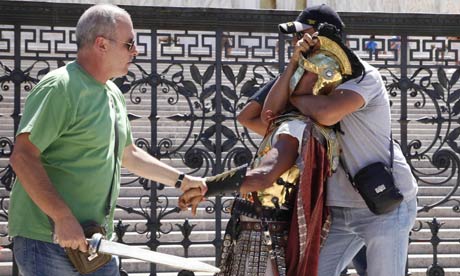
Gladiators Clash at the Colosseum
The MSNBC reports that violent turf wars have begun between groups of gladiator impersonators in Rome, leading to an undercover sting operation, arrests, and even---swordfights?
One of the more amusing photos from the arrests is one of a costumed gladiator in a headlock, courtesy of an officer in plain clothes.
If you have been to Rome, you've probably seen these guys hanging about outside the Colosseum, charging tourists absurd amounts of money to pose for pictures.
According to the reports, they've been fighting over the most lucrative spots and even intimidating customers. The Telegraph says:
Also covering this story:
BBC
The Guardian
Fox News
One of the more amusing photos from the arrests is one of a costumed gladiator in a headlock, courtesy of an officer in plain clothes.
If you have been to Rome, you've probably seen these guys hanging about outside the Colosseum, charging tourists absurd amounts of money to pose for pictures.
| (Photo Source) |
According to the reports, they've been fighting over the most lucrative spots and even intimidating customers. The Telegraph says:
Authorities said the replica gladiators and Roman legionaries came from seven families who jealously guarded their turf, seeing off rivals with verbal threats and, if necessary, physical intimidation.
The undercover operation was launched after police received complaints from bona fide tourist operators about the "gladiators'" abusive behaviour.
Also covering this story:
BBC
The Guardian
Fox News
Friday, July 22, 2011
Presidential Rat Race 2012: Ignorance, Sensationalism, and Agendas
Today over at CatholicThing Francis Beckwith offers an excellent column on a recent empty-headed piece on Michele Bachmann by Joshua Green, whose research skills appear to just barely surpass those of the stereotypical high school student. Beckwith's column offers a refreshing rebuttal to Green's fallacious logic and his theological and historical ignorance.
Professor Beckwith writes:
(Read the rest.)
Professor Beckwith writes:
The Atlantic has discovered the Reformation, albeit nearly five centuries too late.
Writer Joshua Green reports that the denomination in which presidential candidate Michele Bachmann was a member, the Wisconsin Evangelical Lutheran Synod (WELS), believes that Martin Luther was right about the Catholic papacy. Imagine that. Lutherans who believe ideas espoused by Luther. Shocking, isn’t it? Perhaps next week the Atlantic will inform its readers that the pope is Catholic, that Methodists are enamored of John Wesley, or that the Great Schism put a damper on Catholic-Orthodox relations.
(Read the rest.)
Friday, July 15, 2011
So much for penmanship.
The state of Indiana no longer includes cursive writing in its curricular standards.From TribStar.com:
State officials sent school leaders a memo April 25 telling them that instead of cursive writing, students will be expected to become proficient in keyboard use.
The memo says schools may continue to teach cursive as a local standard, or they may decide to stop teaching cursive altogether.
(Read the rest.)
Could this be the beginning of the end of cursive for the next generation of students?
I don't think schools will have to spend more time on keyboarding now than they have in the past. It may be they'll need less, considering how many kids these days seem to be using computers practically from infancy.
Handwritten assignments are still a fact of life in schools, and are a key part of many standardized tests, including Advanced Placement exams. Even in college, there are essay questions on midterm exams that require handwritten responses. Professors and test readers have little patience for unreadable work.
As many a secondary-level teacher can tell you, once those penmanship lessons from elementary school end, it is all downhill when it comes to neatly written work. The decline often reaches the point where some students give whole new meaning to the term chicken scratch. I'm not kidding. I had a student once whose printed writing literally looked like it was produced by actual chickens. The teaching of cursive seems worthwhile if only for the development (and maybe extended maintenance) of the fine motor skills that help students avoid this.
Let's hope high school teachers in Indiana can still read their students' work in ten more years.
Tip of the ruler to: Curriculum Matters
Friday, July 8, 2011
What will Governor Moonbeam Do? (Part 2)
Governor Jerry Brown has a controversial bill on his desk awaiting his response. SB48, according to Equality California (a group which favors this legislation) will:
In my previous post, I discussed the impracticality and even inhumanity of injecting identity politics into the classroom. The California Catholic Conference voiced its opposition to the bill on those grounds last April.
But the debate over SB48, nicknamed "The Fair, Accurate, Inclusive and Respectful (FAIR) Education Act" is not simply a debate about how to encourage politeness in schoolchildren. It's not really even about bigotry.
When schools teach about the Women's Suffrage or Civil Rights movement, they usually do so in a manner that constitutes an endorsement. In the process, students rightly learn that institutionalized sexism and racism are dehumanizing and therefore socially unacceptable. It is wrong to discriminate against human beings because of a state of being such as skin color or gender. Skin color does not make a person good. It does not affect the state of his or her soul. Women may in general be physically weaker than men, but that does not make us morally inferior. While there may be evidence to suggest that men have more inclinations toward violence, that does not mean human males are born into a state of moral inferiority when compared to women.
A person's moral inferiority comes from choices, not from the way the way he or she was born. A man who, for example, cheats on his wife does so not simply because he has a male inclination for unfathfulness; he does so because he chose act upon it. The action is where the moral problem lies, not the inclination.
So what will schools be endorsing when they teach about the LGBT movement if it is given the same treatment as the Civil Rights movement? The LGBT movement's goal is the acceptance of certain behavior, not merely the acceptance of a state of being or an inclination. If the school treats that goal as laudable, it is essentially endorsing the homosexual lifestyle as something morally acceptable. This will most certainly come into conflict with the religious and cultural values of many students in California schools.
That is what makes this issue different. It is not simply about how one is born, or whether a person has certain desires, tendencies, drives, or inclinations. It is about how one chooses to live and act, and whether a school, as an agent of the State, has the right to tell parents and students how to define sin.
In short, the debate over SB 48 is a debate about the role of the state in defining the sexual morality of private citizens and their children.
This becomes an especially sticky issue because teachings on sexual morality are often (though not always) faith based, which means this is also a question of free exercise of religion.
Though schools are often important for the social development of children, parents are the first and most important educators, especially in matters of faith and morals, and they are right to object when a particular school or and entire school system seeks to undermine what they teach their children in good conscience.
It gets even stickier when students become old enough to choose whether or not to believe as they were raised. It is not unheard of for a student to be raised in one faith, but convert to another in her teens. At the secondary level, a public school has to avoid infringing upon the constitutional rights of the student as well as the parents. The state has no business telling a student that she cannot believe what her faith teaches.
Schools and their employees cannot fulfill the requirements of this bill, and remain neutral with respect to the morality of homosexual behavior. This creates serious problems for parents, teachers, and students, whose reasoned moral objections to homosexuality and the LGBT movement come in conflict with this legislation. Whether legislators in California like it or not, individual citizens do have a right to work in an environment that does not force them to choose between their consciences and their employment or education. It is not the place of the public schools to engage in social engineering or to judge the beliefs and opinions of students, though efforts to do so are nothing new, historically speaking. It is a practice that goes as far back as the 19th century.
As I pointed out in my last post, the state is much more likely to reach its stated goal of reducing bullying if it sticks to the more neutral path of instructing students in the very useful principle of respect for one's fellow human beings. It is actually possible to teach kids to be polite to others, even in the face of serious disagreement or even fear, without injecting oneself into the religious instruction the student receives from his or her family.
Specific moral instruction is best left in the purview of parents, but there are many in education and in politics who believe they and the schools have a duty to subvert parental teachings with which they do not agree, especially if those parents embrace traditional Judeo-Christian morality. In my own experiences at multiple public schools, I observed that this prejudice is so pervasive within the world of public education, that many of my colleagues were not even conscious of how it affected their attitudes toward parents and even toward their own students.
Contrary to what some among my former colleagues believe, it is possible to have strenuous moral objections to someone else's choices, actions, or lifestyle, without losing sight of that person's humanity. With effort, one can even express such disagreements politely. It is even possible for young people to manage this with proper instruction. But the purveyors of "tolerance" seem as unable to tolerate this concept as to tolerate the suggestion that there is even such a thing as objective morality.
Tolerating the idea of objective morality means living with the possibility of falling from grace, and this is not terribly compatible with modern thinking.
In fact, our fallen nature is really our most ancient and universally recognized trait. From Shakespeare's plays to Lord of the Rings, fall and redemption make up the thematic material of some of the greatest literature ever written. Even the Ancient Greeks had their own story of a "fall" in the form of Pandora and the infamous box of furies. As G.K. Chesterton noted, it wasn't until recently that people began to suggest that there is no such thing as sin:
... amend the Education Code to include social sciences instruction on the contributions of lesbian, gay, bisexual and transgender (LGBT) people. This bill would also prohibit discriminatory instruction and discriminatory materials from being adopted by the State Board of Education.(The full text of the bill may be found here.)
In my previous post, I discussed the impracticality and even inhumanity of injecting identity politics into the classroom. The California Catholic Conference voiced its opposition to the bill on those grounds last April.
But the debate over SB48, nicknamed "The Fair, Accurate, Inclusive and Respectful (FAIR) Education Act" is not simply a debate about how to encourage politeness in schoolchildren. It's not really even about bigotry.
When schools teach about the Women's Suffrage or Civil Rights movement, they usually do so in a manner that constitutes an endorsement. In the process, students rightly learn that institutionalized sexism and racism are dehumanizing and therefore socially unacceptable. It is wrong to discriminate against human beings because of a state of being such as skin color or gender. Skin color does not make a person good. It does not affect the state of his or her soul. Women may in general be physically weaker than men, but that does not make us morally inferior. While there may be evidence to suggest that men have more inclinations toward violence, that does not mean human males are born into a state of moral inferiority when compared to women.
A person's moral inferiority comes from choices, not from the way the way he or she was born. A man who, for example, cheats on his wife does so not simply because he has a male inclination for unfathfulness; he does so because he chose act upon it. The action is where the moral problem lies, not the inclination.
So what will schools be endorsing when they teach about the LGBT movement if it is given the same treatment as the Civil Rights movement? The LGBT movement's goal is the acceptance of certain behavior, not merely the acceptance of a state of being or an inclination. If the school treats that goal as laudable, it is essentially endorsing the homosexual lifestyle as something morally acceptable. This will most certainly come into conflict with the religious and cultural values of many students in California schools.
That is what makes this issue different. It is not simply about how one is born, or whether a person has certain desires, tendencies, drives, or inclinations. It is about how one chooses to live and act, and whether a school, as an agent of the State, has the right to tell parents and students how to define sin.
In short, the debate over SB 48 is a debate about the role of the state in defining the sexual morality of private citizens and their children.
This becomes an especially sticky issue because teachings on sexual morality are often (though not always) faith based, which means this is also a question of free exercise of religion.
Though schools are often important for the social development of children, parents are the first and most important educators, especially in matters of faith and morals, and they are right to object when a particular school or and entire school system seeks to undermine what they teach their children in good conscience.
It gets even stickier when students become old enough to choose whether or not to believe as they were raised. It is not unheard of for a student to be raised in one faith, but convert to another in her teens. At the secondary level, a public school has to avoid infringing upon the constitutional rights of the student as well as the parents. The state has no business telling a student that she cannot believe what her faith teaches.
Schools and their employees cannot fulfill the requirements of this bill, and remain neutral with respect to the morality of homosexual behavior. This creates serious problems for parents, teachers, and students, whose reasoned moral objections to homosexuality and the LGBT movement come in conflict with this legislation. Whether legislators in California like it or not, individual citizens do have a right to work in an environment that does not force them to choose between their consciences and their employment or education. It is not the place of the public schools to engage in social engineering or to judge the beliefs and opinions of students, though efforts to do so are nothing new, historically speaking. It is a practice that goes as far back as the 19th century.
As I pointed out in my last post, the state is much more likely to reach its stated goal of reducing bullying if it sticks to the more neutral path of instructing students in the very useful principle of respect for one's fellow human beings. It is actually possible to teach kids to be polite to others, even in the face of serious disagreement or even fear, without injecting oneself into the religious instruction the student receives from his or her family.
Specific moral instruction is best left in the purview of parents, but there are many in education and in politics who believe they and the schools have a duty to subvert parental teachings with which they do not agree, especially if those parents embrace traditional Judeo-Christian morality. In my own experiences at multiple public schools, I observed that this prejudice is so pervasive within the world of public education, that many of my colleagues were not even conscious of how it affected their attitudes toward parents and even toward their own students.
Contrary to what some among my former colleagues believe, it is possible to have strenuous moral objections to someone else's choices, actions, or lifestyle, without losing sight of that person's humanity. With effort, one can even express such disagreements politely. It is even possible for young people to manage this with proper instruction. But the purveyors of "tolerance" seem as unable to tolerate this concept as to tolerate the suggestion that there is even such a thing as objective morality.
Tolerating the idea of objective morality means living with the possibility of falling from grace, and this is not terribly compatible with modern thinking.
In fact, our fallen nature is really our most ancient and universally recognized trait. From Shakespeare's plays to Lord of the Rings, fall and redemption make up the thematic material of some of the greatest literature ever written. Even the Ancient Greeks had their own story of a "fall" in the form of Pandora and the infamous box of furies. As G.K. Chesterton noted, it wasn't until recently that people began to suggest that there is no such thing as sin:
Whether or no man could be washed in miraculous waters, there was no doubt at any rate that he wanted washing. But certain religious leaders in London, not mere materialists, have begun in our day not to deny the highly disputable water, but to deny the indisputable dirt. Certain new theologians dispute original sin, which is the only part of Christian theology which can really be proved. Some followers of the Reverend R. J. Campbell, in their almost too fastidious spirituality, admit divine sinlessness, which they cannot see even in their dreams. But they essentially deny human sin, which they can see in the street. The strongest saints and the strongest sceptics alike took positive evil as the starting-point of their argument. If it be true (as it certainly is) that a man can feel exquisite happiness in skinning a cat, then the religious philosopher can only draw one of two deductions. He must either deny the existence of God, as all atheists do; or he must deny the present union between God and man, as all Christians do. The new theologians seem to think it a highly rationalistic solution to deny the cat. (Orthodoxy)
I suspect that this bill is less about bullying, and more a part of an effort to teach the next generations to deny both dirt and cat.
-----------------------------------------------------------------
Update: Read about what Archbishop Gomez has to say on this topic.
Thursday, July 7, 2011
What Will Governor Moonbeam Do?
Identity politics took a central place in the political discourse of our nation during the last presidential election. It seemed to me that this did more to reinforce racial division in the country than it did to heal it. I suspect it may have even served to undo some of the progress that has been made over the past couple of decades. One of my eleventh graders that year said to me one day that she never felt divided from anyone because of race, until she witnessed the national tension during that campaign season. She discovered unity is more difficult when people are determined to carry out the dehumanizing practice of sorting themselves and others into competing victim groups.
This brings me to the issue of identity politics, and its influence on education as we know it.
As many of you are no doubt already aware, a piece of legislation is about to hit the governor's desk in California that, as the San Francisco Gate puts it, "would make the state the first requiring public schools to include the contributions of gays and lesbians in social studies curriculum". It further explains that the bill "adds lesbian, gay, bisexual and transgender people as well as people with disabilities to the list of groups that schools must include in the lessons. It also would prohibit material that reflects adversely on gays."
So, if Jerry Brown signs SB48, the good news is English teachers will have to stop ignoring Walt Whitman and Oscar Wilde.
Wait a minute... They are already in the curriculum!
And if since the bill also covers historical figures with disabilities, history teachers will have to stop leaving out FDR.
Wait... Never mind. He's already there too.
We remember writers, mathematicians, scientists, and historical figures, not because they are token figures of a certain group, but because of their influence for good or ill. We read Mary Shelley's Frankenstein because it is a great novel, not merely because a woman wrote it. We study FDR's presidency because it was unique and historically important, not simply because he was in a wheelchair. While someone's ethnicity, disability, or gender will contribute to who she is, it is not her only definitive characteristic. Even for historical figures whose identity is very important, such as Frederick Douglass or Martin Luther King, great accomplishment and historical influence are still the primary reasons why we remember them.
Many suggest that the debate over homosexuality in America is no different from the questions of race that our nation faced over the past century. Even if, for the sake of argument, we concede this point, this legislation still remains impractical in light of certain realities in the classroom.
Nobody who has ever spent significant time in a school can deny that kids are pretty good at dividing themselves along arbitrary lines, whether it be race, class, fashion, glasses, or grades. I have seen students treat one another better after meaningful personal interaction. I have never seen a student decide that he is going to quit making fun of someone because a great author or historical figure had the same trait as the "other". A student who bullies his classmate because said classmate is "a brain", for instance, isn't going to change his behavior because Einstein was "a brain" too. In fact, he is more likely to write off Einstein as well as his classmate, and go on his merry, anti-brain way. I have never seen a token minority author or historical figure serve to eliminate racism, nor a lesson on a token woman cure anyone of misogyny.
As someone whose curriculum consisted mostly of old books written by people who are now dead, I found the question of prejudice to be a very relevant one for my classroom. If students cannot see the human dignity of those living human beings sitting next to them in class, they aren't going to be able to see it in fictional characters created by long-deceased authors. After all, can there be a greater divide between people than between the living and the dead? Students must learn to see the inherent human dignity of those around them before they will be able to see it in people and characters from the past. Mark Twain showed us this more than a century ago: it is the lesson that we learn from reading Huckleberry Finn. It is the time they spend on the river together that allows Huck to see Jim as a man and a friend, and not merely as a slave.
Tolerance is not a false pretense that people have no significantly different beliefs, backgrounds, and ideas. It is not a hypocritical assertion that we are all the same. It is a learned skill. It is, essentially, a form of patience that allows us to live and work with people whom we do not entirely understand, or with whom we fundamentally disagree, without losing our sanity or our awareness of each others humanity.
A curriculum that emphasizes differences and token representatives of politically fashionable classes of human beings does more to undermine a culture of acceptance in schools than it does to create one. Students need no reminders that there are stark differences among them. Drawing attention to labels provides those unneeded reminders, and reinforces the false and dehumanizing notion that students cannot relate to anyone who does not have some arbitrary identifying characteristic in common.
The bill is also intended to add the history of the LGBT movement, but prohibits any material that could reflect poorly upon it. This bears more resemblance to propaganda than it does to an honest approach to history. If similar legal injunctions existed with respect to study of the movement for racial equality, many activities of groups such as the Black Panthers and the more controversial comments of Louis Farrakhan would be forbidden material. The fact that some people working for racial equality behaved badly has not undone the appreciation most people currently have for the progress our nation has made in race relations over the past five decades. Human history, like the human beings in it, is full of behavior that "reflects badly" on someone. We can learn as much from those as we can from the moments when heroic people did something gloriously right.
In charity, I can only hope that those who are promoting this bill are unaware of the practical problems outlined above.
If they are aware of them, one needs to ask why they think a curricular emphasis on the LGBT movement will will change the value students place on their classmates or on Walt Whitman's literary achievements. I shall deal with that question later.
This brings me to the issue of identity politics, and its influence on education as we know it.
As many of you are no doubt already aware, a piece of legislation is about to hit the governor's desk in California that, as the San Francisco Gate puts it, "would make the state the first requiring public schools to include the contributions of gays and lesbians in social studies curriculum". It further explains that the bill "adds lesbian, gay, bisexual and transgender people as well as people with disabilities to the list of groups that schools must include in the lessons. It also would prohibit material that reflects adversely on gays."
So, if Jerry Brown signs SB48, the good news is English teachers will have to stop ignoring Walt Whitman and Oscar Wilde.
Wait a minute... They are already in the curriculum!
And if since the bill also covers historical figures with disabilities, history teachers will have to stop leaving out FDR.
Wait... Never mind. He's already there too.
We remember writers, mathematicians, scientists, and historical figures, not because they are token figures of a certain group, but because of their influence for good or ill. We read Mary Shelley's Frankenstein because it is a great novel, not merely because a woman wrote it. We study FDR's presidency because it was unique and historically important, not simply because he was in a wheelchair. While someone's ethnicity, disability, or gender will contribute to who she is, it is not her only definitive characteristic. Even for historical figures whose identity is very important, such as Frederick Douglass or Martin Luther King, great accomplishment and historical influence are still the primary reasons why we remember them.
Many suggest that the debate over homosexuality in America is no different from the questions of race that our nation faced over the past century. Even if, for the sake of argument, we concede this point, this legislation still remains impractical in light of certain realities in the classroom.
Nobody who has ever spent significant time in a school can deny that kids are pretty good at dividing themselves along arbitrary lines, whether it be race, class, fashion, glasses, or grades. I have seen students treat one another better after meaningful personal interaction. I have never seen a student decide that he is going to quit making fun of someone because a great author or historical figure had the same trait as the "other". A student who bullies his classmate because said classmate is "a brain", for instance, isn't going to change his behavior because Einstein was "a brain" too. In fact, he is more likely to write off Einstein as well as his classmate, and go on his merry, anti-brain way. I have never seen a token minority author or historical figure serve to eliminate racism, nor a lesson on a token woman cure anyone of misogyny.
As someone whose curriculum consisted mostly of old books written by people who are now dead, I found the question of prejudice to be a very relevant one for my classroom. If students cannot see the human dignity of those living human beings sitting next to them in class, they aren't going to be able to see it in fictional characters created by long-deceased authors. After all, can there be a greater divide between people than between the living and the dead? Students must learn to see the inherent human dignity of those around them before they will be able to see it in people and characters from the past. Mark Twain showed us this more than a century ago: it is the lesson that we learn from reading Huckleberry Finn. It is the time they spend on the river together that allows Huck to see Jim as a man and a friend, and not merely as a slave.
Tolerance is not a false pretense that people have no significantly different beliefs, backgrounds, and ideas. It is not a hypocritical assertion that we are all the same. It is a learned skill. It is, essentially, a form of patience that allows us to live and work with people whom we do not entirely understand, or with whom we fundamentally disagree, without losing our sanity or our awareness of each others humanity.
A curriculum that emphasizes differences and token representatives of politically fashionable classes of human beings does more to undermine a culture of acceptance in schools than it does to create one. Students need no reminders that there are stark differences among them. Drawing attention to labels provides those unneeded reminders, and reinforces the false and dehumanizing notion that students cannot relate to anyone who does not have some arbitrary identifying characteristic in common.
The bill is also intended to add the history of the LGBT movement, but prohibits any material that could reflect poorly upon it. This bears more resemblance to propaganda than it does to an honest approach to history. If similar legal injunctions existed with respect to study of the movement for racial equality, many activities of groups such as the Black Panthers and the more controversial comments of Louis Farrakhan would be forbidden material. The fact that some people working for racial equality behaved badly has not undone the appreciation most people currently have for the progress our nation has made in race relations over the past five decades. Human history, like the human beings in it, is full of behavior that "reflects badly" on someone. We can learn as much from those as we can from the moments when heroic people did something gloriously right.
In charity, I can only hope that those who are promoting this bill are unaware of the practical problems outlined above.
If they are aware of them, one needs to ask why they think a curricular emphasis on the LGBT movement will will change the value students place on their classmates or on Walt Whitman's literary achievements. I shall deal with that question later.
Tuesday, June 14, 2011
Surviving the Economy and Avoiding the Servile State
It seems like everyone is talking about the economy and what ails it. Some blame big government and socialist thinking and policies. Others blame capitalism, republicans, and big business. They are both right. They are also both wrong.
Neither big government nor big business have the needs of human beings as their central concern. Big business is too busy with its profits, big government is too busy holding onto its power, and very often they are both too busy cooperating with each other to reach their respective goals to have any time left to take human dignity into account. When Hilaire Belloc published The Servile State, he was concerned that trends at the time would lead to "the establishment of compulsory labour legally enforceable upon those who do not own the means of production for the advantage of those who do". Were he alive today, I think he would still be worried.
At the time, Belloc was more alarmed about big business running amok, but he also pointed out that an out of control government would ultimately lead to the same end: a society in which a few have total legal and economic power over the many (see the illustration below for a visual representation of this concept). Considering the size of the government at present, as well as the current state of big business, we may have even more reason for concern than did Belloc and his contemporaries.
Belloc argued that the best way to halt our advancement toward the "servile state" was to encourage policies that favor keeping both government and business small, and ownership of the means of production (i.e. land, tools, equipment, skills, etc.) as widespread as possible. The ideal economy, he believed, would be one consisting primarily of small, independent, family owned businesses. He reasoned that this would lead to a more human (and humane) workplace as well as a more just society. This economic ideal, which is neither capitalist nor socialist, is commonly called Distributism.
Over at The Huffington Post, Thom Hartmann is trying to make sense of the present economy. He is right that, historically speaking, "There's Nothing "Normal" About A Middle Class". His observation that social upheaval precedes two historical surges in the middle class population is also worth considering. But there are two flaws in his approach as he tries to figure out why a middle class is able to sustain itself in certain periods of history and not in others.
The first problem is that he fails to take into account the existence of widespread ownership of the means of production during the historical periods he cites. Without this, the middle class could not have grown as it did.
Hartmann points to the depopulation of the European continent during the plague, and the colonization of the Americas as points in history that allowed a middle class to form. These instances of social upheaval lead to movement away from a servile society to a more democratic one. Hartmann attributes this movement to the changed ratio of people to resources, but there is more to it than that. This social upheaval led to the absence of landowning nobility, allowing the common man to take ownership of the resources around him.
Whether plague survivors or colonists, people in both periods of history Hartmann cites would have found themselves in a position much more favorable to ownership and self-sufficiency because they would have been able to control the land on which they lived and worked. Stake out a plot of land, plant a few crops, teach your kids how to farm, and you have a family business. Or, at least, you have the means to feed yourself even if you can't make money selling what you grow.
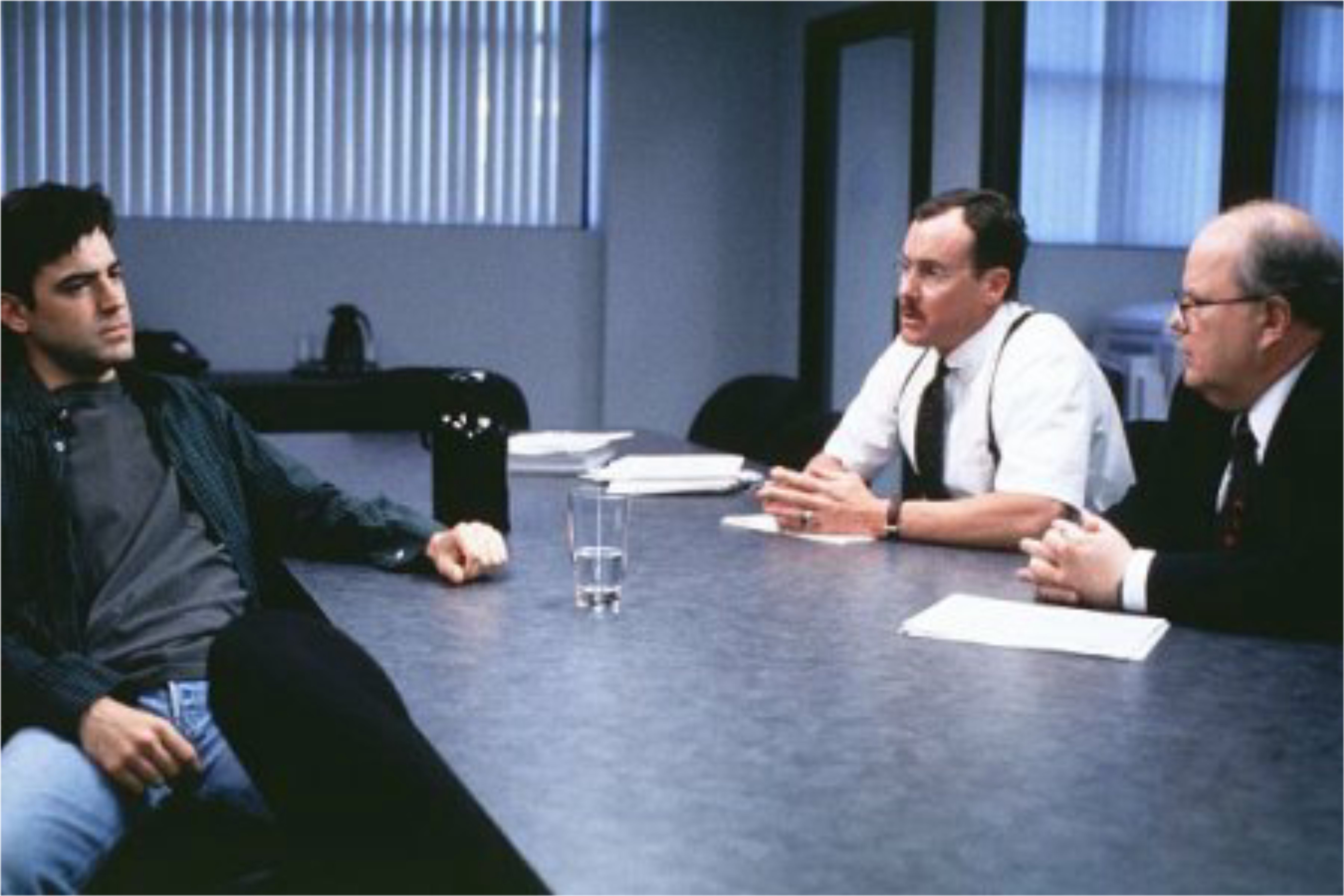
Like commoners living in a feudal society, corporate and government employees of today spend their labors working with resources that are not their own. What does this mean for employees? I offer the following dialogue from "Office Space" as an answer to that:
In other words, employment is not the problem for the middle class. Nor is unemployment. The problem is dependence, either on government or employers.
This leads to Hartmann's second problem: he ignores what the "middle class" was, and does not think carefully enough about what it is now.
In the past, the middle classes were those who were able to make a living for themselves without being born into the wealthy upper classes. Socially, they were commoners. Economically they were not, because they owned the fruits of their labors. That left them somewhere in between the two.
In present political discourse we are generally inclined to define the middle class as those who have an income that is--well--in the middle. We do not often consider how many of those people do not depend on either government or corporate employment for their "middle class" status. Hartmann compares the merchant classes of the middle ages to present-day middle class citizens. Many merchants of that period (such as the father of St. Francis of Assisi) certainly made a tidy income. But they did so as owners of their own small businesses. Small farmers would have been able to feed themselves without depending on corporate food distributors to provide groceries. They would have earned money selling their goods to the local community without having to contract with a large corporation in order to survive. Farmers and merchants in pre-industrialized society were not at the mercy of an indifferent bureaucracy to "create jobs". They created their own.
G.K. Chesterton wrote "Too much capitalism does not mean too many capitalists, but too few." The social gap that ought to concern us today is not merely between rich and poor. It is between employers and employees. There are far too few of the former.
Unfortunately, we have a long way to go before we can change the structure of our economy. Our culture and our education system still train us and our children to become employees rather than entrepreneurs or independent thinkers. Our political system thrives on the votes our politicians buy from us using our own tax dollars.
The solution to our present economic problem is not "investment in infrastructure" through another "New Deal". This merely makes the government another big employer. Nor is the solution to give existing big employers more latitude to do whatever they want regardless of the human cost. Common sense and a renewal of an independent human spirit is the answer.
I only hope that it won't take another bubonic plague to make us regain ours.
--------------------------------------------------------------------------------------
Further Reading:
Pope Leo XIII, Rerum Novarum
Hilaire Belloc, The Servile State
G.K. Chesterton, Orthodoxy
G.K. Chesterton, What’s Wrong with the World
Neither big government nor big business have the needs of human beings as their central concern. Big business is too busy with its profits, big government is too busy holding onto its power, and very often they are both too busy cooperating with each other to reach their respective goals to have any time left to take human dignity into account. When Hilaire Belloc published The Servile State, he was concerned that trends at the time would lead to "the establishment of compulsory labour legally enforceable upon those who do not own the means of production for the advantage of those who do". Were he alive today, I think he would still be worried.
At the time, Belloc was more alarmed about big business running amok, but he also pointed out that an out of control government would ultimately lead to the same end: a society in which a few have total legal and economic power over the many (see the illustration below for a visual representation of this concept). Considering the size of the government at present, as well as the current state of big business, we may have even more reason for concern than did Belloc and his contemporaries.
Belloc argued that the best way to halt our advancement toward the "servile state" was to encourage policies that favor keeping both government and business small, and ownership of the means of production (i.e. land, tools, equipment, skills, etc.) as widespread as possible. The ideal economy, he believed, would be one consisting primarily of small, independent, family owned businesses. He reasoned that this would lead to a more human (and humane) workplace as well as a more just society. This economic ideal, which is neither capitalist nor socialist, is commonly called Distributism.
Over at The Huffington Post, Thom Hartmann is trying to make sense of the present economy. He is right that, historically speaking, "There's Nothing "Normal" About A Middle Class". His observation that social upheaval precedes two historical surges in the middle class population is also worth considering. But there are two flaws in his approach as he tries to figure out why a middle class is able to sustain itself in certain periods of history and not in others.
The first problem is that he fails to take into account the existence of widespread ownership of the means of production during the historical periods he cites. Without this, the middle class could not have grown as it did.
Hartmann points to the depopulation of the European continent during the plague, and the colonization of the Americas as points in history that allowed a middle class to form. These instances of social upheaval lead to movement away from a servile society to a more democratic one. Hartmann attributes this movement to the changed ratio of people to resources, but there is more to it than that. This social upheaval led to the absence of landowning nobility, allowing the common man to take ownership of the resources around him.
Whether plague survivors or colonists, people in both periods of history Hartmann cites would have found themselves in a position much more favorable to ownership and self-sufficiency because they would have been able to control the land on which they lived and worked. Stake out a plot of land, plant a few crops, teach your kids how to farm, and you have a family business. Or, at least, you have the means to feed yourself even if you can't make money selling what you grow.
Like commoners living in a feudal society, corporate and government employees of today spend their labors working with resources that are not their own. What does this mean for employees? I offer the following dialogue from "Office Space" as an answer to that:
Peter Gibbons: The thing is, Bob, it's not that I'm lazy, it's that I just don't care.Bob Porter: Don't... don't care?Peter Gibbons: It's a problem of motivation, all right? Now if I work my a** off and Initech ships a few extra units, I don't see another dime, so where's the motivation? And here's something else, Bob: I have eight different bosses right now.Bob Slydell: I beg your pardon?Peter Gibbons: Eight bosses.Bob Slydell: Eight?Peter Gibbons: Eight, Bob. So that means that when I make a mistake, I have eight different people coming by to tell me about it. That's my only real motivation is not to be hassled, that and the fear of losing my job. But you know, Bob, that will only make someone work just hard enough not to get fired.
In other words, employment is not the problem for the middle class. Nor is unemployment. The problem is dependence, either on government or employers.
This leads to Hartmann's second problem: he ignores what the "middle class" was, and does not think carefully enough about what it is now.
In the past, the middle classes were those who were able to make a living for themselves without being born into the wealthy upper classes. Socially, they were commoners. Economically they were not, because they owned the fruits of their labors. That left them somewhere in between the two.
In present political discourse we are generally inclined to define the middle class as those who have an income that is--well--in the middle. We do not often consider how many of those people do not depend on either government or corporate employment for their "middle class" status. Hartmann compares the merchant classes of the middle ages to present-day middle class citizens. Many merchants of that period (such as the father of St. Francis of Assisi) certainly made a tidy income. But they did so as owners of their own small businesses. Small farmers would have been able to feed themselves without depending on corporate food distributors to provide groceries. They would have earned money selling their goods to the local community without having to contract with a large corporation in order to survive. Farmers and merchants in pre-industrialized society were not at the mercy of an indifferent bureaucracy to "create jobs". They created their own.
G.K. Chesterton wrote "Too much capitalism does not mean too many capitalists, but too few." The social gap that ought to concern us today is not merely between rich and poor. It is between employers and employees. There are far too few of the former.
Unfortunately, we have a long way to go before we can change the structure of our economy. Our culture and our education system still train us and our children to become employees rather than entrepreneurs or independent thinkers. Our political system thrives on the votes our politicians buy from us using our own tax dollars.
The solution to our present economic problem is not "investment in infrastructure" through another "New Deal". This merely makes the government another big employer. Nor is the solution to give existing big employers more latitude to do whatever they want regardless of the human cost. Common sense and a renewal of an independent human spirit is the answer.
I only hope that it won't take another bubonic plague to make us regain ours.
--------------------------------------------------------------------------------------
Further Reading:
Pope Leo XIII, Rerum Novarum
Hilaire Belloc, The Servile State
G.K. Chesterton, Orthodoxy
G.K. Chesterton, What’s Wrong with the World
Wednesday, June 8, 2011
Fashion Trend Trivializes Rosary
One of my favorite gifts that I received for my confirmation was a beautiful rosary bracelet. I felt that wearing it provided me with a way to express my faith publicly but not ostentatiously, and on occasion it became a conversation piece that allowed me to share my faith with others who do not know what the rosary is. It also came in very handy if I happened to forget to bring a full-sized rosary with me when I might have need of one.
Those who wear their beads with genuine devotion are in good company. After all, many religious wear their rosaries in their cinctures, keeping them available at all times. In our human frailty, keeping our rosaries where we can see them is probably the best way many of us have to remind ourselves to actually use them.
But, we have to be careful about how we do so, lest they become Pharisaical display or mere superficial ornaments.
I have noticed over the past few years that many more people, especially teens and young adults, are wearing rosaries as fashion statements. Even Justin Bieber has jumped on this bandwagon.
Unfortunately, the comportment and dress of some of some forces me to doubt that they are wearing rosaries as devotionals. Many celebrities whose public behavior is, shall we say, less than in line with Catholic morality, have popularized rosary beads as superficial fashion statements. Britney Spears and Madonna are among the most prominent examples.
At the most extreme end of this problem is the inclusion of rosaries worn around the neck in the attire of gang members. This has even caught the attention of schools, law enforcement, and news media. The San Antonio Police Department Youth Crime Service Unit "Gang Awareness" handbook and USA Today both report that rosary beads are now common components of gang-related attire.
More recently I have seen items labeled as "rosary necklaces" for sale in shops that cater to the more unsavory trends in youth fashion. These usually have features that are rather different from the real thing. Hot Topic, a mall chain that features some of the more edgy fashions popular among suburban teens, offers a so-called "rosary necklace" with a charm that looks like a pair of brass knuckles where the crucifix should be, and a gun-shaped center. Such items are especially appealing to teens and young adults who buy into the glorified images of street culture so common in entertainment media.
On the one hand, it could be argued that if someone is going to wear a rosary as a mere fashion statement, it is less disrespectful to wear a bad knock-off than an actual sacred object. On the other hand, calling the bad knock-off a rosary, instead of something else, mocks the real thing and suggests that it is OK to pervert an item that is sacred into a profane fad. Either way, this trend displays a great lack of respect for Catholic beliefs and practices, especially when worn by those who have no interest in even the appearance of using them for actual prayer or following Catholic teaching. This public trivialization of one of our most distinctive spiritual tools should be of great concern to those who understand its true value.
Pope John Paul II called the rosary "an effective spiritual weapon against the evils afflicting society" (Rosarium Virginis Mariae). No weapon, whether temporal or spiritual is of any use if we do not understand it or know how to use it.
It may seem like I am splitting hairs here. It may seem like I am nitpicking when I express concern about this. After all, we have much to be concerned about when it comes to our kids and what they do and what they see on television. The fact that Lady Gaga wears something resembling a rosary around her neck (or eats one) may seem trivial compared to everything else she wears (or doesn't) and the things she says and does.
But I'm not alone here. Even the bishops find this trend to be disturbing, and have encouraged efforts to catechize people who walk into Catholic shops looking for rosaries, and thinking they are merely buying a necklace. Some business owners have begun giving out free leaflets on how to pray the rosary to the customers who purchase them, hoping that this will at least encourage respect for it, and maybe even teach people something.
If prayer, and the rosary in particular, is the most powerful tool we have to combat all of those evils that threaten our children (and he who is behind them), we must be concerned if people begin to forget what the rosary is for.
Imagine if every celebrity, twenty-something, and teen who wore something like the absurd piece of jewelry above actually learned to pray a real rosary.
![]() |
| (Photo Source) |
But, we have to be careful about how we do so, lest they become Pharisaical display or mere superficial ornaments.
I have noticed over the past few years that many more people, especially teens and young adults, are wearing rosaries as fashion statements. Even Justin Bieber has jumped on this bandwagon.
Unfortunately, the comportment and dress of some of some forces me to doubt that they are wearing rosaries as devotionals. Many celebrities whose public behavior is, shall we say, less than in line with Catholic morality, have popularized rosary beads as superficial fashion statements. Britney Spears and Madonna are among the most prominent examples.
At the most extreme end of this problem is the inclusion of rosaries worn around the neck in the attire of gang members. This has even caught the attention of schools, law enforcement, and news media. The San Antonio Police Department Youth Crime Service Unit "Gang Awareness" handbook and USA Today both report that rosary beads are now common components of gang-related attire.
On the one hand, it could be argued that if someone is going to wear a rosary as a mere fashion statement, it is less disrespectful to wear a bad knock-off than an actual sacred object. On the other hand, calling the bad knock-off a rosary, instead of something else, mocks the real thing and suggests that it is OK to pervert an item that is sacred into a profane fad. Either way, this trend displays a great lack of respect for Catholic beliefs and practices, especially when worn by those who have no interest in even the appearance of using them for actual prayer or following Catholic teaching. This public trivialization of one of our most distinctive spiritual tools should be of great concern to those who understand its true value.
Pope John Paul II called the rosary "an effective spiritual weapon against the evils afflicting society" (Rosarium Virginis Mariae). No weapon, whether temporal or spiritual is of any use if we do not understand it or know how to use it.
It may seem like I am splitting hairs here. It may seem like I am nitpicking when I express concern about this. After all, we have much to be concerned about when it comes to our kids and what they do and what they see on television. The fact that Lady Gaga wears something resembling a rosary around her neck (or eats one) may seem trivial compared to everything else she wears (or doesn't) and the things she says and does.
But I'm not alone here. Even the bishops find this trend to be disturbing, and have encouraged efforts to catechize people who walk into Catholic shops looking for rosaries, and thinking they are merely buying a necklace. Some business owners have begun giving out free leaflets on how to pray the rosary to the customers who purchase them, hoping that this will at least encourage respect for it, and maybe even teach people something.
If prayer, and the rosary in particular, is the most powerful tool we have to combat all of those evils that threaten our children (and he who is behind them), we must be concerned if people begin to forget what the rosary is for.
Imagine if every celebrity, twenty-something, and teen who wore something like the absurd piece of jewelry above actually learned to pray a real rosary.
Thursday, May 5, 2011
It's About Time
You may recall that the University of Notre Dame was the center of a much publicized scandal some time back. Much to the chagrin of every serious Catholic associated with the institution and the outrage of many other serious Catholics who are not, they invited President Obama to speak a their 2009 commencement, despite the fact that his positions on many fundamental social issues are directly contrary to Church teachings. (See the video below or read the Voter's Guide for Serious Catholics for more on which issues these are and why they are important.)
It could be argued that a Catholic university could legitimately invite a public figure who disagrees with church teaching to speak in a debate on issues of life and family. But, to invite President Obama to be a commencement speaker, and to award him an honorary degree while he was there, was a strange gesture for a Catholic university to make, to say the least. This is especially so when one considers the USCCB's 2004 statement on "Catholics in Political Life" which says:
Not surprisingly, Obama's remarks on the occasion, while full of words like "common ground", essentially asked Catholics and others with traditional Judeo-Christian values to set aside their consciences and follow his own moral views. (My response to his speech here.) Genuinlely conciliatory? I think not.
Protestors who came to speak out against this scandalous invitation were arrested for trespassing.
Those charges have now, two years later, been dropped, thanks to the efforts of the Thomas More Society, the president of which happens to be a Notre Dame graduate.
Links:
Thomas More Society’s Relentless Legal Pursuit Wins Justice for Pro-Life Activists at Notre Dame
WDNU News: Charges Dropped in Notre Dame Protest
LifeNews.com: Charges Dropped Against Notre Dame-Obama Speech Protestors
Tip of the Schoolmarm Ruler to: Joseph Bottum at CatholicVote.org.
It could be argued that a Catholic university could legitimately invite a public figure who disagrees with church teaching to speak in a debate on issues of life and family. But, to invite President Obama to be a commencement speaker, and to award him an honorary degree while he was there, was a strange gesture for a Catholic university to make, to say the least. This is especially so when one considers the USCCB's 2004 statement on "Catholics in Political Life" which says:
"The Catholic community and Catholic institutions should not honor those who act in defiance of our fundamental moral principles. They should not be given awards, honors or platforms which would suggest support for their actions."
Not surprisingly, Obama's remarks on the occasion, while full of words like "common ground", essentially asked Catholics and others with traditional Judeo-Christian values to set aside their consciences and follow his own moral views. (My response to his speech here.) Genuinlely conciliatory? I think not.
![]() |
| (Source) |
Links:
Thomas More Society’s Relentless Legal Pursuit Wins Justice for Pro-Life Activists at Notre Dame
WDNU News: Charges Dropped in Notre Dame Protest
LifeNews.com: Charges Dropped Against Notre Dame-Obama Speech Protestors
Tip of the Schoolmarm Ruler to: Joseph Bottum at CatholicVote.org.
Tuesday, March 1, 2011
Wisconsin Woes
![]() |
| (Source) |
I have spent most of the last few weeks listening. Mostly to a lot of hotheaded responses on both sides.
On one end of the spectrum, liberals accuse conservatives of inventing and even creating budget deficits in order to keep the working man down in favor of fascism, greedy corporations, and the great anti-feminist conspiracy. Some compare the striking teachers to the demonstrators in Egypt. Others, who appear to have forgotten some details of world history, compare the Wisconsin teachers to the Solidarity Movement in Poland. (Wait, wasn't the solidarity movement working against collectivism?)
Even some of my fellow conservatives have let their tempers override their reason. Some accuse teachers of being greedy statist shills, and distort information about their compensation, suggesting that they make $80,000-$100,000 per year, conveniently never bothering to mention that this figure includes the estimated value of their benefits. The Madison school district website states that their salary ranges from $32,913 to $64,681. A fairly typical range for a public school teacher salary schedule. Rachel Alexander at TownHall reports that the average salary in Wisconsin is around $56,000. Depending on whom one asks, the national average is somewhere between $40,000-$50,000 per year.
Sheesh.
This self-described "Crazy Schoolmarm" will now try to offer a sane reflection on the issue from the perspective of an educator.
When I initially entered this field, it was with full knowledge that I would be making much less money than friends in other fields with similar education and experience. I assumed I would be driving used cars, and renting a small apartment for most (if not all ) of the rest of my life. Contrary to rumor, my home state of California does not pay a higher salary to its public school teachers to compensate for the cost of living. In fact, because of the cost of living, I expected that if I were ever able to own a home, it would not be until my retirement. In fact, I considered myself fortunate that I could even afford to pay rent on my own 500 square foot apartment while I taught in that state, instead of living with relatives or half a dozen roommates. (My apartment was smaller than my classroom, by the way.) I have two things to thank for my ability to rent that quiet apartment where I could retreat to grade papers in peace. One is the highly sensible upbringing I received from my parents. The other, I must suppose, is the teacher's union, whose machinations led, no doubt, to the very affordable health benefits in my district which freed up more of my monthly budget for rent.
This would probably be the right time to mention that I have been a (reluctant) card-carrying member of the California Teacher's Association (CTA), and therefore also of the NEA.
You are probably asking, "So, how did a nice conservative Catholic blogger like you end up in a union like that?". Read on.
California, like Wisconsin, is not what we call a "Right to Work" state. What this meant for me as a public school teacher was that union dues were deducted from my paycheck whether I joined the union or not. The only way to have any say in how this money was used was to (yes, you guessed it!) join the union! This way, I could check the little box on the membership form that told them to keep my money out of political activity, and I had a vote. Unfortunately, my vote would not be enough to change the Union's socially liberal bias. As Black Adder points out in his post at American Catholic, this does not exactly honor one's right to freely associate. I would have much preferred to take my money to the Association of American Educators, which offers similar membership benefits, without the liberal politics.
In principle, I am not actually opposed to Teacher's unions, so long as they do what all unions were originally meant to do, which is protect their members from unjust treatment in the workplace. Those who have never worked in a school may not realize how intensely dysfunctional and even hostile internal school politics can become, and the level to which unprofessional behavior can, in certain unfortunate cases, dominate a school and drive out skilled teachers. (In fact, I would guess that this is the greatest reason for most problems with teacher retention.)
In practice, however, I have mostly found that the dysfunctional internal politics in schools has merely spread to the union. As a result, I felt I needed a union to protect me from my union, more than from my employer. The problem is that the mainstream teacher's unions have been overstepping their bounds for some time, and function more as ideological advocacy groups than as professional associations protecting the rights of workers and the integrity of the profession at the same time. (Did I mention that we were sometimes requested to picket against legislation, regardless of our personal opinions?--I quietly stayed out of that, by the way.)
When working as a public school teacher, I often wondered how much the district was paying for the highly affordable (for me) health benefits I mentioned before. There is, after all, "no such thing as a free lunch". I wondered how the state was able to afford it. Now I know.
It couldn't.
California now faces a problem similar to, and perhaps even more dire than, that of Wisconsin. High cost of living and a troubled economy continue to contribute to declining enrollment in public schools. Declining enrollment means less funding, and less funding means a system-wide budget crisis, and severely reduced job security for teachers. Even before I left, schools were pink-slipping many teachers every spring, just in case they couldn't afford to keep them the next year. Shortly after, there was speculation that some teachers might have to be payed in IOU's!
As in Wisconsin, the CTA often demands that the state continue the dubious practice of spending money it doesn't have. Many state employees forget that the state's money comes from taxpayers, including themselves. Others do not forget, and actually ask for increased taxes. The problem is, taxes can only go so high before everyone starts to suffer. This is usually when they start moving somewhere else, as my husband and I did, and the declining enrollment problem only gets worse! If I were still living on my own in my home state, even given the tightness of my personal budget at the time, I would have been willing to pay a higher premium on my health benefits, if it meant a greater likelihood that I would actually still have a job and said benefits in future years.
As far as I have been able do discover, the cost of living in Wisconsin is considerably less than that in California, making it much more likely that someone, even in her first years in the classroom, will be able to support herself there on her take-home pay. A slight increase in one's health care premium is, under the circumstances, a small price to pay for increased job security, especially if one is still able to eat and have a roof over one's head. Furthermore, interrupting the education of thousands of children, and even using false doctor's notes (video link) to do so, is poor role modeling and in violation of what should be the generally accepted ethics of the profession.
There is, of course, the question of collective bargaining rights. Governor Walker's bill does limit these. So far as I can tell though, it does not do so sufficiently to warrant the outrage we have seen. In fact, it looks like it will do something to protect union members from misuse of their money, and prevent unions from making unreasonable demands on the state budget. If you are interested, here is a summary of what the bill will do, and if you are really interested, the full text of the actual bill (a very lengthy PDF document).
In short, I believe the following:
Public workers, like other workers have the right to unionize. What they do not have is the right to force dues out of public employees who do not wish to join them, and then to use that money for ends contrary to the consciences of those from whom they obtained it. They do not have the right to make demands or perform actions that are contrary to the public good. Since public worker strikes often mean serious harm to the public good, I do not think striking is a moral option under most circumstances, including those in Wisconsin. (See what the Catechism of the Catholic Church says about strikes here)
The state, as an employer, does have the duty to respect the rights of its employees, and during the budgeting process should make a reasonable effort to pay them a just wage. It also has the duty to protect the society in general, and the economic welfare of the taxpayer, and part of this is keeping an eye on the budget and not taxing the private sector out of existence. It is wrong, as Chris Christie tried to point out to the New Jersey firefighters, for politicians to make promises of benefits and perks for which the state cannot pay, leaving future generations to deal with rising debt and tempers.
A good salary and great benefits are very welcome things, but not if they lead to general ruin.
Sanity restored.
Maybe.
Back to business.
__________________________________
Related reading:
A Statement by the Bishop of the Diocese of Madison
Sunday, February 20, 2011
It isn't all Wal-Mart's Fault
My two favorite locally-owned cafés recently went out of business. It's too bad. They both had great atmosphere and some really dangerous desserts, not to mention very friendly people behind the counter who actually bothered to recognize the faces and habits of their regular customers. Now the nearest place for me to get an herbal tea and my chocolate fix is the place Dave Ramsey loves to call "Fivebucks".
My first summer job in high school was also at a locally-owned coffee place back in my hometown. My boss told me that the place pretty much lived hand-to-mouth most of the time, and it had been in business for almost a decade at that point, and had a steady flow of loyal customers!
It's tough owning a small business, which is probably why I have never yet actually done it. I have imagined. I have fantasized. I have even done a little research on the matter. But then I always get a nice cold dose of reality. Like this story earlier this month involving a man who was shot in a Seattle-area Denny's. He was shot, as it happens, by another customer who had a bad temper, and even worse aim. Tragically, he ended up a paraplegic as a result of his injuries. The shooter went to prison, and the victim went to court--and took Denny's with him.
Denny's settled out of court for $13 million, which saved it from the $46 million the jury was about to award. According to the article, "The jury found the company failed to provide security even though police had responded many times to reports of violent crimes at the restaurant."
Now, I do not wish to minimize the genuine pain and suffering of the victim. It does seem like someone ought to compensate him for that which he has lost, but I am not certain that it is the restaurant who has the responsibility, and I am greatly concerned about what such a ruling means for restaurant owners who do not have thirteen million dollars lying around to pay to injured customers. Even with security present, there is no guarantee that some hothead with a firearm isn't going to start shooting. If they can't hire their own security guard, will mom and pop and grandma have to go to court, too? Should business owners move if the neighborhood starts to decline, in order to avoid liability?
Small businesses do not only have to contend with cuthroat competition from impersonal big-box stores and monster coffee chains. They also have to face the increasingly high cost of doing business in a lawsuit-happy society. Along with small restaurants and coffee shops we are watching the gradual disappearance of small, medical practices and other types of businesses. Small private schools have to dedicate ridiculous amounts of time and paperwork to keeping their legal backsides covered in every detail. Why? Because people are just as happy to sue them as Wal-mart, and for the same large amounts. Maybe the big guys can take it. But I don't know about mom and pop and grandma.
Maybe that's why internet businesses are becoming so popular. No buildings for people to be injured in.
My first summer job in high school was also at a locally-owned coffee place back in my hometown. My boss told me that the place pretty much lived hand-to-mouth most of the time, and it had been in business for almost a decade at that point, and had a steady flow of loyal customers!
It's tough owning a small business, which is probably why I have never yet actually done it. I have imagined. I have fantasized. I have even done a little research on the matter. But then I always get a nice cold dose of reality. Like this story earlier this month involving a man who was shot in a Seattle-area Denny's. He was shot, as it happens, by another customer who had a bad temper, and even worse aim. Tragically, he ended up a paraplegic as a result of his injuries. The shooter went to prison, and the victim went to court--and took Denny's with him.
Denny's settled out of court for $13 million, which saved it from the $46 million the jury was about to award. According to the article, "The jury found the company failed to provide security even though police had responded many times to reports of violent crimes at the restaurant."
Now, I do not wish to minimize the genuine pain and suffering of the victim. It does seem like someone ought to compensate him for that which he has lost, but I am not certain that it is the restaurant who has the responsibility, and I am greatly concerned about what such a ruling means for restaurant owners who do not have thirteen million dollars lying around to pay to injured customers. Even with security present, there is no guarantee that some hothead with a firearm isn't going to start shooting. If they can't hire their own security guard, will mom and pop and grandma have to go to court, too? Should business owners move if the neighborhood starts to decline, in order to avoid liability?
Small businesses do not only have to contend with cuthroat competition from impersonal big-box stores and monster coffee chains. They also have to face the increasingly high cost of doing business in a lawsuit-happy society. Along with small restaurants and coffee shops we are watching the gradual disappearance of small, medical practices and other types of businesses. Small private schools have to dedicate ridiculous amounts of time and paperwork to keeping their legal backsides covered in every detail. Why? Because people are just as happy to sue them as Wal-mart, and for the same large amounts. Maybe the big guys can take it. But I don't know about mom and pop and grandma.
Maybe that's why internet businesses are becoming so popular. No buildings for people to be injured in.
Sunday, February 13, 2011
A tip for job seekers:
Hello, ladies! (Men, be advised that reading this post further is optional for you.) Welcome to today's fashion rant. The topic: What not to "wear to work"
Example:
These little numbers from the Chartlotte Russe Website show up in their "wear to work" section. In fairness, I will say that most of the items they list could be appropriate for an office setting (Blazers, pants, pencil skirts, ruffled tops, etc.) A sweater or jacket would be essential with the sleeveless tops, and the pencil skirts are a tad short (just above the knee, rather than just below). Then there are things like these:
Either the Charlotte Russe folks expect some of their clients to be...*ahem*... working outdoors, or they are completely clueless about appropriate office wear.
If you don't want it ogled or fired, keep it covered.
If you want to know what is appropriate "business casual" or "business formal" attire, there are many websites out there with detailed information.
Example:
These little numbers from the Chartlotte Russe Website show up in their "wear to work" section. In fairness, I will say that most of the items they list could be appropriate for an office setting (Blazers, pants, pencil skirts, ruffled tops, etc.) A sweater or jacket would be essential with the sleeveless tops, and the pencil skirts are a tad short (just above the knee, rather than just below). Then there are things like these:
Either the Charlotte Russe folks expect some of their clients to be...*ahem*... working outdoors, or they are completely clueless about appropriate office wear.
If you don't want it ogled or fired, keep it covered.
If you want to know what is appropriate "business casual" or "business formal" attire, there are many websites out there with detailed information.
Monday, January 3, 2011
Cybill Shepherd on going on The Pill
"... I became sexually active as a teenager. One day, my mom took me to my family doctor. He wrote something on a prescription pad and said, ‘Take one of these every day, and all your periods will be regular.’ What a thrill! He didn’t even tell me it was birth control.”
It's a thrill to have your doctor lie to you? Really?
Shouldn't she be completely offended at the sexist attitude of her doctor, whose behavior suggests that he believed women (especially young ones) can't handle a simple explanation of what medications actually do?
I know I'm offended as much by her attitude toward herself, as by his attitude toward women.
Shepherd's comments are cited in a New York Magazine article entitled "Waking Up from the Pill". Interesting reading, as it shows that some people in secular culture are questioning the cost of such technological interventions in a woman's fertility, even if they are not yet ready to admit that they may have overestimated their value.
----------------------------------------
Update: Ms. Shepherd also made similar remarks about her first birth control pills in an interview with Larry King:
I still cannot understand how a "pro-choice" woman could be so excited about this, since her doctor made the choice for her.
It's a thrill to have your doctor lie to you? Really?
Shouldn't she be completely offended at the sexist attitude of her doctor, whose behavior suggests that he believed women (especially young ones) can't handle a simple explanation of what medications actually do?
I know I'm offended as much by her attitude toward herself, as by his attitude toward women.
Shepherd's comments are cited in a New York Magazine article entitled "Waking Up from the Pill". Interesting reading, as it shows that some people in secular culture are questioning the cost of such technological interventions in a woman's fertility, even if they are not yet ready to admit that they may have overestimated their value.
----------------------------------------
Update: Ms. Shepherd also made similar remarks about her first birth control pills in an interview with Larry King:
KING: You've always been pro-choice, right?
SHEPHERD: Always been pro-choice.
KING: Even growing up in an area where pro-life would have been sacrosanct?
SHEPHERD: I was very lucky. Very close family friend in 1966, a doctor, prescribed me birth control pills without telling my mother and without telling me. Just went for my first gynecological appointment, and he said, "Do you have a boyfriend?" I said yes. He said, "Do you love him?" I said, "Yes, we're going to get married?"
He said: "Well, you know, your periods have been a little irregular here. I'm going to give you a prescription of something that's going to make your periods real regular."
I was very fortunate, and that is why I feel compelled to stand up for the young women in this country now who are not allowed to control their own fertility, their bodily fertility. People keep wanting to take away from women our right to control our pleasure and our bodies and our reproductive health. And for this, I will always continue to fight wherever it is.
KING: Are you Catholic?
SHEPHERD: No, I'm not. I was raised Episcopal.
I still cannot understand how a "pro-choice" woman could be so excited about this, since her doctor made the choice for her.
Tuesday, October 5, 2010
Say Cheesy!
There are many little things that serve to make life more pleasant, and they are often the patient work of skilled hands. Good meals made from scratch, beautiful music, and richly worded poetry are among them. The mass-produced, the inane, the vulgar, and the bland become much less appealing when held alongside these things.
Tonight my husband drew my attention to this post over at Fr. Z's blog which links to a recently composed sample ofbland lounge music a setting for the new translation of the Gloria in the forthcoming new (and, dare I say, improved) missal.
If you are interested in assailing your ears for a moment, click here.
Here I must paraphrase the fictionalized version of Mozart in the film Amadeus. "One hears such sounds and what can one say but... turn of the century liturgical music!"
I once saw a T.V. documentary explaining the process by which perfectly good cheese is adulterated with procesed fats and artificial colorings in order to produce the ubiquitous single slice of American cheese. Oddly enough, this composition put me in mind of that.
I have been a liturgical singer since I was in my teens. Up to and during that period of my life, the works of Haugen and Haas, as well as much protestant worship music, made up the bulk of the music I heard and sang at mass. It was not until my college years (at a secular university) that I was exposed to truly traditional and well-performed Catholic music, and knew it for what it was. I had to take courses from the Music department at my university and join one of the performance choirs in order to learn about and sing what had previously been hidden from me. It had been hidden, in part, because many in the generation before mine had ignored it, laboring under the misconception that the young have no capacity to appreciate that which is old.
Hearing traditional music after a lifetime of hearing the new stuff is much like trying gourmet cheese after a lifetime of eating Velveeta.
What I have seen of the new English translation is more poetic, more faithful to the Latin, and more theologically "meaty" than that which we currently use. It is the hope of many that this will lead to a more beautiful liturgy and better catechesis for the Faithful. In particular, I would like to see the Latin Rite liturgy in America better retain its Catholic identity. (We can take a lesson from Eastern Catholics as well as our Orthodox brothers and sisters here, whose worship suggests a preoccupation with tradition over superficial modernization.) Maybe the new translation will even encourage a higher level of composition for liturgial music? Maybe?
I am not insisting that we all have to install massive pipe organs in our churches and start singing nothing but FaurÄ—, Mozart, Byrd and Palestrina. Not all choirs have the skill for that. Simple, traditional hymns have enough of the poetic and the reverent in their lyrics and their composition to sound lovely with less traditional guitar or piano accompaniment. For new mass settings, it might be worthwhile to take some of our cues from these.
Or, if I may continue my cheese analogy, if you can't have brie, try a good, everyday cheddar!
Alas, listening to the sample above is like watching someone pour Cheez Whiz all over a delicately prepared filet mignon.
Tonight my husband drew my attention to this post over at Fr. Z's blog which links to a recently composed sample of
If you are interested in assailing your ears for a moment, click here.
Here I must paraphrase the fictionalized version of Mozart in the film Amadeus. "One hears such sounds and what can one say but... turn of the century liturgical music!"
I once saw a T.V. documentary explaining the process by which perfectly good cheese is adulterated with procesed fats and artificial colorings in order to produce the ubiquitous single slice of American cheese. Oddly enough, this composition put me in mind of that.
I have been a liturgical singer since I was in my teens. Up to and during that period of my life, the works of Haugen and Haas, as well as much protestant worship music, made up the bulk of the music I heard and sang at mass. It was not until my college years (at a secular university) that I was exposed to truly traditional and well-performed Catholic music, and knew it for what it was. I had to take courses from the Music department at my university and join one of the performance choirs in order to learn about and sing what had previously been hidden from me. It had been hidden, in part, because many in the generation before mine had ignored it, laboring under the misconception that the young have no capacity to appreciate that which is old.
Hearing traditional music after a lifetime of hearing the new stuff is much like trying gourmet cheese after a lifetime of eating Velveeta.
What I have seen of the new English translation is more poetic, more faithful to the Latin, and more theologically "meaty" than that which we currently use. It is the hope of many that this will lead to a more beautiful liturgy and better catechesis for the Faithful. In particular, I would like to see the Latin Rite liturgy in America better retain its Catholic identity. (We can take a lesson from Eastern Catholics as well as our Orthodox brothers and sisters here, whose worship suggests a preoccupation with tradition over superficial modernization.) Maybe the new translation will even encourage a higher level of composition for liturgial music? Maybe?
I am not insisting that we all have to install massive pipe organs in our churches and start singing nothing but FaurÄ—, Mozart, Byrd and Palestrina. Not all choirs have the skill for that. Simple, traditional hymns have enough of the poetic and the reverent in their lyrics and their composition to sound lovely with less traditional guitar or piano accompaniment. For new mass settings, it might be worthwhile to take some of our cues from these.
Or, if I may continue my cheese analogy, if you can't have brie, try a good, everyday cheddar!
Alas, listening to the sample above is like watching someone pour Cheez Whiz all over a delicately prepared filet mignon.
Friday, March 20, 2009
Today's vocabulary lesson from the Crazy Schoolmarm:
carpetbagger |ˈkärpitˌbagər|
noun. derogatory.
While we're on the subject, one organization that is actually seeing more business during these tough economic times is Planned Parenthood. Abortions provide a major source of revenue for this organization, and this part of their business is booming, according to a report from NPR's All Things Considered.
Profiting from despair and death.
AIG kinda pales in comparison.
------------------------------------------------------------
Hat tip: SuzyB.org.
noun. derogatory.
- historical (in the U.S.): a person from the northern states who went to the South after the Civil War to profit from the Reconstruction.
- a person perceived as an unscrupulous opportunist : the organization is rife with carpetbaggers.
While we're on the subject, one organization that is actually seeing more business during these tough economic times is Planned Parenthood. Abortions provide a major source of revenue for this organization, and this part of their business is booming, according to a report from NPR's All Things Considered.
Profiting from despair and death.
AIG kinda pales in comparison.
------------------------------------------------------------
Hat tip: SuzyB.org.
Sunday, March 1, 2009
Pro-Life health care workers: polish your resumes
According to Bloomberg and other sources, President Obama plans to reverse a concience protection rule issued by the Bush administration last December:
Feb. 27 (Bloomberg) -- President Barack Obama plans to revoke a last minute rule from the Bush administration to shield health workers who refuse to participate in abortions or other medical activities that go against their beliefs.
The new proposal appeared as a notice on the White House Office of Management and Budget’s Web site. The original rule was issued in late December, in the final weeks of the Bush administration, and took effect on Jan. 20, the day Obama became president.
The rule issued by Bush health chief Michael Leavitt prohibited groups that take U.S. money from firing, denying professional certification to or otherwise discriminating against medical providers who refused to perform or assist in abortions or give referral information.
During my last year as an undergraduate, I briefly considered a career in law. As I investigated this possibility, I became so uncomfortable with the possibility that my faith and my job might come into conflict, that I opted for teaching. (It didn't help that many legal documents make extremely dull reading).
If we think there is a shortage of health care workers now, it will be interesting to see what what happens when people begin to leave or avoid medical professions altogether as a result of this.
I have posted on this issue before. I duplicate my comments below:
So, the logic of Planned Parenthood and other opponents of such regulation is that there will not be enough people providing abortions, euthanasia, in-vitro fertilizations, embryonic stem cell research, and other ethically dubious "services".
Hold on a second, though...
I thought people were so excited about these things that they were eager to provide them!
The subtext of the opposition's argument is that there will not be enough people to perptetuate the Culture of Death unless Planned Parenthood, the AMA, and other left-leaning "powers that be" in the medical, scientific, and political world are free to force doctors, nurses, pharmacists, and researchers to participate in unethical practices against their will.
The other underlying message is that the practices mentioned above are absolutely necessary and vital health services. There seems to be little faith in what human ingenuity can do, even within the bounds of divine law. There are natural alternatives to artificial birth control. Abortion is not the only option for pregnant women. In-Vitro fertilization is not the only fertility treatment out there. Adult stem cells have proven much more useful so far than the embryonic variety, and we can care for the elderly and the terminally ill without hastening their deaths.
To expect any professional to violate his or her conscience in order to remain employed is ludicrous and irresponsible. What good is a conscience if one is not permitted to follow it? What kinds of doctors, lawyers, teachers, scientists, and other professionals would we have in our society if we only hire those who are willing to compromise their most closely held beliefs for a paycheck? What kind of society will we have if we teach our children to listen to their bosses before their hearts?
Furthermore, in a nation where freedom of speech, religion, and association are held to be sacred values, it is inappropriate for employers to penalize their workers for exercising their rights in every part of their lives.
I can tell you this: there are many people in many professions who will choose their consciences over everything else, even if it means changing careers. Many people have already risked their jobs in order to provide what they believe to be the best, most ethical care for their patients. If people are worried about a health care shortage, they should wait and see how many doctors and other health care providers will elect to leave their profession rather than lose their souls.
I suggest that if such procedures as abortion and embyronic stem-cell research are as widely accepted as we are led to believe, proponents of such things should have nothing to fear!
Feb. 27 (Bloomberg) -- President Barack Obama plans to revoke a last minute rule from the Bush administration to shield health workers who refuse to participate in abortions or other medical activities that go against their beliefs.
The new proposal appeared as a notice on the White House Office of Management and Budget’s Web site. The original rule was issued in late December, in the final weeks of the Bush administration, and took effect on Jan. 20, the day Obama became president.
The rule issued by Bush health chief Michael Leavitt prohibited groups that take U.S. money from firing, denying professional certification to or otherwise discriminating against medical providers who refused to perform or assist in abortions or give referral information.
During my last year as an undergraduate, I briefly considered a career in law. As I investigated this possibility, I became so uncomfortable with the possibility that my faith and my job might come into conflict, that I opted for teaching. (It didn't help that many legal documents make extremely dull reading).
If we think there is a shortage of health care workers now, it will be interesting to see what what happens when people begin to leave or avoid medical professions altogether as a result of this.
I have posted on this issue before. I duplicate my comments below:
So, the logic of Planned Parenthood and other opponents of such regulation is that there will not be enough people providing abortions, euthanasia, in-vitro fertilizations, embryonic stem cell research, and other ethically dubious "services".
Hold on a second, though...
I thought people were so excited about these things that they were eager to provide them!
The subtext of the opposition's argument is that there will not be enough people to perptetuate the Culture of Death unless Planned Parenthood, the AMA, and other left-leaning "powers that be" in the medical, scientific, and political world are free to force doctors, nurses, pharmacists, and researchers to participate in unethical practices against their will.
The other underlying message is that the practices mentioned above are absolutely necessary and vital health services. There seems to be little faith in what human ingenuity can do, even within the bounds of divine law. There are natural alternatives to artificial birth control. Abortion is not the only option for pregnant women. In-Vitro fertilization is not the only fertility treatment out there. Adult stem cells have proven much more useful so far than the embryonic variety, and we can care for the elderly and the terminally ill without hastening their deaths.
To expect any professional to violate his or her conscience in order to remain employed is ludicrous and irresponsible. What good is a conscience if one is not permitted to follow it? What kinds of doctors, lawyers, teachers, scientists, and other professionals would we have in our society if we only hire those who are willing to compromise their most closely held beliefs for a paycheck? What kind of society will we have if we teach our children to listen to their bosses before their hearts?
Furthermore, in a nation where freedom of speech, religion, and association are held to be sacred values, it is inappropriate for employers to penalize their workers for exercising their rights in every part of their lives.
I can tell you this: there are many people in many professions who will choose their consciences over everything else, even if it means changing careers. Many people have already risked their jobs in order to provide what they believe to be the best, most ethical care for their patients. If people are worried about a health care shortage, they should wait and see how many doctors and other health care providers will elect to leave their profession rather than lose their souls.
I suggest that if such procedures as abortion and embyronic stem-cell research are as widely accepted as we are led to believe, proponents of such things should have nothing to fear!
Monday, February 2, 2009
Eugenics and idiocy in the media once again...
FoxNews has an article about a woman in California who just gave birth to eight children after getting a fertility treatment:
Reports are circulating that cast an unflattering light on the miracle mom who gave birth to octuplets in California Monday.
CBS News reported Friday that the mother of eight newborns, who already had six children, filed for bankruptcy and abandoned her home less than two years ago. She hasn't been identified publicly yet, though CBS News described her as a woman in her 30s who lives with her parents.
The woman's mother revealed to the Los Angeles Times that her daughter already had six children before seeking fertility treatment, though she had no idea she would become pregnant with so many babies.
...
The babies were born nine weeks premature, adding to their health risks, the Associated Press reported. Because of the risks, doctors generally advise against births with so many multiples — though the decision is left up to the mother.
Stress comes along with any pregnancy, but giving birth to octuplets could be overwhelming, according to Dr. Charles Sophy, medical director of Los Angeles County Department of Children and Family Services,
"Any new parent is going to be under stress and multiple that by 8, it's a lot of stress," Sophy told FOXNews.com. "Hopefully the upfront work and due diligence was done."
Sophy said the most pressing concern for Suleman should be getting the youngsters on a schedule.
"Eating, sleeping and bathing are the key areas to get scheduled," he said. "The same goes for mom and dad. Parents need to make sure they're whole or else they won't be valuable to their children."
Sophy said the expense of raising 14 children will likely be prohibitive, citing studies that estimate it costs roughly $2.5 million to raise a child to adulthood. Using that math, raising 14 children would cost roughly $35 million.
"And that's basic stuff," he said. "That doesn't include swimming lessons and things like that. It's very costly and hopefully the planning that needs to be done was done upfront."
The subtext: She's poor, she's ignorant, she's too stupid to know better than to have 8 more kids when she's bankrupt and living with her parents. Oh, and the poor dear will never be able to manage the STRESS!
In other words, she's not a miracle mom, she's just an ignorant woman.
They fall just short of saying she should have done the "smart" thing and had them all killed in the womb. You know, save the poor babies from a lifetime of illness and suffering and the taxpayers from the expense of providing them with health care. Doesn't she know that chilren are better off dead than chronically ill? Doesn't she know they'll be a drain on society? You know, like Nancy Pelosi says, "family planning" stimulates the economy!
I'm surprised they didn't comment upon all of those little carbon footprints.
It really irritates me when people play the ignorant/hysterical/weak woman card. Really.
Setting aside the ethical problems with the kind of fertility treatment she received, let me ask this: Is there something wrong with seeing this as courage?
She could have aborted some or all of those children, but she didn't. She has six already, so it isn't like she doesn't know that having kids is difficult. And she sought fertility treatment, so it's not like she doesn't know how this happened. Come on.
Furthermore, having been a Kaiser patient, I can tell you it isn't their style to not inform a woman of the negative risks of motherhood, especially if she is having multiples. She had to know what she was getting herself into. And she did it anyway.
Think about it. How many women have the guts to try to raise 16 children, even if they're born one at a time?
I'd have a cup of tea with someone like that any time. She can bring her 16 kids along.
Who said FoxNews was a right-wing news outlet?
Reports are circulating that cast an unflattering light on the miracle mom who gave birth to octuplets in California Monday.
CBS News reported Friday that the mother of eight newborns, who already had six children, filed for bankruptcy and abandoned her home less than two years ago. She hasn't been identified publicly yet, though CBS News described her as a woman in her 30s who lives with her parents.
The woman's mother revealed to the Los Angeles Times that her daughter already had six children before seeking fertility treatment, though she had no idea she would become pregnant with so many babies.
...
The babies were born nine weeks premature, adding to their health risks, the Associated Press reported. Because of the risks, doctors generally advise against births with so many multiples — though the decision is left up to the mother.
Stress comes along with any pregnancy, but giving birth to octuplets could be overwhelming, according to Dr. Charles Sophy, medical director of Los Angeles County Department of Children and Family Services,
"Any new parent is going to be under stress and multiple that by 8, it's a lot of stress," Sophy told FOXNews.com. "Hopefully the upfront work and due diligence was done."
Sophy said the most pressing concern for Suleman should be getting the youngsters on a schedule.
"Eating, sleeping and bathing are the key areas to get scheduled," he said. "The same goes for mom and dad. Parents need to make sure they're whole or else they won't be valuable to their children."
Sophy said the expense of raising 14 children will likely be prohibitive, citing studies that estimate it costs roughly $2.5 million to raise a child to adulthood. Using that math, raising 14 children would cost roughly $35 million.
"And that's basic stuff," he said. "That doesn't include swimming lessons and things like that. It's very costly and hopefully the planning that needs to be done was done upfront."
The subtext: She's poor, she's ignorant, she's too stupid to know better than to have 8 more kids when she's bankrupt and living with her parents. Oh, and the poor dear will never be able to manage the STRESS!
In other words, she's not a miracle mom, she's just an ignorant woman.
They fall just short of saying she should have done the "smart" thing and had them all killed in the womb. You know, save the poor babies from a lifetime of illness and suffering and the taxpayers from the expense of providing them with health care. Doesn't she know that chilren are better off dead than chronically ill? Doesn't she know they'll be a drain on society? You know, like Nancy Pelosi says, "family planning" stimulates the economy!
I'm surprised they didn't comment upon all of those little carbon footprints.
It really irritates me when people play the ignorant/hysterical/weak woman card. Really.
Setting aside the ethical problems with the kind of fertility treatment she received, let me ask this: Is there something wrong with seeing this as courage?
She could have aborted some or all of those children, but she didn't. She has six already, so it isn't like she doesn't know that having kids is difficult. And she sought fertility treatment, so it's not like she doesn't know how this happened. Come on.
Furthermore, having been a Kaiser patient, I can tell you it isn't their style to not inform a woman of the negative risks of motherhood, especially if she is having multiples. She had to know what she was getting herself into. And she did it anyway.
Think about it. How many women have the guts to try to raise 16 children, even if they're born one at a time?
I'd have a cup of tea with someone like that any time. She can bring her 16 kids along.
Who said FoxNews was a right-wing news outlet?
Monday, January 26, 2009
Get a grip, Nancy.
Or at least take an Economics course.
Pelosi: Contraception is Good Stimulus for the Economy
Her words:
"Well, the family planning services reduce cost. They reduce cost. The states are in terrible fiscal budget crises now and part of what we do for children's health, education and some of those elements are to help the states meet their financial needs. One of those - one of the initiatives you mentioned, the contraception, will reduce costs to the states and to the federal government."
Her line of reasoning:
Never mind that in the real world, one needs people to be employees to produce commodities and other people to be customers who buy products. These business transactions keep the economy moving. Money means little if there isn't a population around to use it. Japan is a prominent example of this connection between growth in the population and the economy. For the past few years, Japan has been working to avert an economic downturn as its own population declines.
Let's also consider the fact that young people generate a great deal of economic activity with their parents' money. Think of all of those teenagers at the malls and movie theaters with Mom and Dad's cash in their pockets. Think of all of those Wii systems, computers, iPods, and other techno-toys people bought for their sons, daughters, nieces, nephews, and grandchildren this past Christmas. Heck, just think of what the 13-25 crowd does for the cosmetic industry! I don't see many advertisements for zit creams directed at the over 40 crowd.
But, then, who ever said that Washington is the real world?
Those of us in the real world want to be able to keep our hard-earned money so that we can feed, clothe, educate, and (within reason) entertain our children as we see fit. Nancy Pelosi is telling us we shouldn't even have them! In her view, they'll only drain the resources of the government village that will raise them for us, because obviously we can't (or shouldn't have to) take on the arduous task of raising them ourselves.
It's the same condescending attitude that we see in "humanitarian" agencies that provide abortion and birth control overseas.
I suppose I should be thankful for one thing, though. Mrs. Pelosi is at least has the honesty not to hide how out of touch she really is.
____________________________________________
Update:
Check out this video from Students for Life:
Just call her No Apologies Nancy!
---------------------------------------------------------------------------------------
Related:
Nancy Pelosi's Neo-Eugenics
Pelosi: Contraception is Good Stimulus for the Economy
Her words:
"Well, the family planning services reduce cost. They reduce cost. The states are in terrible fiscal budget crises now and part of what we do for children's health, education and some of those elements are to help the states meet their financial needs. One of those - one of the initiatives you mentioned, the contraception, will reduce costs to the states and to the federal government."
Her line of reasoning:
- It is the government's responsibility to provide for people.
- Government spending on people is good for the economy.
- More people mean more government spending.
- Therefore, fewer people mean less spending.
- Fewer people are cheaper than more people, making it easier for the government to spend more money per person.
- Hence, birth control (with its ugly cousin abortion) is better for the economy.
Never mind that in the real world, one needs people to be employees to produce commodities and other people to be customers who buy products. These business transactions keep the economy moving. Money means little if there isn't a population around to use it. Japan is a prominent example of this connection between growth in the population and the economy. For the past few years, Japan has been working to avert an economic downturn as its own population declines.
Let's also consider the fact that young people generate a great deal of economic activity with their parents' money. Think of all of those teenagers at the malls and movie theaters with Mom and Dad's cash in their pockets. Think of all of those Wii systems, computers, iPods, and other techno-toys people bought for their sons, daughters, nieces, nephews, and grandchildren this past Christmas. Heck, just think of what the 13-25 crowd does for the cosmetic industry! I don't see many advertisements for zit creams directed at the over 40 crowd.
But, then, who ever said that Washington is the real world?
Those of us in the real world want to be able to keep our hard-earned money so that we can feed, clothe, educate, and (within reason) entertain our children as we see fit. Nancy Pelosi is telling us we shouldn't even have them! In her view, they'll only drain the resources of the government village that will raise them for us, because obviously we can't (or shouldn't have to) take on the arduous task of raising them ourselves.
It's the same condescending attitude that we see in "humanitarian" agencies that provide abortion and birth control overseas.
I suppose I should be thankful for one thing, though. Mrs. Pelosi is at least has the honesty not to hide how out of touch she really is.
____________________________________________
Update:
Check out this video from Students for Life:
Just call her No Apologies Nancy!
---------------------------------------------------------------------------------------
Related:
Nancy Pelosi's Neo-Eugenics
Schoolmarm Ruler tips to: SuzyB.org, Tito
Subscribe to:
Posts (Atom)