Showing posts with label Wildlife. Show all posts

Friday, September 2, 2011

Evolution before Darwin

Father Juan Ignacio Molina, a Jesuit priest from Chile, was a naturalist, geographer, and historian whose work so benefited his home country that they named a city after him and put his face on a stamp.   Less known to many is that he proposed his own theory of evolution in 1815, when Charles Darwin was only six years old:
Juan described an analogy between living organisms and minerals. He proposed an idea of the gradual evolution of human beings, thereby anticipating Darwin's theory of evolution. In an 1815 work on nature's three kingdoms (mineral, vegetable and animal) he describes the Creator's plan for a continuous seamless chain of life from mineral life to vegetable life to animal life with no discrete discontinuous steps. Crystalline minerals tend to gather together in preparation for the higher form of vegetable life which then evolve into animal life. John showed unusual insight as well as care to maintain the scientific method, basing his claims on scientific observations. Called a heretic by some observers, he was ordered by the Archbishop of Bologna to hand over his findings to a committee of 18 theologians. The latter found no difficulty with John's work and approved publication. (Source)


For more on the Catholic perspective on evolution, I suggest reading Pope John Paul II's 1996 address to the Pontifical Academy of Sciences.


-----------------------------------------------------------------------------
Read more about Juan Molina, SJ.
Click here for a list of other Jesuit scientists and mathematicians.

Thursday, February 21, 2008

Another Study Confirms Estrogen Footprints

This time at the University of New Brunswick. See the story at LifeSite News. and also at the Gulf of Maine Times, MedicalNewsToday.com. Looking for a non-pro-life source? Even the American Association for the Advancement of Science, which supports embryonic stem cell research is covering this on their EurekAlert news site.

To review: Women take the pill, and the hormones are excreted into the sewage system. They do not get filtered out by water treatment processes, and end up back in the environment, where they do bizarre things to fish populations. To top it off, people who eat the fish, also eat the hormones.

I posted on this twice before. The first time, I linked to a report from Canada's Freshwater Institute Fisheries and Oceans on the effects of synthetic hormones on aquatic life.

The second post links to a Scientific American article that discusses potential breast cancer risks for human populations that ingest fish from waters contaminated with synthetic hormones. Hormones which are classified as known carcinogens by the World Health Organization, according to documents from a Mayo Clinic Study which I have cited previously.

That's three separate studies so far, people.

Think about it.

Nod: Tito

Friday, May 4, 2007

Regarding legal "Personhood"

Soooo....

There are people who think this should be a legal person....


But not this?


Chimps are cute and everything, but I don't get it.

Full story here.

Human fetal development info here.

Monday, April 16, 2007

Cardinals in my garden.


No, not that kind. :) That would be pretty cool, though.

Not the baseball team either.

I mean the ones with feathers. A pair of them seems to have developed a thing for a tall tree in our backyard. If we're lucky, maybe they'll start nesting.

I never actually saw cardinals until I moved to Texas. I have always thought them beautiful, but never had a chance to really get a good look. But lately, I have been seeing them and hearing their songs almost daily. The male cardinal stands out the most, being brightly colored. Occasionally he'll streak through the air from one end of our property to the other.


Read more about Northern Cardinals here.

Read about Catholic Cardinals here.

Cardinal Virtues

Thursday, April 12, 2007

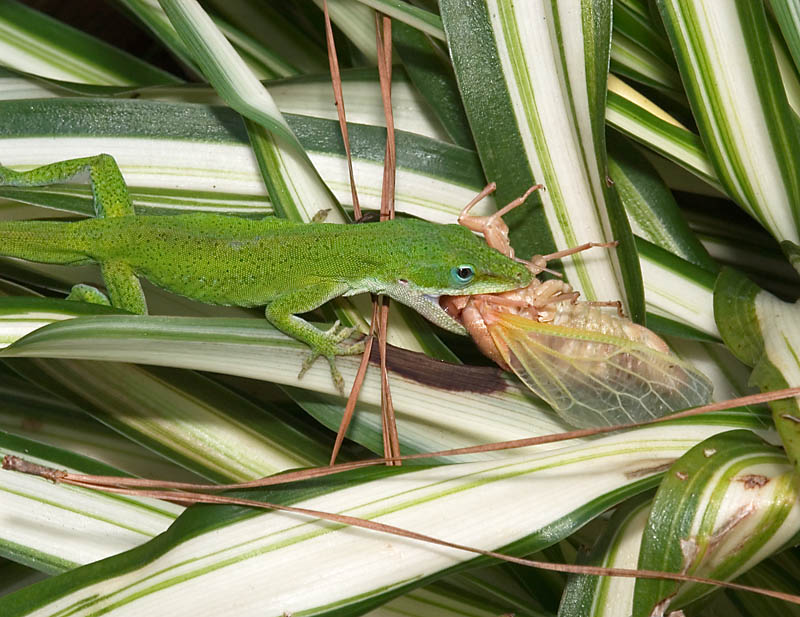
Making friends with the Natives: The Green Anole

As I no longer live in my native California, I often see animals that are completely new to me. Since even the caterpillars can be venomous in Texas, I generally don't touch any unfamiliar critter until I learn that (a) it won't hurt me and (b) I won't hurt it.

So when I saw a little green lizard in my garden, I left it alone, and looked it up. Turns out this little one is harmless and eats bugs, including roaches. I absolutely loathe roaches. Hot dog! He can eat as many of those as he likes, and since this little green lizard is rather pretty, I'm glad to see him sunning himself on my shrubberies.

Anolis carolinensis

Saturday, March 24, 2007

Never mind carbon. Estrogen footprints?

A lot of people take female hormones. Some for menopausal hormone replacement therapy. Some to treat health problems. Others for birth control.

The synthetic hormones used in birth control pills and hormone replacement therapy ultimately end up in our sewage systems. Sewage goes to sewage treatment plants. Treated water then goes back into the environment.

But the water treatment doesn't filter out the estrogens.

Which begs the question, what about the fish?

According to the Canadian Freshwater Institute Fisheries and Oceans, it doesn't look good. Their report Effects of a Synthetic Estrogen on Aquatic Populations: a Whole Ecosystem Study suggests that this is an environmental concern worth watching.

This is from their executive summary:
Municipal wastewater treatment plants (MWTP) discharge numerous contaminants into aquatic systems, and some of these chemicals are known or believed to act like hormones and interfere with the growth, reproduction and development of aquatic organisms. It is becoming increasingly apparent that male fish exposed to these effluents are becoming feminized due to the presence of natural and synthetic estrogens in the water. The potent synthetic estrogens excreted by women taking hormone replacement therapy or birth control pills are not completely broken down in the sewage treatment process and are discharged into waterways. The male fish exposed to these estrogens produce egg proteins, have smaller gonads and, in the more severe cases, develop eggs...

During the summer of 2001, the synthetic estrogen used in birth control pills, ethynylestradiol, was added continuously to one lake to maintain low and environmentally-relevant concentrations in the water. Laboratory and field studies had previously demonstrated that this estrogen does not persist in the water, and can be degraded by bacteria naturally present in the sediments of the lake. The additions were done from the end of May until the end of October, and mean concentrations of the estrogen were 6.1 ng/L in the surface waters of the lake. We monitored the lake for responses of the individual fish (lake trout, sucker and minnows) and their populations, as well as changes in the tadpoles, bacteria, algae, leeches, zooplankton and benthic invertebrates as a result of the estrogen additions.

This study was successful at reproducing some of the impacts seen in fish downstream of MWTPs. Male fish from the estrogen-addition lake produced high concentrations of egg protein precursors, had developmental delays in their gonads and, in one species of minnow, produced eggs. Female fish exposed to the estrogen also showed delays in reproductive development and changes in the amount and timing of the egg protein production. The kidneys and livers were also impacted likely due to the atypical and high production of egg proteins in these fish. In the fall of 2001, we did not see any changes in the sizes of the fish populations, fish growth rates, the numbers of males versus females, and the survival of the offspring. It is likely that population- level responses of long-lived organisms will take longer to appear, and for this reason we are continuing to monitor the fish populations in this lake for 3 years following the estrogen additions.

The short version? We've got some freaky fish out there now.

Which means we need some solutions here. Obviously we will need to alter our water treatment methods. Who knows what else might be geting through. Of course, it will take time and more research to figure out how to do that, so what do we do in the meantime to minimize the environmental impact of our excess artificial estrogen?

There will always be a few people who need their medical hormone treatments for their health, and they should be able to recieve them, but the rest of us have some thinking to do.

Personally, I'm still a fan of Natural Family Planning. No excess hormones. No trash to throw away. (Don't forget the used condoms, sponges, diaphragms, cervical caps, patches, nuva-rings, injection needles, pill packages, etc. have to go somewhere) And, as I have pointed out before, emerging German research indicates that NFP has the same success rates as the pill, when used properly.


But what about people who just don't want to give up their birth control pills? What are they going to do?

Maybe Al Gore could start an estrogen offset program. :)


Hat tip: Alan
----------------------------
Update May 2, 2007: Wondering if I could be the first to use the term "estrogen footprint" I did a Google search and found out that one other person (a commenter on another blog) has thought up the term besides myself and used it online, a mere 3 weeks before I originally composed this post. :) The two of us should get together and write a Wikipedia entry. It's kind of fun to be one of the first ones to use a new term in writing. (Yes, I'm a language nerd.)

Polar bear needs to die.

That's according to certain animal rights activists.

Story at CNN.com,
and at the Daily Mail,
and ABC News.

Friday, March 9, 2007

Real June bugs--In March!

One of the great things about living in a place with great biodiversity is that my inner child always has something to look at.

The downside is, my inner gardener always has something to be annoyed about.


Like weeds that grow visibly in only a few hours.

Or massive numbers of June bugs invading my yard, and leaving their ravenous spawn behind to kill my garden over the summer.


Maybe we should bring the fire ants back. Those would take care of part of the problem, anyway.

Or we could just let them kill the grass. Mowing and weeding a lawn is a pain, anyway.

Monday, March 5, 2007

Birth Control is for the Squirrels.

Today's oddball news comes from you, Santa Monica, CA. These are your tax dollars at work:

SANTA MONICA, California (AP) -- Officials have tried poison, gassing and euthanasia to control a breeding frenzy among squirrels in a city park here. Now, they plan to give birth control a shot.

Under a new program to start this summer, squirrels in Palisades Park will be injected with an immuno-contraceptive vaccine to stunt their sexual development.


Contraceptive vaccine! Once again , reproduction is a disease.

At least this is one population control endeavor that makes sense. Squirrels are cute, but they also carry fleas, and (unlike people) really are incapable of self-restraint.

Of course, the reason given for this measure in the CNN article is the fact that they don't want to kill them.

My alternate headline?
Santa Monican Sissys can't kill Superfluous Squirrels.

Source: CNN

Thanks to my brother for the tip!

_______________
Edit: Some of the comments on this story by Dave Barry's readers are worth a look.

Wednesday, February 14, 2007

Happy Bird-Mating Season--er--Valentine's Day.

Somehow, this never came up when we were cutting out paper hearts in kindergarten. :)


St. Valentine

At least three different Saint Valentines, all of them martyrs, are mentioned in the early martyrologies under date of 14 February. One is described as a priest at Rome, another as bishop of Interamna (modern Terni), and these two seem both to have suffered in the second half of the third century and to have been buried on the Flaminian Way, but at different distances from the city. In William of Malmesbury's time what was known to the ancients as the Flaminian Gate of Rome and is now the Porta del Popolo, was called the Gate of St. Valentine. The name seems to have been taken from a small church dedicated to the saint which was in the immediate neighborhood. Of both these St. Valentines some sort of Acta are preserved but they are of relatively late date and of no historical value. Of the third Saint Valentine, who suffered in Africa with a number of companions, nothing further is known.

Saint Valentine's Day

The popular customs associated with Saint Valentine's Day undoubtedly had their origin in a conventional belief generally received in England and France during the Middle Ages, that on 14 February, i.e. half way through the second month of the year, the birds began to pair. Thus in Chaucer's Parliament of Foules we read:

For this was sent on Seynt Valentyne's day
Whan every foul cometh ther to choose his mate.

For this reason the day was looked upon as specially consecrated to lovers and as a proper occasion for writing love letters and sending lovers' tokens. Both the French and English literatures of the fourteenth and fifteenth centuries contain allusions to the practice. Perhaps the earliest to be found is in the 34th and 35th Ballades of the bilingual poet, John Gower, written in French; but Lydgate and Clauvowe supply other examples. Those who chose each other under these circumstances seem to have been called by each other their Valentines. In the Paston Letters, Dame Elizabeth Brews writes thus about a match she hopes to make for her daughter (we modernize the spelling), addressing the favoured suitor:

And, cousin mine, upon Monday is Saint Valentine's Day and every bird chooses himself a mate, and if it like you to come on Thursday night, and make provision that you may abide till then, I trust to God that ye shall speak to my husband and I shall pray that we may bring the matter to a conclusion.

Shortly after the young lady herself wrote a letter to the same man addressing it "Unto my rightwell beloved Valentine, John Paston Esquire". The custom of choosing and sending valentines has of late years fallen into comparative desuetude.


Source: The Catholic Encyclopedia at NewAdvent.org


Tuesday, February 13, 2007

The American Alligator

There are two main varieties of this reptile. One can be found in Washington D.C, typically in a Congressional committee meeting.

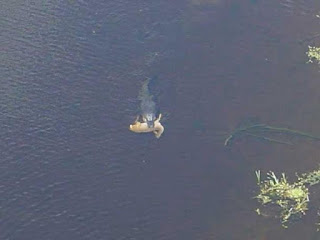
The other resides along the Gulf of Mexico, most famously in Florida. They live all along the Gulf, however, and we have them here in Texas as well. I've gone to see them in person at a national park a couple of times. They're really good at holding still and waiting for dinner to come to them. I have heard that the Florida gators are not as lazy as the Texas ones, but I'm not going to deliberately test that assumption if I can avoid it. Why?

Take a look a this large specimen, apparently from Florida. Note the deer in its mouth:


Anyway, be careful where you swim. :)

Thanks to my friend Michelle for her e-mail.